7.9 - Measuring temperature changes in reactions
Discover how temperature measurements reveal energy changes when salts dissolve and when neutralisation, displacement or precipitation reactions occur in solution. Learn how to collect comparable measurements and interpret the evidence.
Temperature Change Evidence
When a reaction or dissolving process happens in solution, the solution is part of the surroundings being measured. If heat energy is transferred to the solution, the measured temperature rises. If heat energy is taken from the solution, the measured temperature falls.
The temperature change is found from:
temperature change = final temperature - initial temperature
A positive value means the solution temperature increased. A negative value means the solution temperature decreased. The sign matters because +6.0 °C and -6.0 °C show opposite changes.
Temperature Change
The difference between the final measured temperature and the initial measured temperature during a change or reaction.
The temperature change does not tell you every detail about the energy transfer. Heat can be lost to the air, absorbed by the cup, or missed if the final reading is taken too late. It is still useful evidence because a larger measured rise or fall usually shows a larger heat change under the same conditions.
Four Solution Changes
Four types of change can be investigated by measuring temperature in solution.
| Change named in the specification | What is happening | What temperature measurement can show |
|---|---|---|
| Salts dissolving in water | A solid ionic compound separates into ions in water | The solution may get warmer or cooler, depending on the salt |
| Neutralisation reactions | An acid reacts with a base or alkali | The solution temperature often rises because heat energy is transferred to the solution |
| Displacement reactions | A more reactive element displaces a less reactive element from a compound in solution | The temperature can change as the reaction happens in the solution |
| Precipitation reactions | Two solutions react to form an insoluble solid called a precipitate | The temperature can change as the precipitate forms |
For salts dissolving, do not assume every salt behaves the same way. Some dissolving changes make the solution colder, while others make it warmer. The measured temperature change is the evidence.
For a neutralisation example, dilute hydrochloric acid reacting with sodium hydroxide solution forms sodium chloride solution and water:
hydrochloric acid + sodium hydroxide -> sodium chloride + water
HCl(aq) + NaOH(aq) -> NaCl(aq) + H2O(l)
For a displacement example, zinc can displace copper from copper sulfate solution:
zinc + copper sulfate -> zinc sulfate + copper
Zn(s) + CuSO4(aq) -> ZnSO4(aq) + Cu(s)
For a precipitation example, calcium chloride solution can react with sodium carbonate solution to form solid calcium carbonate:
calcium chloride + sodium carbonate -> calcium carbonate + sodium chloride
CaCl2(aq) + Na2CO3(aq) -> CaCO3(s) + 2NaCl(aq)
Measuring Temperature Change
A simple way to measure a temperature change in solution is to use an insulated cup. A polystyrene cup is often placed in a beaker to make it more stable. A lid helps reduce heat transfer to or from the air.
[DIAGRAM: asset_name: solution_temperature_change_apparatus_and_data: Measuring temperature changes in solution reactions - diagram 1; asset_slug: 171_7_9_temperature_changes_in_solution_reactions_diagram1; file: diagram_assets/171_7_9_temperature_changes_in_solution_reactions_diagram1.png; recommended_method: deterministic_drawn; description: Deterministic monochrome split-panel teaching visual. Left panel shows a polystyrene cup supported in a beaker with a lid, thermometer or temperature probe, stirring rod, measuring cylinder for a known volume of solution A, and solution B being added. Labels include record initial temperature and record highest or lowest temperature after mixing. Right panel shows a compact example data table for salts dissolving, neutralisation, displacement and precipitation with initial temperature, final temperature and temperature change values, including both positive and negative changes. The visual is exact practical/data support, so deterministic drawing is required; all values and labels are also explained in the lesson prose.]
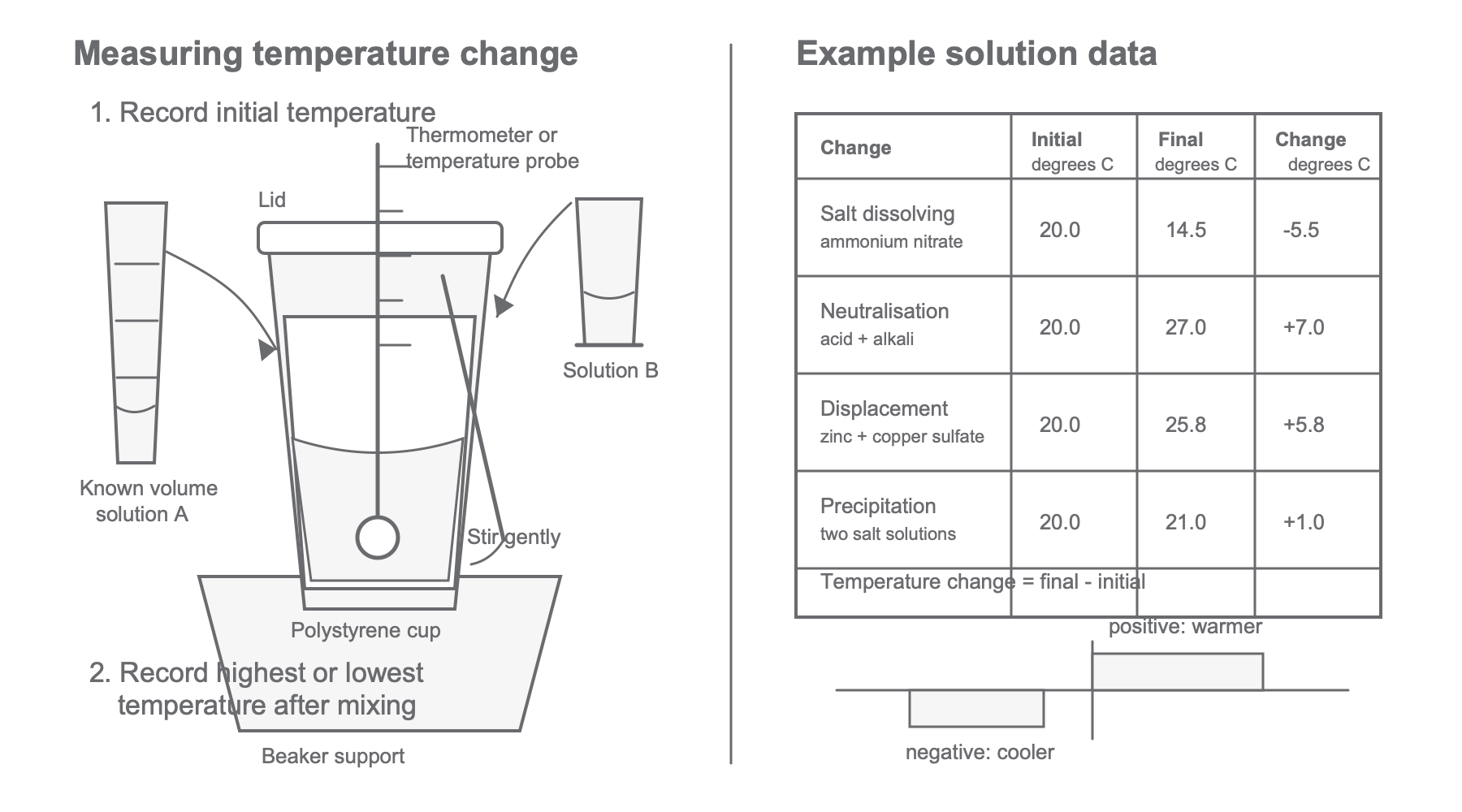
A general method for a solution reaction is:
- Measure a known volume of the first solution into the insulated cup.
- Bring both reactants to the same starting temperature, then record the initial temperature.
- Measure a known volume, or known mass, of the second reactant.
- Add the second reactant, put the lid on if used, and stir gently.
- Keep the probe bulb immersed without touching the cup. Record the highest temperature reached if the temperature rises, or the lowest temperature reached if the temperature falls.
- Calculate the temperature change.
Continue this lesson.
You’re previewing NovaLearn without an account. Create a free account to read the rest.
Create free account