9.13C - Why alkenes are unsaturated
Explain why alkenes are unsaturated hydrocarbons and recognise their carbon–carbon double bond. The elements present and the type of bond answer different parts of that description. This is a separate Chemistry point.
Recognising the alkene functional group
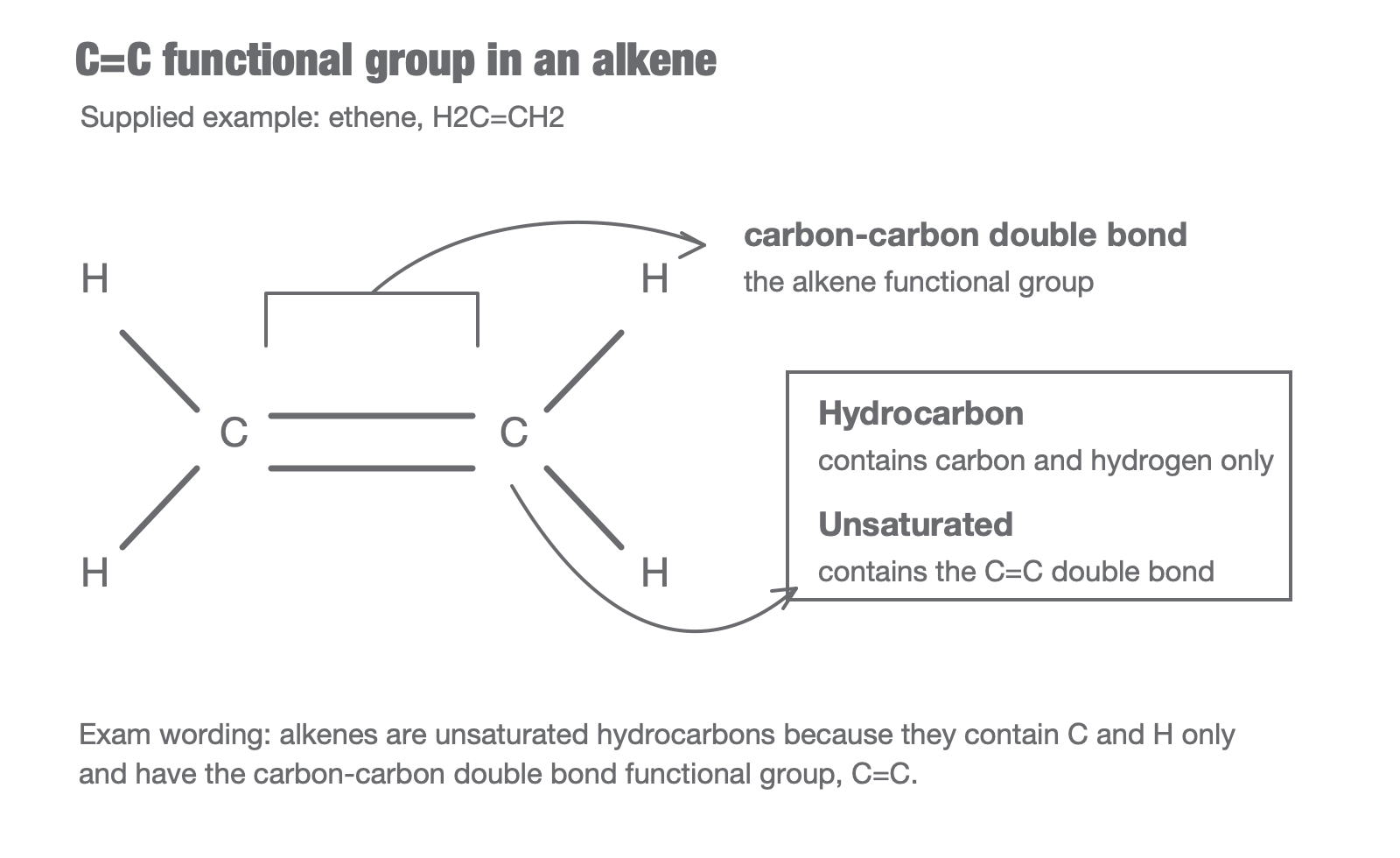
A hydrocarbon contains carbon and hydrogen only. An alkene is an unsaturated hydrocarbon containing a carbon–carbon double bond, written .
A functional group is the atom or group of atoms responsible for the characteristic reactions of an organic family. The alkene functional group is C=C. It must be a double bond between two carbon atoms: is a carbon–oxygen double bond, not the alkene functional group.
[DIAGRAM: asset_name: c_c_functional_group: The C=C functional group in an alkene - diagram 1; asset_slug: 217_9_13c_alkenes_are_unsaturated_hydrocarbons_describing_that_their_molecules_conta_diagram1; file: 217_9_13c_alkenes_are_unsaturated_hydrocarbons_describing_that_their_molecules_conta_diagram1.png; recommended_method: deterministic_drawn; description: Monochrome deterministic structure-support diagram showing a simple supplied alkene example with H2C=CH2, the C=C double bond circled or bracketed, labels "carbon-carbon double bond", "alkene functional group" and "hydrocarbon: C and H only". Exact assessed concept visual; white background, #6A6B6E linework/text only, no colour coding, no bromine, no addition reaction, no polymerisation and no formula-recall table.]
Continue this lesson.
You’re previewing NovaLearn without an account. Create a free account to read the rest.
Create free account