9.36C - Nanoparticle properties and uses
Explore why small particle size can change a material’s properties. Use surface-area calculations to explain catalysts, then link the light behaviour of metal oxide nanoparticles to sunscreens.
Separate Chemistry.
Why smaller particles expose more surface
A nanoparticulate material contains particles about 1–100 nm in size. Its properties can differ from those of larger particles of the same substance. One reason is that a greater proportion of its atoms are at the surface, where contact with other substances occurs.
Surface area to volume ratio means exposed surface area per unit volume. For similarly shaped particles, reducing particle size increases this ratio. It does not mean a single small particle has more surface area than a single large particle.
A cube model
For a cube of side length :
If is in nm, area is in nm², volume is in nm³, and is in nm⁻¹.
Divide and separate the same volume
A cube of side 4 nm has area nm² and volume nm³. Its area per volume is nm⁻¹, often written numerically as SA:V = 1.5:1 using nm² and nm³.
Cut it into 64 cubes of side 1 nm and separate them so every face is exposed. Each has area 6 nm². Total area becomes nm², while total volume stays 64 nm³. Area per volume is now nm⁻¹: four times greater.
[DIAGRAM: asset_name: surface_area_to_volume_cube_comparison - diagram 1; asset_slug: 240_9_36c_properties_of_nanoparticulate_materials_are_related_to_their_uses_diagram1; file: 240_9_36c_surface_area_comparison_v2.png; recommended_method: deterministic_drawn; description: Quantitative bar charts compare a 4 nm cube with 64 separated 1 nm cubes. Total volumes are both 64 nm³, exposed areas are 96 and 384 nm², and surface area per volume is 1.5 and 6 nm⁻¹. All faces must be exposed.]
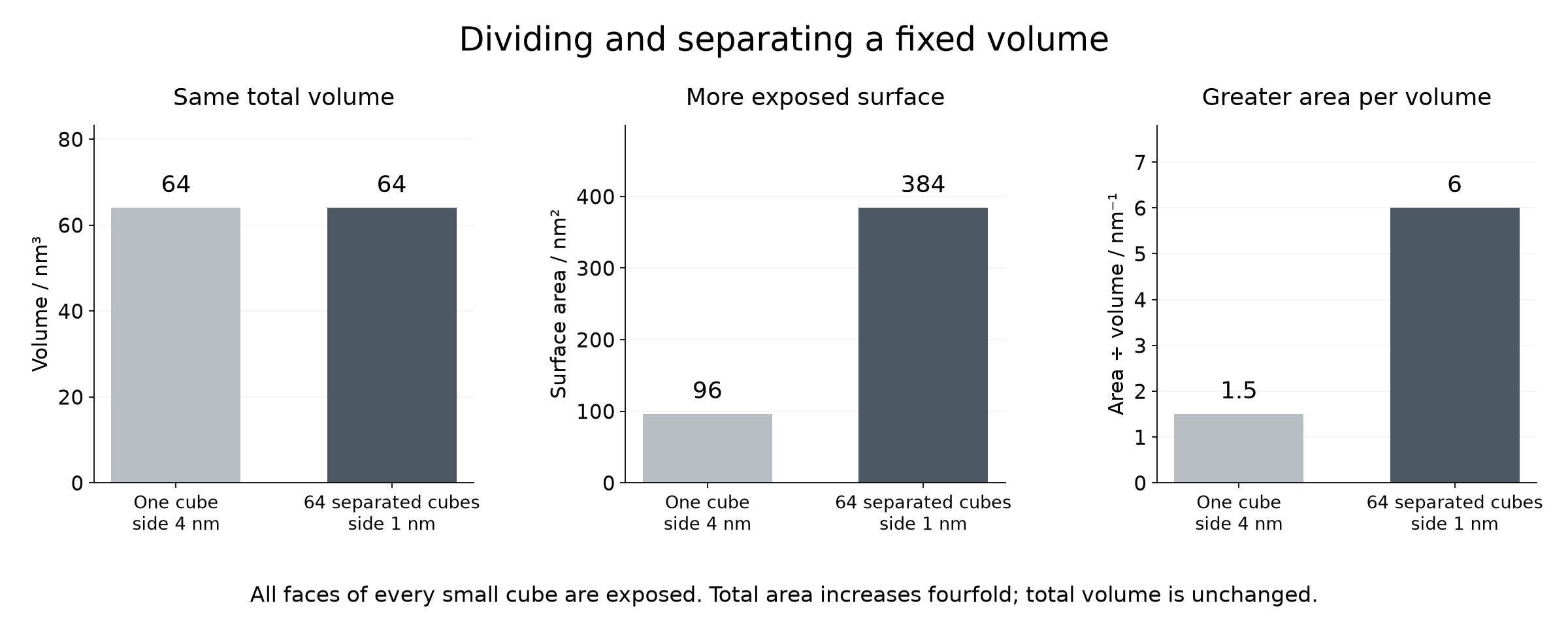
The cube is a simple geometric model, not a claim that every nanoparticle is cubic. If the pieces stay tightly packed together, faces in contact are not exposed; clumping can reduce the accessible surface.
Nanoparticles as catalysts
For equal masses of the same solid catalyst, smaller, well-dispersed particles expose more total surface. Reactions occur at active sites on that surface. More accessible sites let more reactant particles interact with the catalyst, which can increase the reaction rate under the same conditions.
Continue this lesson.
You’re previewing NovaLearn without an account. Create a free account to read the rest.
Create free account