7.13 - Explaining the overall energy change
Use the energy required to break reactant bonds and the energy released when product bonds form to explain whether a reaction is exothermic or endothermic overall.
Compare the two energy transfers
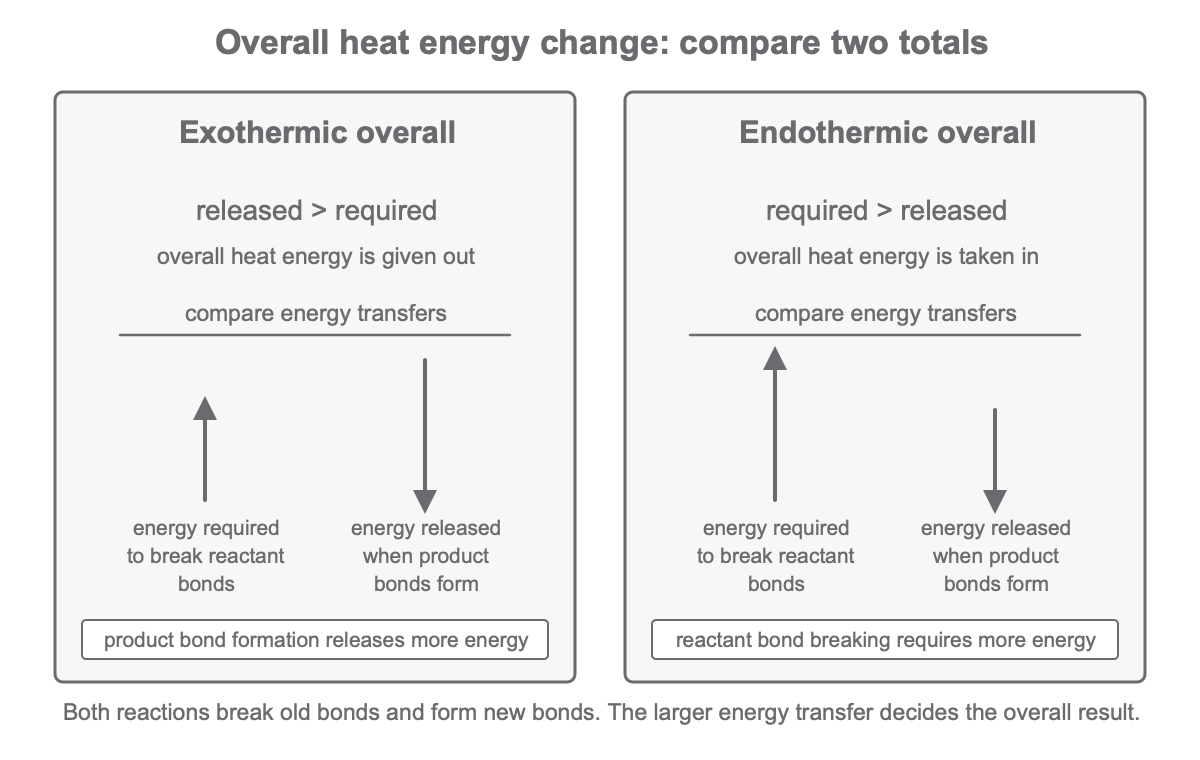
Bond breaking requires energy; bond formation releases energy. Reactions can involve both, so neither observation alone tells you the overall result.
[DIAGRAM: asset_name: bond_energy_overall_comparison: Comparing bond breaking and bond making energy transfers - diagram 1; asset_slug: 175_7_13_bond_breaking_and_bond_making_in_overall_energy_change_diagram1; file: diagram_assets/175_7_13_bond_breaking_and_bond_making_in_overall_energy_change_diagram1.png; recommended_method: deterministic_drawn; description: Exact monochrome comparison diagram for Edexcel 1CH0 7.13. It shows two side-by-side cases. In the exothermic case, a smaller arrow labelled "energy required to break reactant bonds" is compared with a larger arrow labelled "energy released when product bonds form", with the conclusion "released > required, overall heat energy given out". In the endothermic case, the required arrow is larger than the released arrow, with the conclusion "required > released, overall heat energy taken in". Deterministic drawing is used because arrow size, comparison labels and wording are assessed explanation content.]
| Comparison | Overall result |
|---|---|
| Forming product bonds releases more energy than breaking reactant bonds requires | Exothermic: energy given out |
| Forming product bonds releases less energy than breaking reactant bonds requires | Endothermic: energy taken in |
For example, if breaking bonds needs 310 kJ and forming bonds releases 480 kJ, the surplus 170 kJ is transferred to the surroundings. The reaction is exothermic. It still needs energy for bond breaking.
Continue this lesson.
You’re previewing NovaLearn without an account. Create a free account to read the rest.
Create free account