5.16C - Molar gas volume at room conditions
This Higher-tier separate Chemistry lesson connects gas amount and volume at room temperature and pressure. At room temperature and pressure, one mole of molecules of any gas occupies the same volume. In this lesson, that volume is the Edexcel value that will be provided in calculations: 24 dm3 or 24000 cm3.
What molar volume means
A mole is an amount of substance. For this specification point, the important idea is not the mass of the gas, the name of the gas, or the size of the gas molecule. The important idea is the volume occupied by one mole of molecules of gas when the gas is at room temperature and pressure.
Molar volume of a gas at room temperature and pressure
Molar volume is the volume occupied by one mole of gas at a stated temperature and pressure. At room temperature and pressure, use approximately 24 dm3 mol-1 or 24000 cm3 mol-1.
For Edexcel calculations where this value is needed, the molar volume will be provided as 24 dm3 or 24000 cm3. These are the same volume written in different units:
- 24 dm3 is 24 cubic decimetres
- 24000 cm3 is 24000 cubic centimetres
- 1 dm3 = 1000 cm3, so 24 dm3 = 24000 cm3
Room temperature and pressure is often shortened to RTP. The model applies to molecular gases and monatomic gases such as helium; for helium the particles are atoms, not molecules. In the diagram, “molecules” describes the molecular gas examples.
[DIAGRAM: asset_name: molar_volume_proportional_model - diagram 1; asset_slug: 135_5_16c_molar_volume_of_any_gas_at_room_temperature_and_pressure_as_the_volume_occ_diagram1; file: diagram_assets/135_5_16c_molar_volume_of_any_gas_at_room_temperature_and_pressure_as_the_volume_occ_diagram1.png; recommended_method: deterministic_drawn; description: Deterministic monochrome proportional bar model for gases at room temperature and pressure. Exact labels: 0.5 mol gas = 12 dm3, 1.0 mol gas = 24 dm3, 1.5 mol gas = 36 dm3, and centre statement 1 mol of molecules of any gas at room temperature and pressure occupies 24 dm3 or 24000 cm3. The visual teaches direct proportionality between amount in mol and gas volume at RTP, without introducing balanced-equation gas-volume ratios, Avogadro's law calculations, or practical apparatus. Nearby prose supplies the same values for accessibility.]
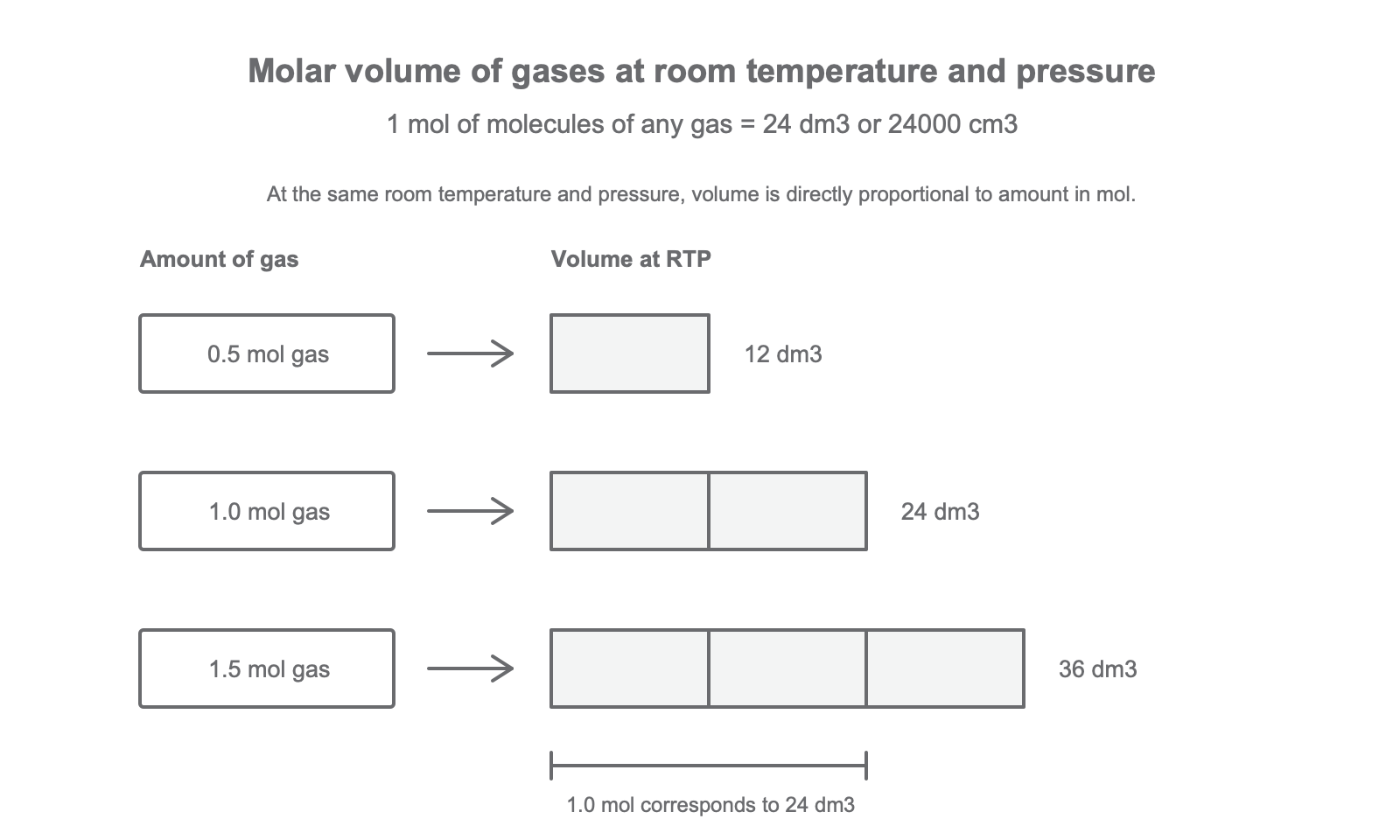
Same volume for any gas
The phrase any gas is important. At room temperature and pressure, one mole of oxygen gas, one mole of carbon dioxide gas and one mole of hydrogen gas are all treated as occupying the same volume in this GCSE calculation model.
That does not mean the gases have the same mass. One mole of CO2 has a different mass from one mole of H2. It means that when the gases are measured at the same room temperature and pressure, one mole of molecules occupies the same gas volume.
This is why the condition is always stated. If a gas is not at room temperature and pressure, you should not assume this value unless the question tells you to use it.
At room temperature and pressure, the gas identity does not change the molar volume used: 1 mol of molecules of any gas occupies 24 dm3 or 24000 cm3.
Volume from moles
If you know the amount of gas in moles, multiply by the molar volume. Keep the units consistent with the answer you want.
Gas volume from moles
For answers in dm3, use 24 dm3 for 1 mol. For answers in cm3, use 24000 cm3 for 1 mol.
Worked example:
Continue this lesson.
You’re previewing NovaLearn without an account. Create a free account to read the rest.
Create free account