4.9 - Resistance to oxidation and the reactivity series
Use the reactivity series to compare how readily metals are oxidised. You will link position in the series to resistance to oxidation, then distinguish this pattern from the protection provided by an oxide coating.
What resistance means
When a metal reacts with oxygen, it forms a metal oxide:
metal + oxygen → metal oxide
Here, oxidation is gain of oxygen. More generally, oxidation is loss of electrons: metal atoms lose electrons as they form positive ions.
Relative resistance to oxidation
A metal with greater resistance to oxidation is less easily oxidised than the metal it is compared with.
The word relative signals a comparison. Copper is more resistant to oxidation than magnesium, but less resistant than gold. Resistance does not mean that reaction is impossible.
Using the reactivity series
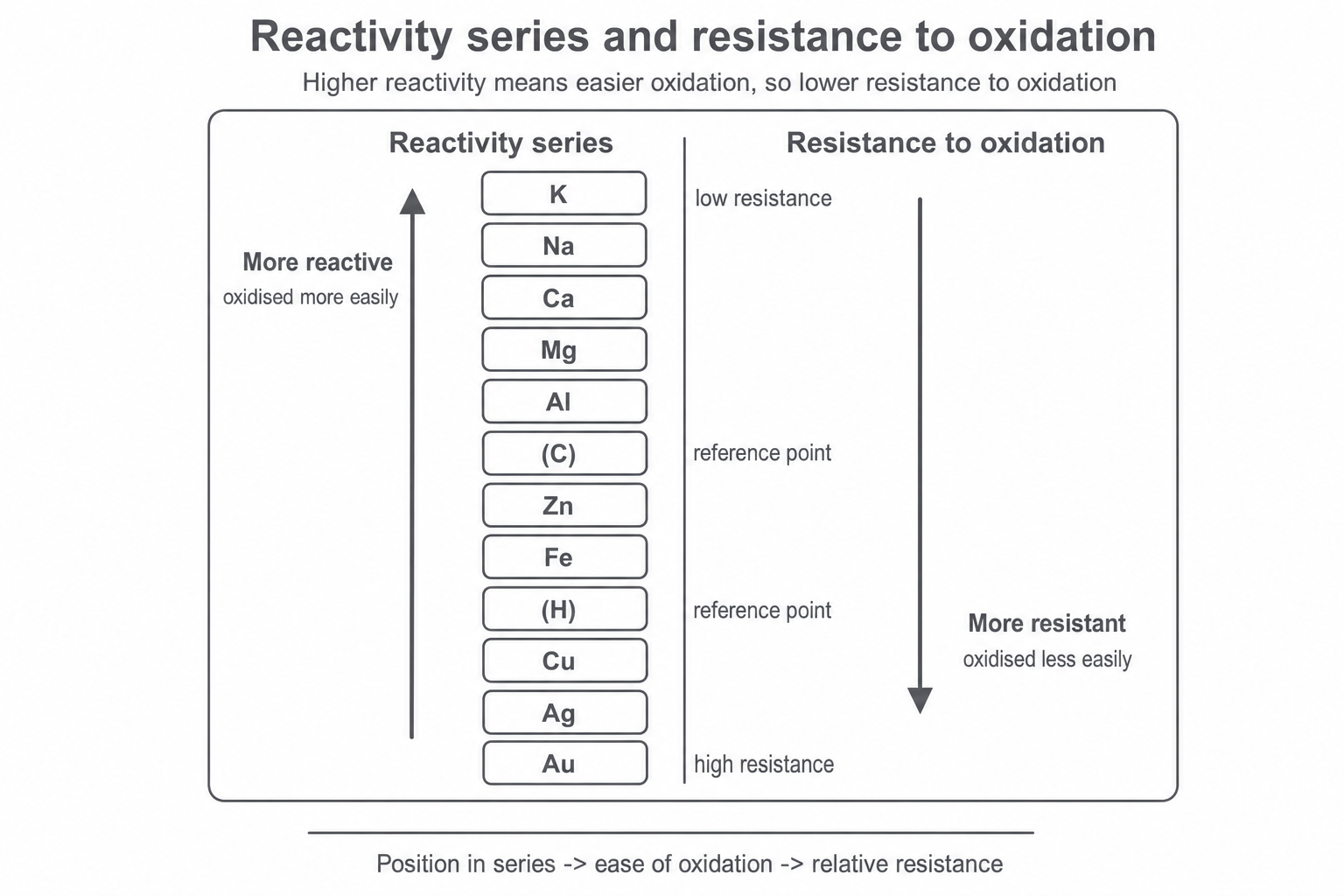
From most to least reactive, the series used here is:
potassium, sodium, calcium, magnesium, aluminium, carbon,
zinc, iron, hydrogen, copper, silver, gold
Carbon and hydrogen are non-metal reference points. Compare the metals when discussing a metal's resistance to oxidation.
[DIAGRAM: asset_name: reactivity_resistance_scale: Reactivity and resistance to oxidation scale - diagram 1; asset_slug: 111_4_9_a_metal_s_relative_resistance_to_oxidation_is_related_to_its_position_in_t_diagram1; file: 111_4_9_a_metal_s_relative_resistance_to_oxidation_is_related_to_its_position_in_t_diagram1_imagegen_v1.png; recommended_method: deterministic_drawn; description: Exact monochrome teaching diagram showing the Edexcel reactivity series vertically, with potassium at the top and gold at the bottom. The left side shows reactivity increasing upwards and oxidation becoming easier near the top. The right side shows relative resistance to oxidation increasing downwards. Deterministic drawing is required because the order, labels, and directional relationship are assessed content.]
Continue this lesson.
You’re previewing NovaLearn without an account. Create a free account to read the rest.
Create free account