7.6 - Catalysts and reaction rate
Learn what distinguishes a catalyst from a reactant, and how rate, product and recovery evidence can support that conclusion.
What a catalyst does
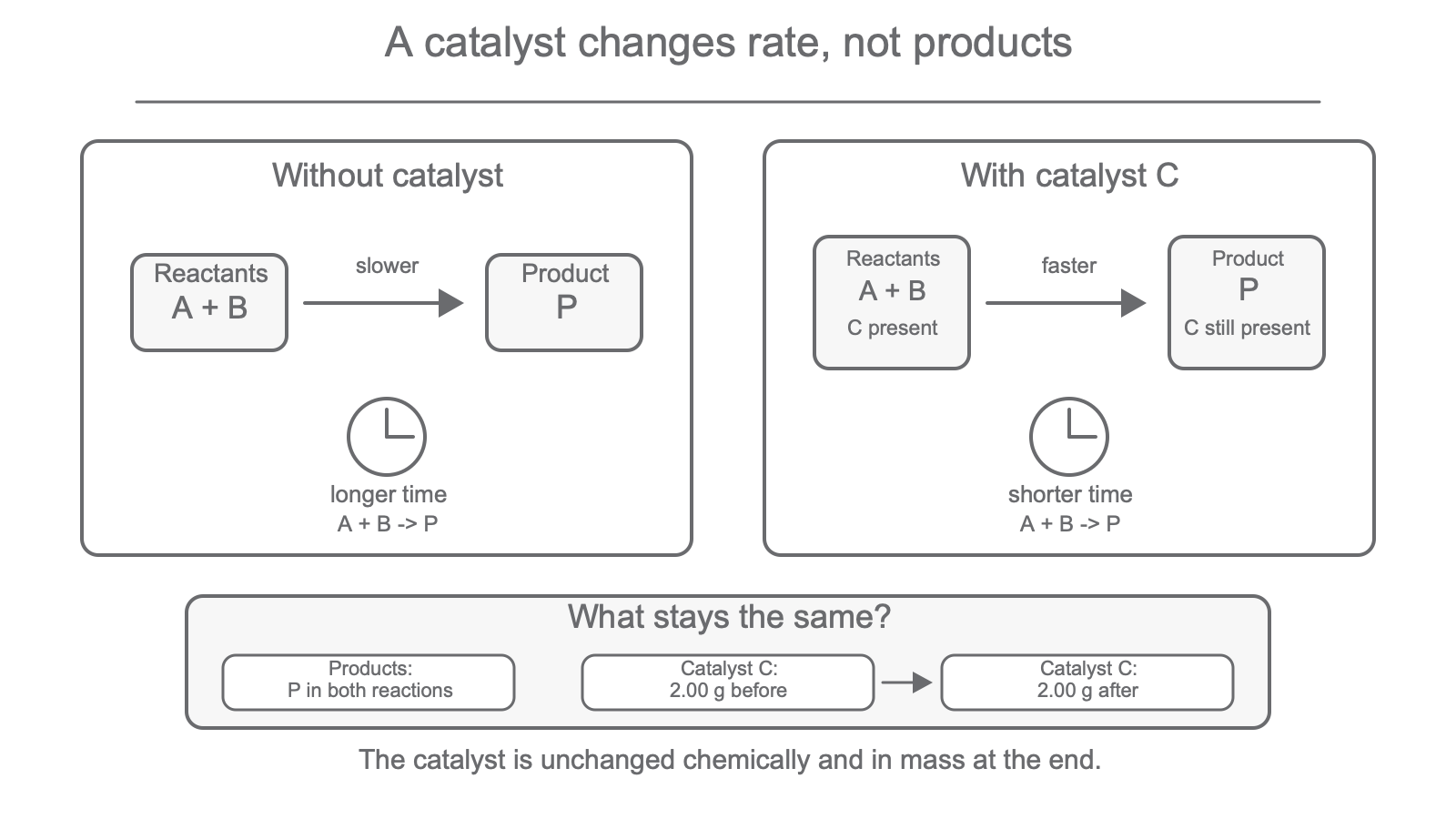
A catalyst is a substance that increases reaction rate. In the reaction being compared, the products remain the same and the catalyst is unchanged chemically and in mass at the end.
Heating and stirring may speed up a reaction, but they are actions, not substances acting as catalysts. A catalyst may take part in intermediate steps, but it is regenerated: it is not consumed in the overall reaction.
For example, manganese(IV) oxide speeds up the decomposition of hydrogen peroxide into water and oxygen. Oxygen is produced faster, while the final products remain water and oxygen. The manganese(IV) oxide remains the same substance.
[DIAGRAM: asset_name: catalyst_changes_rate_not_products: Catalyst changes rate, not products - diagram 1; asset_slug: 168_7_6_a_catalyst_as_a_substance_that_speeds_up_the_rate_of_a_reaction_without_al_diagram1; file: diagram_assets/168_7_6_a_catalyst_as_a_substance_that_speeds_up_the_rate_of_a_reaction_without_al_diagram1.png; recommended_method: deterministic_drawn; description: Exact monochrome teaching diagram for Edexcel GCSE Chemistry 1CH0 7.6. It compares the same reaction without a catalyst and with catalyst C. Both paths show reactants A + B forming product P. The catalysed path is labelled faster and shows catalyst C present at the start and end with mass 2.00 g both times. The diagram must not include activation-energy curves, reaction profiles, enzymes, or industrial examples. It should teach that a catalyst speeds up reaction rate, leaves products unchanged, and is chemically and mass unchanged at the end.]
Continue this lesson.
You’re previewing NovaLearn without an account. Create a free account to read the rest.
Create free account