2.3 - Explaining changes of state using particles
Explain changes of state by linking energy transfer to particle attractions, arrangement and movement. Distinguish heating a substance within one state from supplying energy while it changes state.
What changes and what stays the same
A physical change of state does not change the chemical identity or size of the particles. It changes their arrangement and the freedom of their movement. For example, water molecules remain water molecules when ice melts or water boils: the bonds within each water molecule are not broken.
[DIAGRAM: asset_name: particle_state_change_energy_map - diagram 1; asset_slug: 062_2_3_changes_in_arrangement_movement_and_energy_of_particles_during_these_inter_diagram1; file: 062_2_3_changes_in_arrangement_movement_and_energy_of_particles_during_these_inter_diagram1.png; recommended_method: deterministic_drawn; description: Exact monochrome particle-model transition map for Edexcel GCSE Chemistry 1CH0 point 2.3. It shows labelled solid, liquid and gas particle panels, with arrows for melting, freezing, boiling/evaporation, condensing, sublimation and deposition. Arrow labels state whether energy is gained or lost and summarise the assessed changes in arrangement and movement. Deterministic drawing is used because the particle spacing, arrows and labels are assessed teaching content. Nearby prose provides the same information for accessibility.]
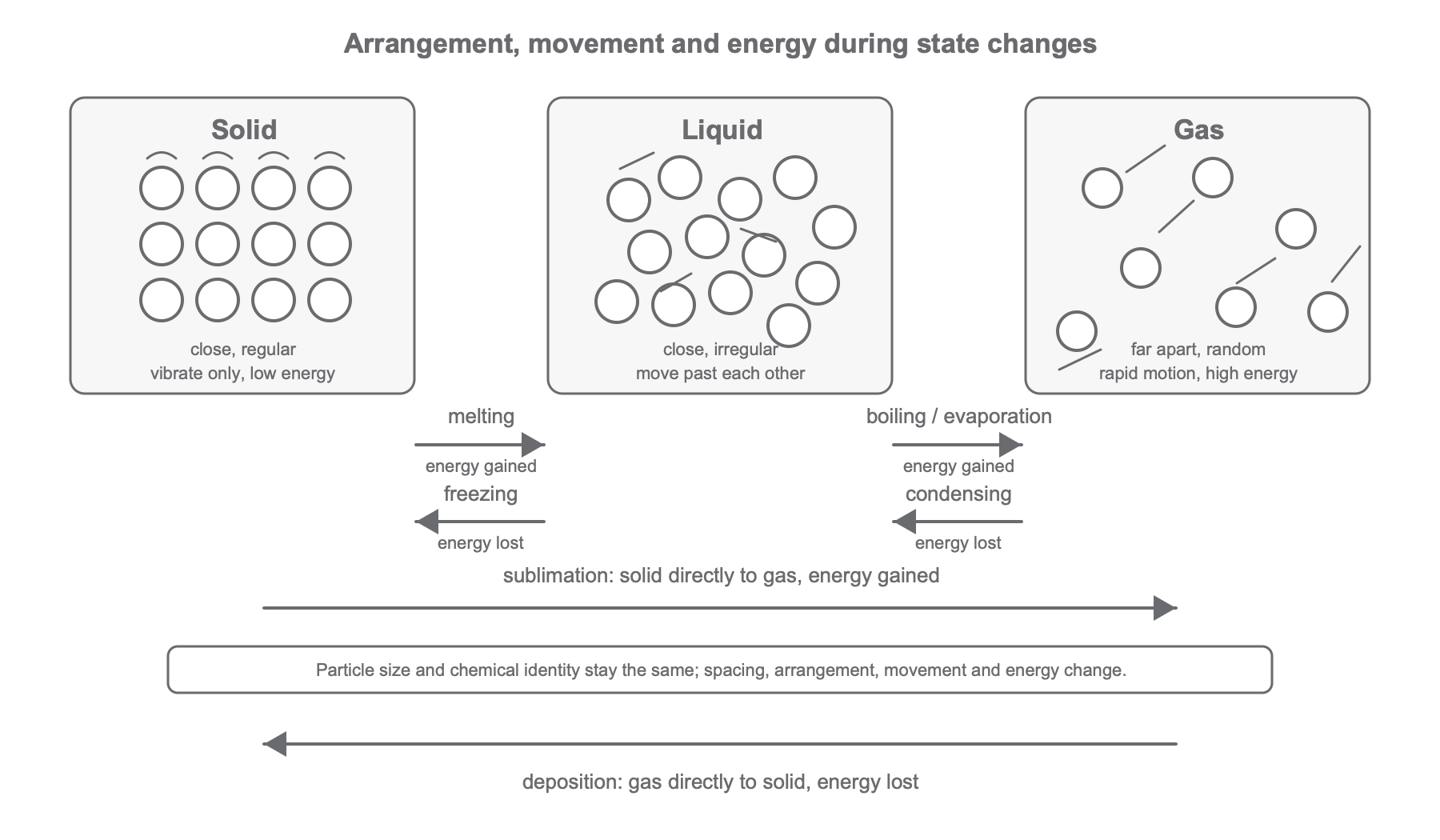
Read these as representative particle samples, not a conserved set being followed from panel to panel. Circle counts and distances are schematic. The low/high energy labels compare the same substance along a heating sequence; they do not measure speed or temperature. Liquid particles remain close together, and the regular solid represents a crystalline solid.
Energy is transferred to the substance during melting, vaporisation and sublimation. It is transferred from the substance to the surroundings during freezing, condensation and deposition.
Heating and changes to less constrained states
When a solid warms before melting, its particles gain average kinetic energy and vibrate more vigorously. At the melting point, further energy allows particles to overcome enough of the attractions holding them in fixed positions. The regular arrangement breaks down; particles remain close together but can move past one another.
When a liquid boils, supplied energy overcomes the attractions that keep particles close together. The particles become widely separated and move freely in all directions as a gas. Evaporation has the same overall liquid-to-gas change, but only sufficiently energetic particles escape from the surface.
During melting or boiling of a pure substance at constant pressure, its temperature stays constant while the state change takes place. The energy changes how particles are held together rather than increasing their average kinetic energy. More freedom of movement does not necessarily mean increasing speed. After the change is complete, further heating can raise the temperature again.
Continue this lesson.
You’re previewing NovaLearn without an account. Create a free account to read the rest.
Create free account