3.17 - Preparing hydrated copper sulfate crystals
This core practical prepares pure, dry hydrated copper sulfate crystals from copper oxide and dilute sulfuric acid. The chemistry is simple neutralisation, but the practical skill is in choosing the right sequence: warm, react with excess insoluble base, filter, crystallise, and dry. A strong answer explains why each step is used, not just what happens next.
Aim and Reaction
Copper oxide is a basic metal oxide, so it reacts with an acid to form a salt and water. Many metal oxides behave as bases; this practical uses copper(II) oxide. In this practical, the acid is dilute sulfuric acid and the salt is copper sulfate.
Reaction used in the practical
The word equation is:
copper oxide + sulfuric acid -> copper sulfate + water
The copper oxide is an insoluble base. That matters because any unreacted copper oxide can be removed by filtration. The copper sulfate is soluble, so it remains dissolved in the filtrate before crystals form.
Hydrated Crystal
A hydrated crystal is a crystal that contains water as part of its crystal structure.
The product is called hydrated copper sulfate because the final crystals contain water in their crystal structure. Do not try to drive off every last bit of water by strong heating; the aim is pure, dry hydrated crystals, not overheated or decomposed material.
Apparatus and Water Bath
The core apparatus is:
- dilute sulfuric acid
- copper oxide powder
- measuring cylinder
- beaker or conical flask
- spatula
- glass rod
- water bath
- Bunsen burner, tripod, gauze and heat-resistant mat where a heated water bath is used
- filter funnel and filter paper
- conical flask or beaker for collecting filtrate
- evaporating basin
- watch glass
- tongs or heat-resistant handling equipment
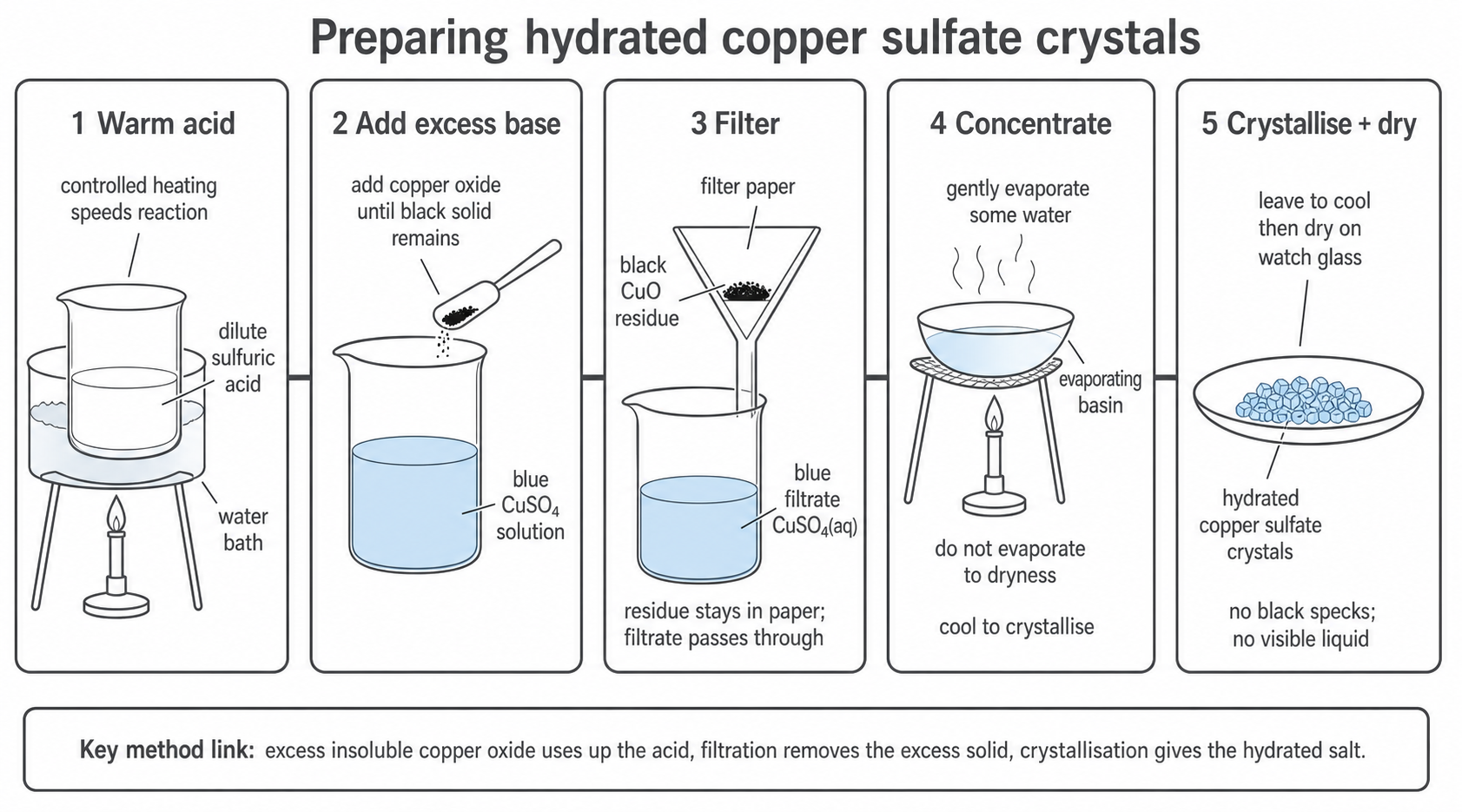
The water bath gives controlled heating. It can warm the acid so the reaction happens at a useful rate, and it can also provide gentler heating during evaporation than heating the solution directly with a roaring flame. In exam answers, the key idea is controlled heating: warm the mixture enough for reaction and evaporation, but do not boil or heat to complete dryness.
Method
The method is a sequence of separation and purification steps.
- Measure a fixed volume of dilute sulfuric acid into a beaker or conical flask.
- Warm the acid using a water bath.
- Add copper oxide a little at a time, stirring after each addition.
- Keep adding copper oxide until some black solid remains even after stirring and warming. This shows the copper oxide is in excess.
- Filter the mixture through filter paper in a filter funnel. The excess copper oxide is the residue. The blue copper sulfate solution is the filtrate.
- Pour the filtrate into an evaporating basin and heat gently to evaporate some water.
- Stop heating when the solution is concentrated enough for crystals to form, for example when crystals begin to appear at the edge or on a cooled glass rod.
- Leave the solution to cool and crystallise.
- Separate the crystals from the remaining solution and dry them on a watch glass or between filter papers.
The order is important. Filtering before crystallisation removes the unreacted black copper oxide. Evaporating before cooling makes the copper sulfate solution more concentrated, so crystals form as the solution cools.
After the filtration stage, do not call the blue solution a precipitate. It is a filtrate containing dissolved copper sulfate. The crystals form later because water is removed and the solution cools.
Why the Steps Work
Adding a small excess of copper oxide makes sure all the sulfuric acid has reacted. If all the acid is used up, the remaining solution contains copper sulfate and water, not leftover acid.
Because copper oxide is insoluble, the excess can be removed. This is the reason the method works with copper oxide but not by simply adding a soluble alkali in excess. A soluble excess would stay in the solution and contaminate the crystals.
| Step | Why it is used |
|---|---|
| warm the acid | increases the rate of reaction and helps the copper oxide react |
| add copper oxide in excess | uses up all the sulfuric acid |
| filter | removes unreacted solid copper oxide |
| evaporate some water | makes the copper sulfate solution more concentrated |
| cool | allows hydrated copper sulfate crystals to form |
| dry | removes surface water from the crystals |
Evaporation and crystallisation are not the same thing. Evaporation removes some solvent. Crystallisation happens when dissolved copper sulfate comes out of solution as solid crystals.
Continue this lesson.
You’re previewing NovaLearn without an account. Create a free account to read the rest.
Create free account