3.22 - What makes a substance an electrolyte?
Learn why molten ionic compounds and their aqueous solutions conduct electricity, while their solids do not. The key is whether charged ions can move.
Mobile ions carry charge
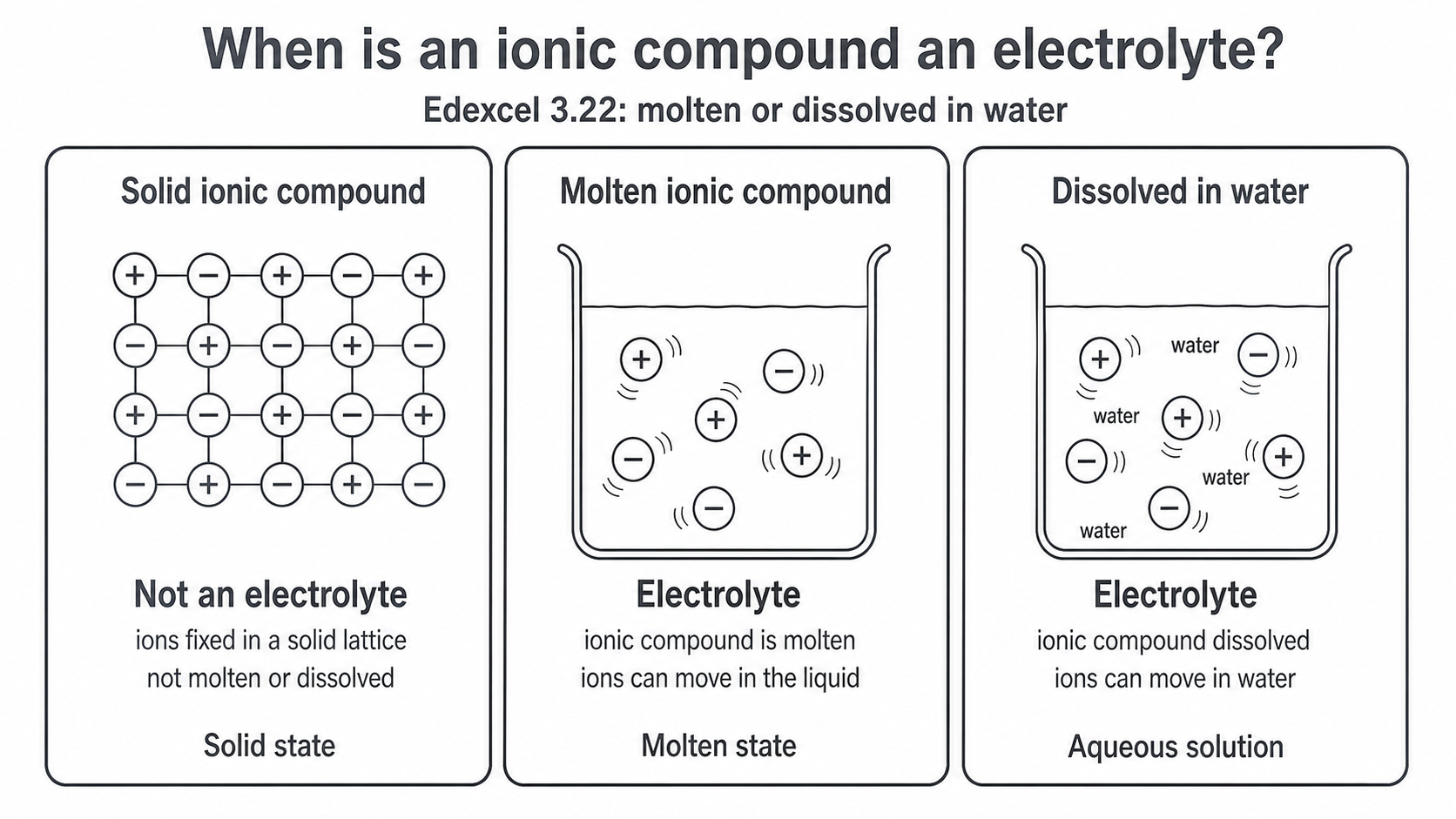
An electrolyte conducts electricity through mobile ions and can undergo electrolysis. The examples in this specification point are ionic compounds that are molten (melted) or dissolved in water (aqueous).
An ionic compound already contains positive and negative ions. Melting does not create their charges. In a solid, strong attractions hold the ions in fixed positions in a lattice, so they cannot carry charge through the material. Melting breaks up the fixed arrangement; dissolving separates the ions in water. The ions can then move and carry charge.
[DIAGRAM: asset_name: electrolyte_states_comparison: Electrolyte states comparison - diagram 1; asset_slug: 093_3_22_electrolytes_are_ionic_compounds_in_the_molten_state_or_dissolved_in_water_diagram1; file: 093_3_22_electrolytes_are_ionic_compounds_in_the_molten_state_or_dissolved_in_water_diagram1_imagegen_v1.png; recommended_method: deterministic_drawn; description: Exact monochrome comparison of three ionic-compound states for Edexcel 3.22. It shows solid sodium chloride as not an electrolyte for this recall point because ions are fixed, molten sodium chloride as an electrolyte because it is an ionic compound in the molten state, and sodium chloride dissolved in water as an electrolyte because it is an ionic compound dissolved in water. Deterministic drawing is required because the labels and state classification are assessed recall content.]
Continue this lesson.
You’re previewing NovaLearn without an account. Create a free account to read the rest.
Create free account