7.4 - Explaining changes in rate using collision theory
Reactions can be sped up or slowed down by changing the conditions. Use collision theory to explain the effects of temperature, concentration, gas pressure and solid surface area.
Collision explanation pattern
A reaction can only happen when reacting particles collide. More collisions each second usually gives a faster reaction because there are more chances for particles to react.
Not every collision makes products. A collision must also have enough energy to react. This lesson uses that idea only to explain rate changes; catalysts, reaction profiles and the formal activation-energy lesson come later in Topic 7.
Rate of reaction
The rate of reaction is how quickly reactants are used up or products are formed.
For this specification point, use this explanation chain:
condition changes -> particle collisions change -> reaction rate changes
[DIAGRAM: asset_name: collision_factor_particles: Conditions and particle collisions - diagram 1; asset_slug: 166_7_4_factors_affecting_reaction_rate_using_collision_theory_diagram1; file: diagram_assets/166_7_4_factors_affecting_reaction_rate_using_collision_theory_diagram1.png; recommended_method: deterministic_drawn; description: Monochrome deterministic teaching diagram with three rows. Row 1 compares lower and higher temperature particle boxes: same number of particles, longer motion arrows at higher temperature, and labels showing more energetic and more frequent collisions. Row 2 compares lower and higher concentration or gas pressure: more particles in the same volume at higher concentration/pressure, labelled more frequent collisions. Row 3 compares a single solid lump with several smaller solid pieces of the same total volume, labelled greater surface area to volume ratio and more exposed solid particles. Exact assessed vocabulary visual; no catalyst, activation-energy profile, graph or colour coding.]
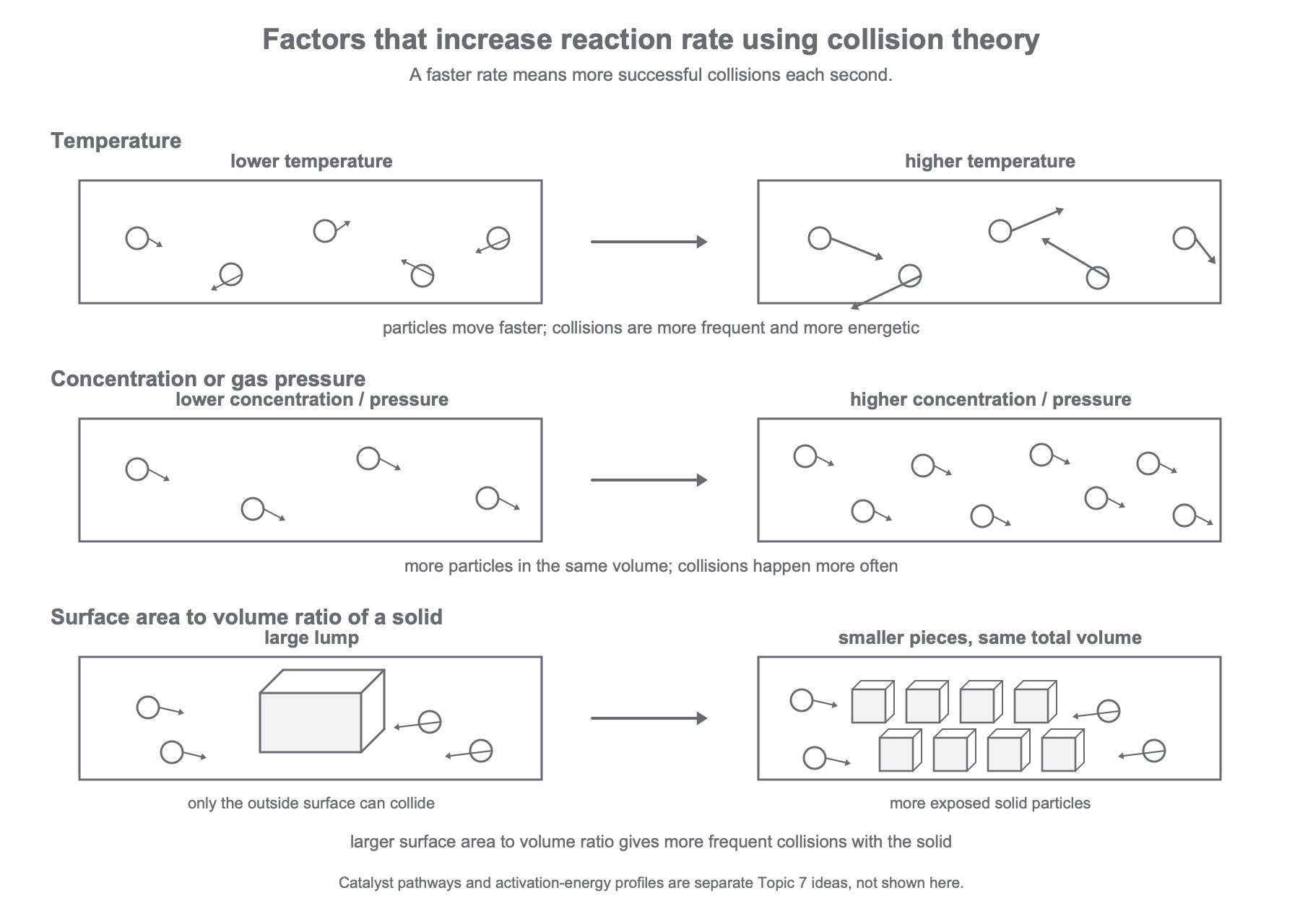
The word explain matters. Pearson's command-word style expects a reasoned link, not just a named factor. For example, "higher temperature means faster rate" is a prediction. "Higher temperature means particles have more kinetic energy, so more collisions have enough energy to react, therefore the rate increases" is an explanation.
Changing temperature
Increasing the temperature increases the rate of many reactions. The particles gain kinetic energy, so they move faster.
This affects reaction rate in two linked ways:
- particles collide more frequently because they are moving faster
- a greater proportion of collisions have enough energy to react
The energy point is usually the more important part of a temperature explanation. A strong GCSE answer still includes frequency when it helps, but it should not miss the idea that higher temperature gives more energetic collisions.
Decreasing temperature has the opposite effect. Particles have less kinetic energy, move more slowly, collide less often, and fewer collisions have enough energy to react.
Changing concentration and pressure
Concentration is the amount of dissolved substance in a given volume of solution. A more concentrated solution has more reacting particles in the same volume.
When concentration increases, reacting particles are closer together or more crowded in each cm3 of solution. They collide more frequently, so the reaction rate increases.
higher concentration -> more particles per unit volume -> more frequent collisions -> faster rate
Lower concentration means fewer particles per unit volume. Collisions happen less often, so the reaction is slower.
Continue this lesson.
You’re previewing NovaLearn without an account. Create a free account to read the rest.
Create free account