3.18 - Making a pure salt by titration
When an acid reacts with an alkali, neutralisation produces a salt and water. If both reactants are soluble, you cannot add one in excess and filter the excess away, so a titration is used to find volumes that react exactly. You will use the measured volumes to prepare an uncontaminated solution, then obtain dry salt crystals.
Why Titration Is Needed
A soluble salt can be made by reacting an acid with an alkali. The general word equation is:
acid + alkali -> salt + water
The difficulty is that both the acid and the alkali are solutions. If too much acid is added, the final solution contains salt, water and extra acid. If too much alkali is added, the final solution contains salt, water and extra alkali. Neither excess reactant can simply be filtered off, because it is dissolved.
Titration
A titration is a practical method in which one solution is added carefully to a measured volume of another solution to find the volume needed for exact neutralisation.
For preparing a pure salt, the titration is used first to find the correct volume of acid and alkali to mix. Then the salt solution is prepared using those volumes, without contaminating it with indicator.
Apparatus and Setup
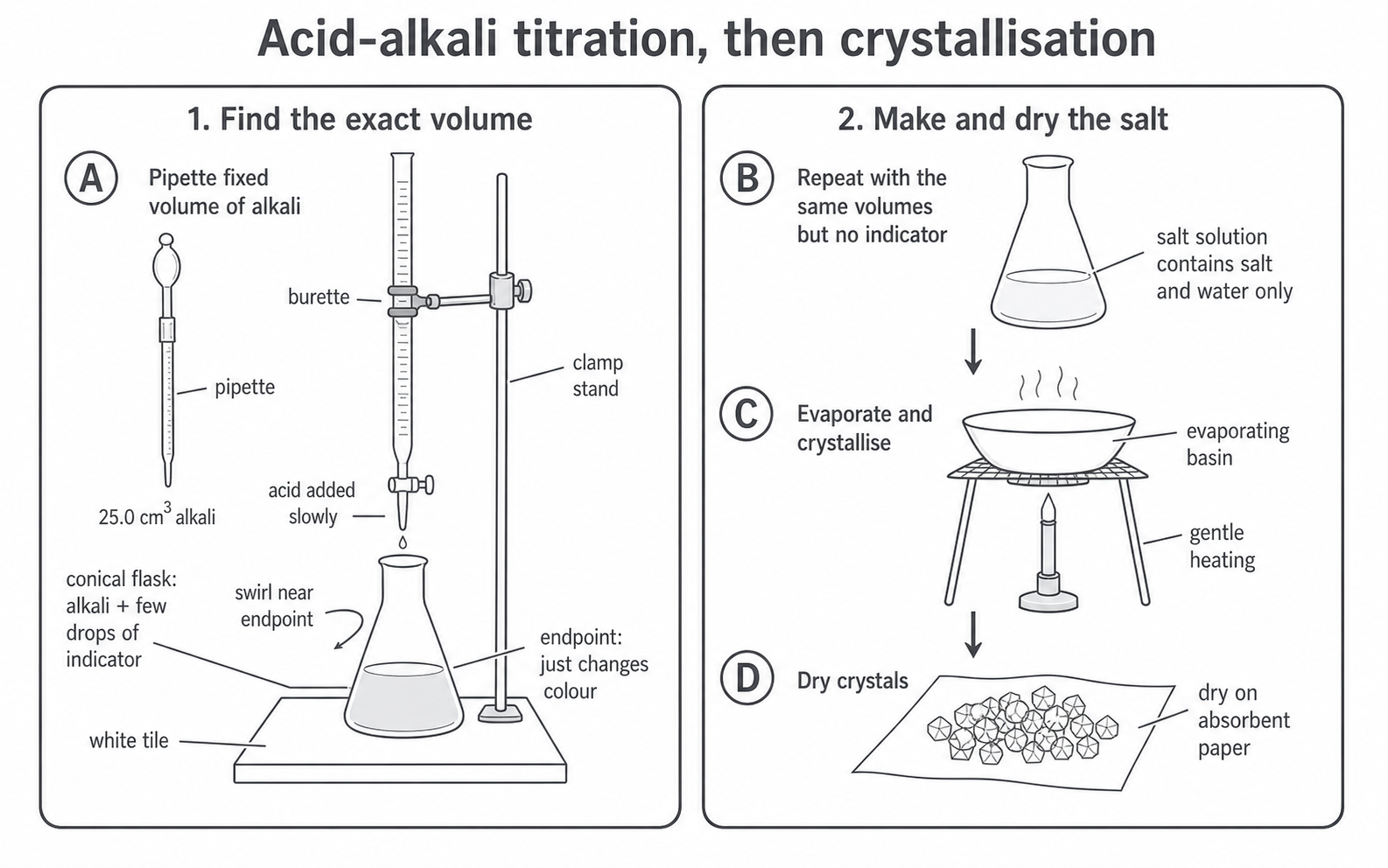
The required apparatus is a burette, a pipette and a suitable indicator. A complete GCSE setup also commonly uses a conical flask, a white tile, a clamp stand, a funnel for filling the burette, and an evaporating basin for the salt solution after neutralisation.
The pipette measures one fixed, accurate volume, for example 25.0 cm³ of alkali. The burette delivers a variable volume accurately, so the acid can be added a little at a time until the endpoint is reached.
Rinse the pipette with the solution it will measure and the burette with the solution it will contain. This avoids diluting the solutions with water left inside the glassware. Fill the burette and run a little solution through the tap so the tip is full and air bubbles are removed. Remove the funnel before readings so no extra liquid can drain into the burette during measurement. Read the bottom of the meniscus at eye level.
Finding the Endpoint
One common arrangement is to place the alkali in the conical flask and the acid in the burette.
- Use the pipette and a pipette filler to transfer a measured volume of alkali into a conical flask.
- Add only a few drops of a suitable indicator, such as methyl orange or phenolphthalein for hydrochloric acid and sodium hydroxide.
- Put the flask on a white tile so the colour change is easier to see.
- Record the initial burette reading.
- Run acid from the burette into the flask while swirling the flask.
- Near the endpoint, add the acid drop by drop until the indicator just changes colour.
- Record the final burette reading.
The titre is the volume delivered: final burette reading minus initial burette reading. For example, readings of 1.20 cm³ and 23.65 cm³ give a titre of 22.45 cm³. With phenolphthalein and acid added to alkali, stop at the first lasting change from pink to colourless after swirling.
Continue this lesson.
You’re previewing NovaLearn without an account. Create a free account to read the rest.
Create free account