7.12 - Energy in breaking and forming bonds
Chemical reactions rearrange atoms by breaking bonds and forming new ones. Learn why these two bond changes transfer energy in opposite directions, and why neither step alone decides the overall energy change.
Breaking and forming bonds
A chemical bond holds particles together through attraction. Breaking a bond needs energy to overcome that attraction and separate the particles: bond breaking is endothermic. Forming a bond releases energy as particles move into a more stable, lower-energy arrangement: bond formation is exothermic.
[DIAGRAM: asset_name: bond_breaking_and_making_energy: Bond breaking and bond making energy changes - diagram 1; asset_slug: 174_7_12_breaking_of_bonds_is_endothermic_and_the_making_of_bonds_is_exothermic_diagram1; file: diagram_assets/174_7_12_breaking_of_bonds_is_endothermic_and_the_making_of_bonds_is_exothermic_diagram1_imagegen_v1.png; recommended_method: imagegen; description: Monochrome concept diagram for Edexcel 7.12. It has two labelled panels. The left panel shows a bonded pair A-B being separated into A and B with an arrow labelled energy in and the label bond breaking: endothermic. The right panel shows A and B joining to form A-B with an arrow labelled energy out to surroundings and the label bond making: exothermic. The visual is assessed/conceptual because arrow direction and labels carry the recall point; the selected existing image has explicit separation and joining arrows.]
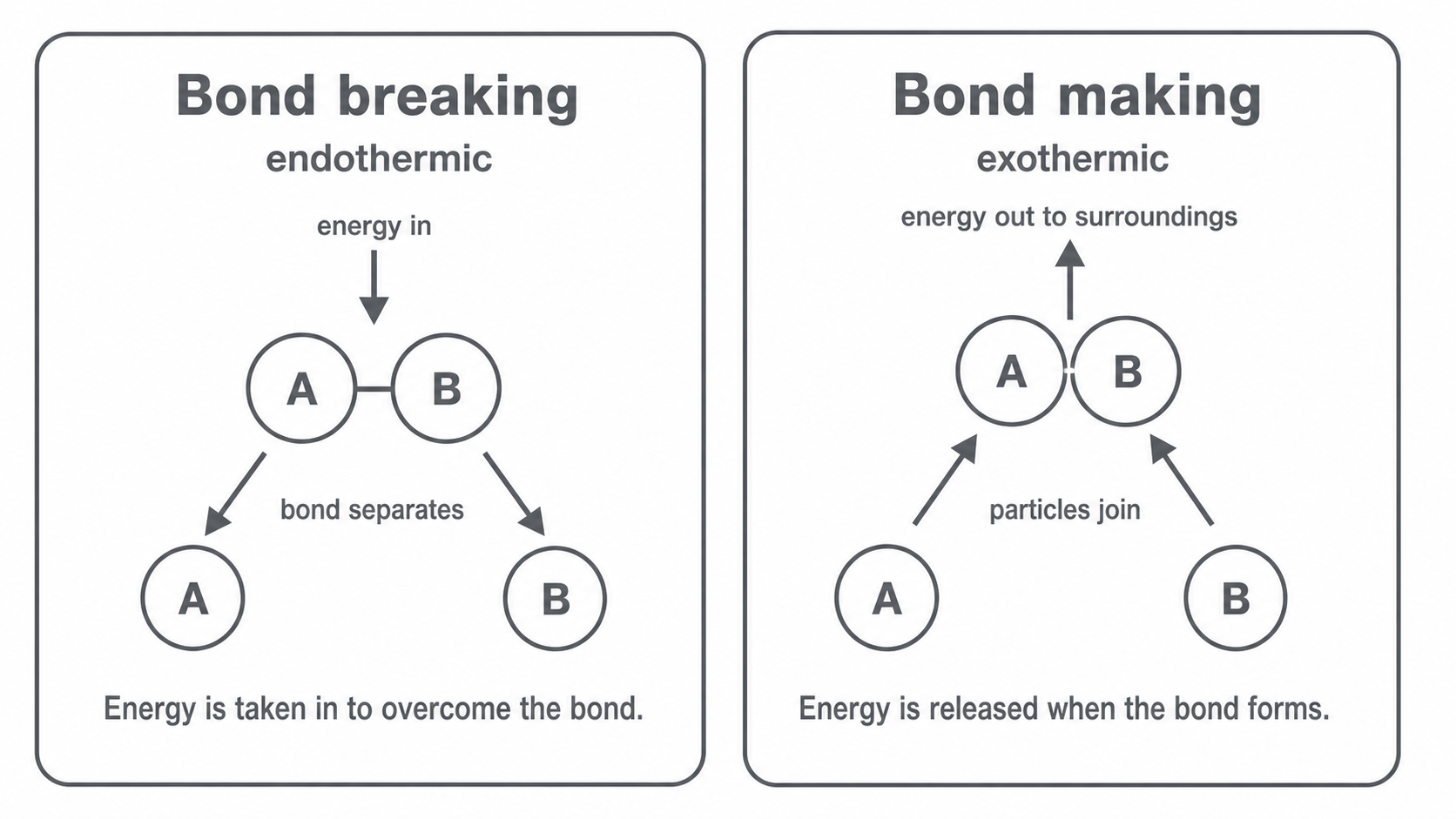
In the left panel, energy is supplied to separate A and B. In the right panel, separated A and B join and energy is transferred to the surroundings. Neither process creates or destroys atoms or energy.
Continue this lesson.
You’re previewing NovaLearn without an account. Create a free account to read the rest.
Create free account