4.3 - Reactivity and the formation of metal ions
The reactivity series puts metals in order from most reactive to least reactive. In this lesson, the evidence comes from reactions with water and dilute acids. The deeper idea is that a more reactive metal atom has a greater tendency to form a positive ion, called a cation.
The reactivity series scale
The reactivity series required here is:
potassium, sodium, calcium, magnesium, aluminium, (carbon), zinc, iron, (hydrogen), copper, silver, gold
Potassium is the most reactive in this list. Gold is the least reactive. Carbon and hydrogen are shown in brackets because they are reference non-metals, not metals forming metal cations in this series.
Reactivity series
A reactivity series is a list of metals in order of how readily they react, with the most reactive at the top and the least reactive at the bottom.
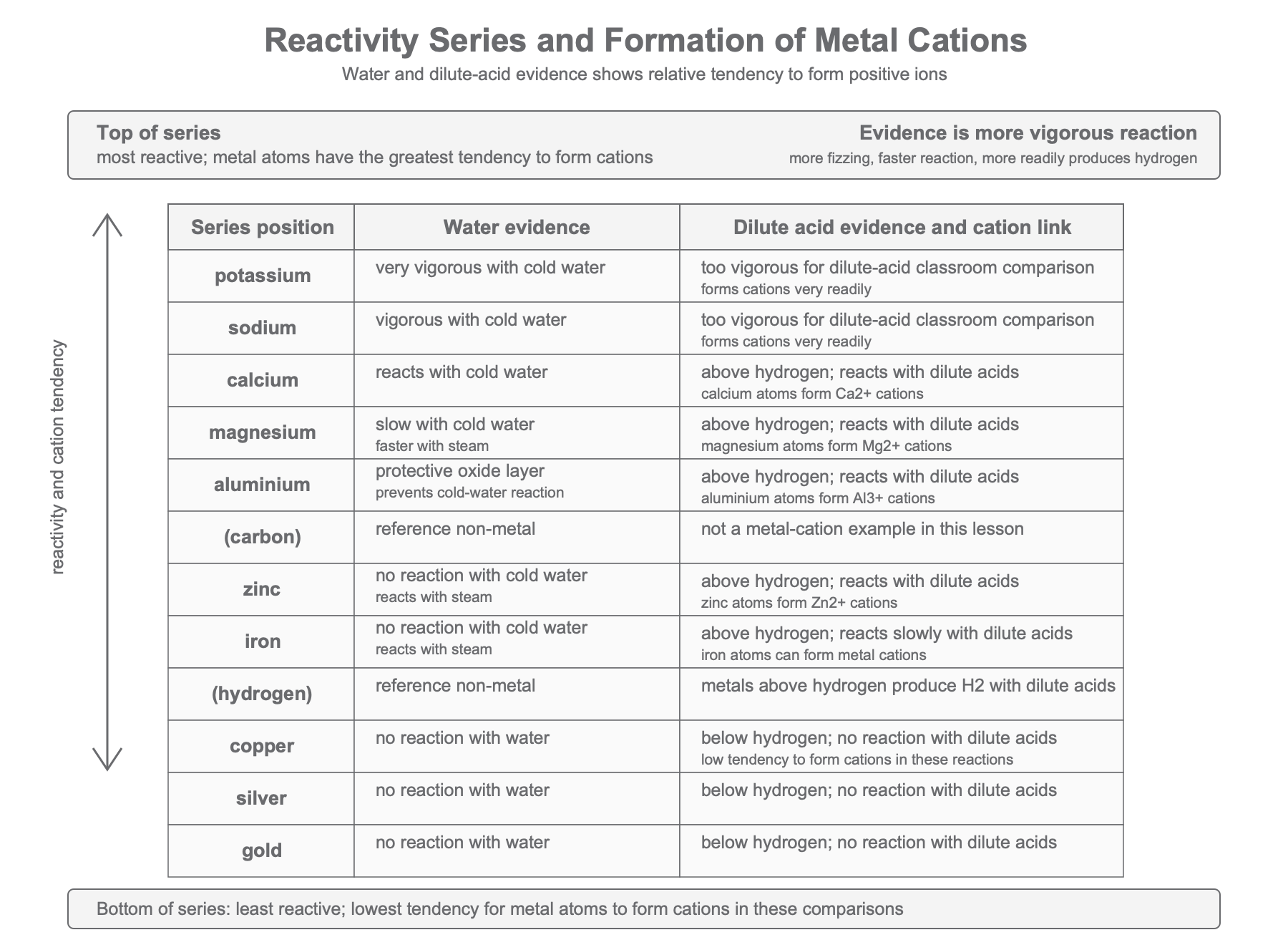
Use the order as a scale. A metal above another metal in the list is more reactive. A metal lower down is less reactive.
The series is not just a memory list. It summarises evidence from reactions. Metals near the top react more readily or more vigorously with water and dilute acids. Metals near the bottom react little or not at all in these conditions.
Evidence from reactions with water
Water helps show the top part of the series. Very reactive metals react with cold water. Less reactive metals may react only slowly, only with steam, or not in normal classroom conditions.
For the required series:
| Position in series | Typical water evidence |
|---|---|
| potassium and sodium | react very vigorously with cold water |
| calcium | reacts with cold water, but less vigorously than potassium or sodium |
| magnesium | reacts very slowly with cold water; reacts faster with steam |
| aluminium | no reliable cold-water reaction in normal conditions because of its protective oxide layer |
| zinc and iron | no reaction with cold water in normal conditions; react with steam to form a metal oxide and hydrogen |
| copper, silver and gold | no reaction with water in GCSE classroom conditions |
When a reactive metal reacts with water, hydrogen gas is produced. For calcium, the word equation is:
calcium + water -> calcium hydroxide + hydrogen
The balanced symbol equation is:
Ca + 2H2O -> Ca(OH)2 + H2
For magnesium with steam, the products are magnesium oxide and hydrogen:
Mg + H2O -> MgO + H2
Cold water separates potassium, sodium and calcium from the rest. Steam helps show that magnesium, zinc and iron are still more reactive than copper, silver and gold.
The observation matters because it gives evidence for the order. Faster fizzing, faster movement, a faster rise in temperature, or a faster disappearance of the metal all suggest a more vigorous reaction. In exam answers, link the observation to the conclusion: because calcium reacts with cold water but magnesium reacts very slowly with cold water, calcium is more reactive than magnesium.
Evidence from dilute acids
Dilute acids help separate the middle and lower parts of the series. The general reaction for a metal that reacts with a dilute acid is:
metal + acid -> salt + hydrogen
For example:
Continue this lesson.
You’re previewing NovaLearn without an account. Create a free account to read the rest.
Create free account