8.21 - How the oceans removed carbon dioxide
Explain how newly formed oceans removed carbon dioxide from the atmosphere, and how some of that carbon could later be stored in rocks.
Carbon dioxide moves into ocean water
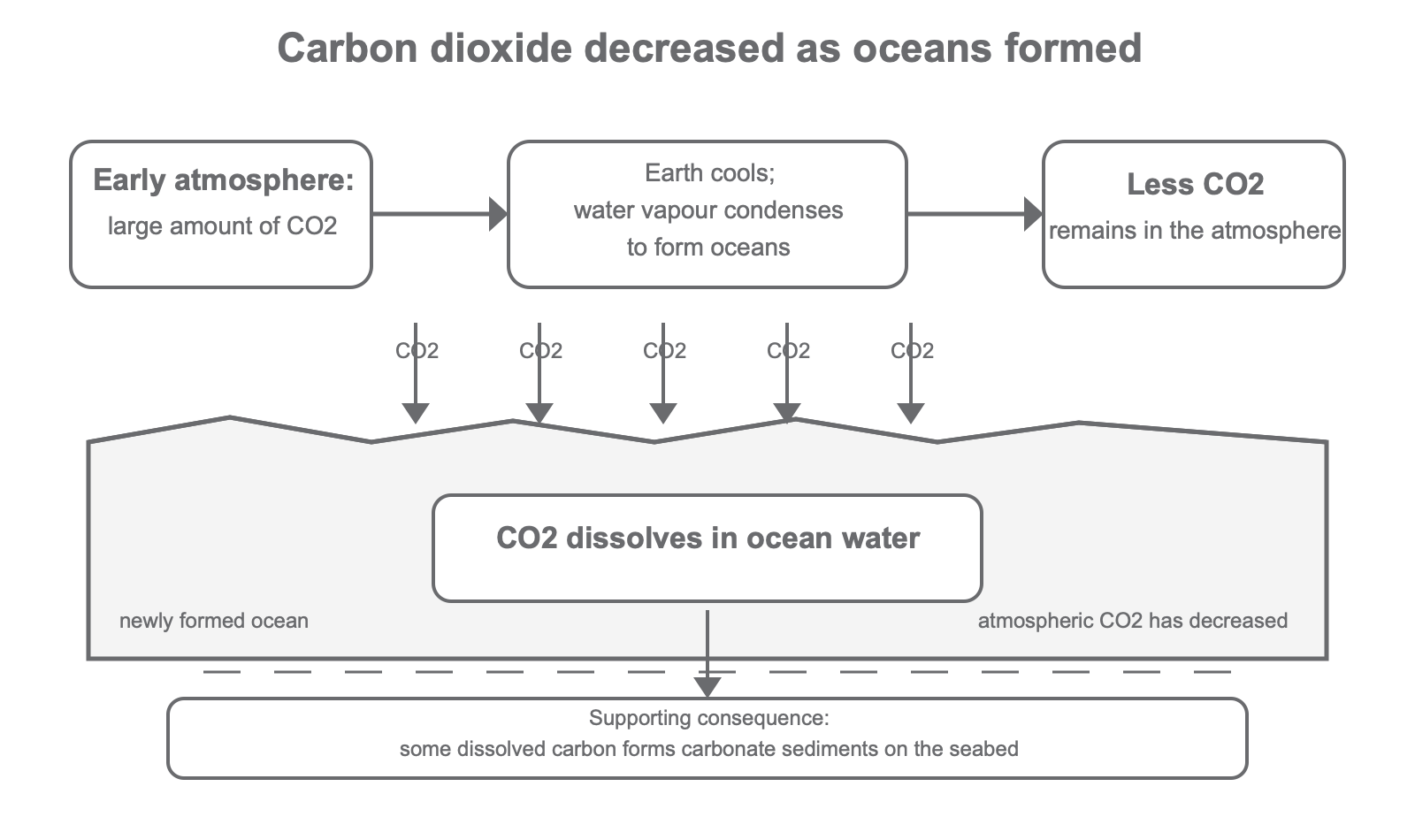
As Earth cooled, water vapour condensed and liquid oceans formed. Carbon dioxide in the atmosphere could then dissolve in this water.
Dissolving means particles spread through a solvent to form a solution. A gas can dissolve: at the ocean surface, some CO₂ molecules pass from the atmosphere into the water. This transfer reduces the amount of CO₂ remaining in the atmosphere. The carbon atoms have moved; they have not vanished.
[DIAGRAM: asset_name: carbon dioxide dissolving in early oceans - diagram 1; asset_slug: 199_8_21_amount_of_carbon_dioxide_in_the_atmosphere_was_decreased_when_carbon_dioxi_diagram1; file: diagram_assets/199_8_21_amount_of_carbon_dioxide_in_the_atmosphere_was_decreased_when_carbon_dioxi_diagram1.png; recommended_method: deterministic_drawn; description: Monochrome process diagram showing the Edexcel 8.21 chain. Top-left box: "early atmosphere: much CO2". Arrow to middle box: "Earth cools; oceans form from condensed water vapour". Arrow down to an ocean layer labelled "CO2 dissolves in ocean water". Arrow to right box: "less CO2 remains in the atmosphere". Under the ocean, show a seabed layer labelled "some dissolved carbon forms carbonate sediments" as supporting consequence, not the core required answer. Use white background, #6A6B6E linework/text/arrows, no colour. Deterministic drawing is required because the arrow directions and labels carry assessed process logic.]
Continue this lesson.
You’re previewing NovaLearn without an account. Create a free account to read the rest.
Create free account