2.5 - Pure substances and mixtures
What does “pure” actually mean? You will distinguish the everyday meaning from chemical purity, then use particles and examples to tell a pure element or compound from a mixture.
Pure in chemistry
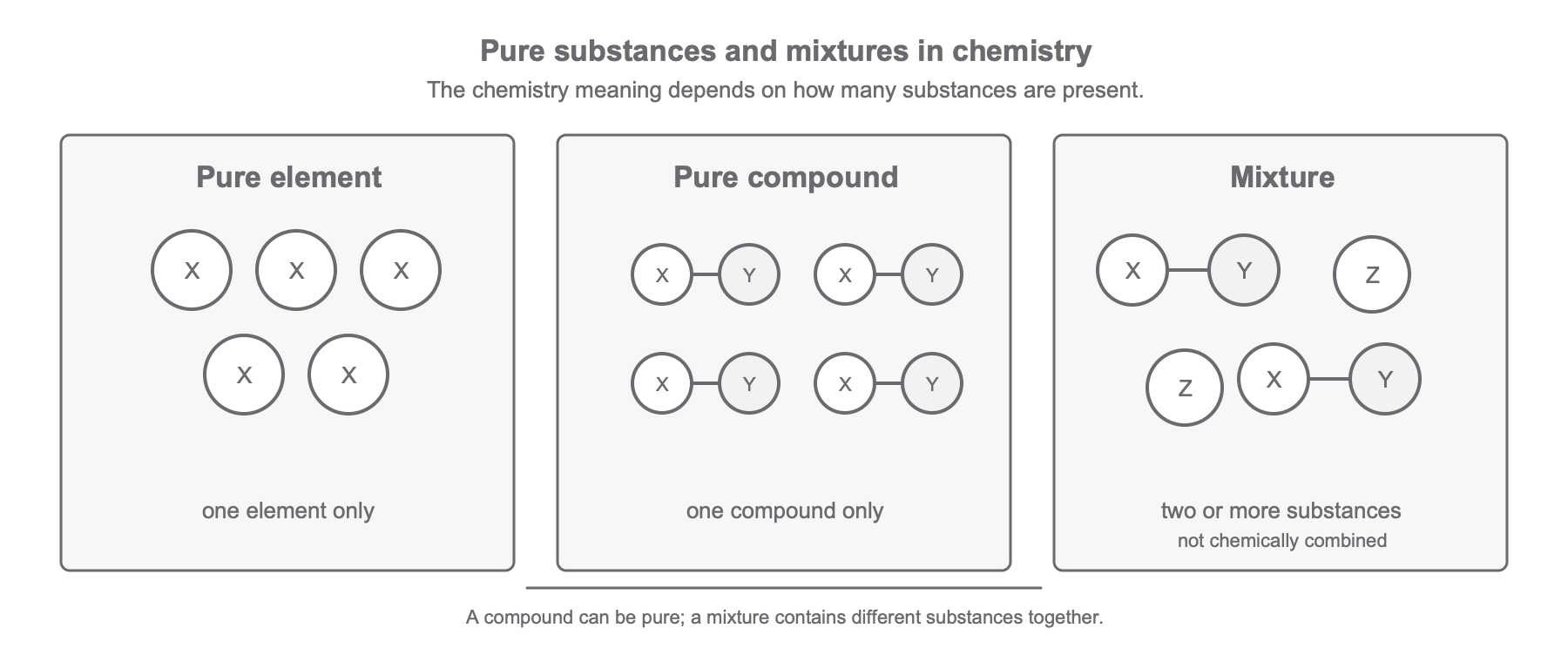
In chemistry, a sample is pure if it contains only one substance. That one substance can be an element or a compound.
Pure substance
A pure substance is a single element or a single compound, not mixed with any other substance.
The word single is important. A piece of copper is pure if it contains only copper atoms. Oxygen gas is pure if it contains only oxygen molecules. Water is pure if it contains only water molecules, H₂O.
Everyday use is different. A drink labelled "pure orange juice" may be natural or have no added sugar, but it still contains many substances, including water, sugars, acids and colour compounds. In chemistry, that makes it a mixture.
Pure elements and pure compounds
A pure substance does not have to contain only one type of atom. This is a common trap.
A pure element contains only atoms of that element. For example, pure copper contains only copper atoms. Pure oxygen gas contains only oxygen particles, even though those particles are oxygen molecules.
A pure compound contains only one compound. Water contains hydrogen atoms and oxygen atoms, but a sample of water is pure if every particle is H₂O and no other substance is mixed in. Carbon dioxide is also a compound, but a sample containing only carbon dioxide is a pure substance.
The difference is that the elements in a compound are chemically combined. Hydrogen and oxygen in water are not a mixture of hydrogen gas and oxygen gas; they are chemically bonded in the compound water.
[DIAGRAM: asset_name: pure_substance_and_mixture_particles - diagram 1; asset_slug: 064_2_5_pure_substances_and_mixtures_diagram1; file: 064_2_5_pure_substances_and_mixtures_diagram1.png; recommended_method: deterministic_drawn; description: Exact monochrome three-panel particle-composition visual. The left panel is labelled "Pure element" and shows identical single particles with the note "one element only". The middle panel is labelled "Pure compound" and shows identical bonded pairs with the note "one compound only". The right panel is labelled "Mixture" and shows two different particle types together with the note "two or more substances, not chemically combined". Deterministic drawing is used because particle identity and labels are assessed definitions. Nearby prose states all assessed content for accessibility.]
Continue this lesson.
You’re previewing NovaLearn without an account. Create a free account to read the rest.
Create free account