7.1 - Measuring rates through gas and colour changes
In this Edexcel core practical, you investigate how changing a condition changes the rate of a chemical reaction. One method measures the volume of carbon dioxide made when hydrochloric acid reacts with marble chips. The other method times the appearance change when sodium thiosulfate reacts with hydrochloric acid and a sulfur precipitate makes a cross disappear.
What rate means
Rate describes how quickly a reactant is used up or how quickly a product is made. In this practical, you do not just write "faster" or "slower"; you collect time data so the rate can be compared from measurements.
The Edexcel 7.1 core practical has two required routes.
| Practical route | Reaction used | What is measured | How rate is compared |
|---|---|---|---|
| Gas production | hydrochloric acid + marble chips | volume of gas made over time | greater gas volume per second or steeper graph means faster rate |
| Colour or precipitate change | sodium thiosulfate + hydrochloric acid | time for the cross to disappear | shorter time, or larger 1/time, means faster rate |
Rate of reaction
The rate of reaction is the change in the amount of reactant or product in a given time.
For the gas method, the useful reaction is:
calcium carbonate + hydrochloric acid -> calcium chloride + carbon dioxide + water
CaCO3(s) + 2HCl(aq) -> CaCl2(aq) + CO2(g) + H2O(l)
The marble chips are calcium carbonate. The carbon dioxide gas is collected and measured at regular time intervals.
For the disappearing-cross method, the useful reaction is:
sodium thiosulfate + hydrochloric acid -> sodium chloride + water + sulfur dioxide + sulfur
Na2S2O3(aq) + 2HCl(aq) -> 2NaCl(aq) + H2O(l) + SO2(g) + S(s)
The sulfur is a solid precipitate. As more sulfur forms, the mixture becomes cloudy and the cross underneath the flask becomes harder to see.
Gas production method
The gas-production part investigates the reaction between hydrochloric acid and marble chips. A condition can be changed, such as the size of the marble chips or the concentration of hydrochloric acid. The dependent variable is the volume of carbon dioxide collected over time.
[DIAGRAM: asset_name: gas_production_apparatus - diagram 1; asset_slug: 163_7_1_core_practical_rates_of_reaction_by_gas_production_and_colour_change_diagram1; file: 163_7_1_core_practical_rates_of_reaction_by_gas_production_and_colour_change_diagram1_imagegen_v1.png; recommended_method: deterministic_drawn; description: Exact monochrome Edexcel 7.1 gas-production apparatus. Show a conical flask containing dilute hydrochloric acid and marble chips, a tight bung, delivery tube, clamped gas syringe with moving plunger and scale, stop clock, and an inset alternative showing gas collected over water in an upturned measuring cylinder. Labels must include conical flask, dilute hydrochloric acid, marble chips, bung, delivery tube, gas syringe, carbon dioxide gas, stop clock, and alternative upturned measuring cylinder over water. Deterministic drawing is required because the apparatus layout and labels are assessed practical content.]
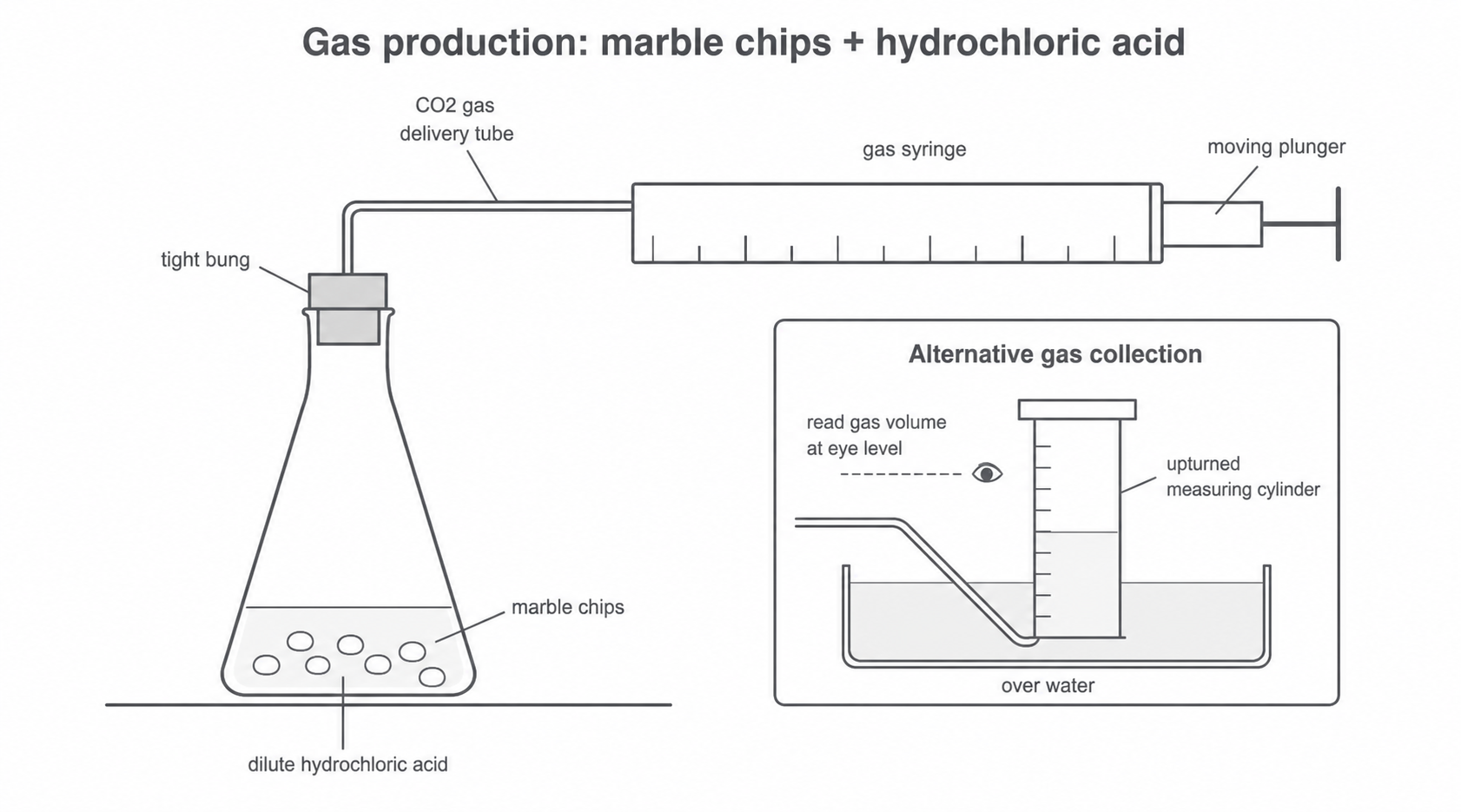
Use this method when changing marble-chip size.
- Measure a fixed volume and concentration of hydrochloric acid into a conical flask.
- Set up the flask with a bung and delivery tube connected to a gas syringe. A suitable alternative is a delivery tube into an upturned measuring cylinder filled with water.
- Measure the same mass of marble chips for each run. Choose the chip size for this run, such as large chips or small chips.
- Add the marble chips to the acid, immediately fit the bung and start the stop clock.
- Record the volume of gas in the gas syringe every fixed time interval, such as every 10 s.
- Continue until no more gas is produced or until a fixed final time is reached.
- Repeat using a different chip size, keeping the other variables the same.
| Type of variable | Example in this investigation | Why it matters |
|---|---|---|
| Independent variable | size of marble chips | this is the condition being changed |
| Dependent variable | volume of carbon dioxide at each time | this shows how quickly product is made |
| Control variable | mass of marble chips | same amount of calcium carbonate makes comparison valid |
| Control variable | volume and concentration of acid | acid amount affects rate and total gas produced |
| Control variable | temperature | temperature affects rate, so it must not drift |
| Control variable | timing intervals and apparatus | results must be collected in the same way |
If the concentration of hydrochloric acid is the independent variable instead, keep the chip size, mass of chips, volume of acid and temperature the same. Only the acid concentration should change.
Safety and accuracy details matter.
- Wear eye protection because dilute hydrochloric acid can irritate eyes.
- Do not point the delivery tube at anyone and check that the gas syringe plunger can move freely, so pressure does not build up.
- Fit the bung quickly because gas produced before the bung is fitted will be lost.
- Make sure the apparatus is airtight, otherwise carbon dioxide escapes and the measured gas volume is too low.
- If using an upturned measuring cylinder over water, fill it with water first, invert it carefully in a trough, keep the delivery tube under the cylinder opening and read the gas volume at eye level.
Disappearing cross method
The sodium thiosulfate part observes a colour or precipitate change. The endpoint is when enough sulfur precipitate has formed to obscure a cross viewed through the reaction mixture.
[DIAGRAM: asset_name: disappearing_cross_method - diagram 2; asset_slug: 163_7_1_core_practical_rates_of_reaction_by_gas_production_and_colour_change_diagram2; file: diagram_assets/163_7_1_core_practical_rates_of_reaction_by_gas_production_and_colour_change_diagram2.png; recommended_method: deterministic_drawn; description: Exact monochrome Edexcel 7.1 sodium thiosulfate disappearing-cross setup. Show a conical flask on white paper with a bold cross, sodium thiosulfate solution in the flask, dilute hydrochloric acid being added from a measuring cylinder, stop clock, thermometer/water bath cue for temperature control, and two small top-view panels labelled cross visible at start and cross obscured by sulfur precipitate at endpoint. Include a safety note label: well ventilated; sulfur dioxide can form. Deterministic drawing is required because endpoint, apparatus labels and safety cue are assessed practical content.]
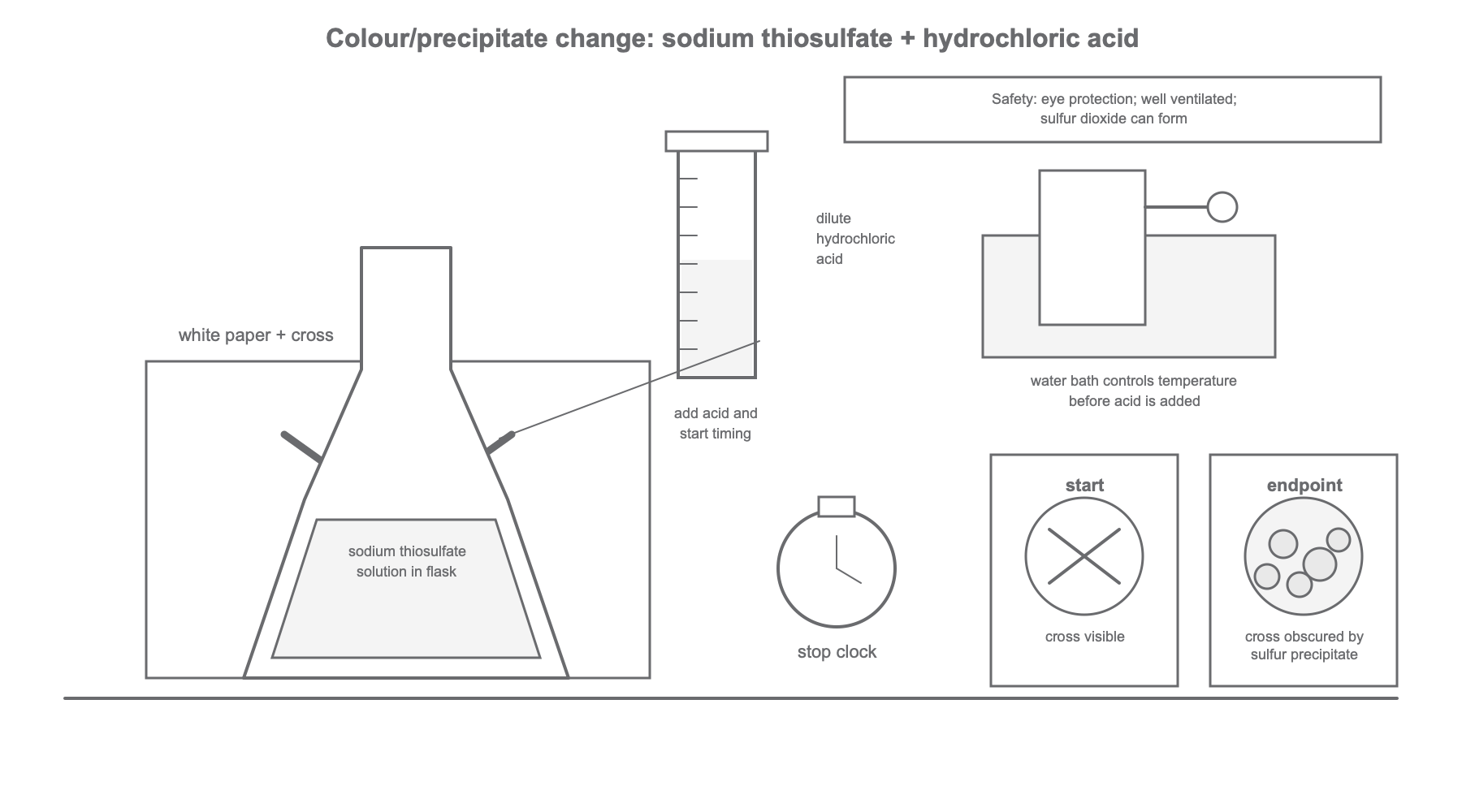
The endpoint panel is schematic: the sulfur forms a fine cloudiness, not visible large rings or gas bubbles.
A method for changing temperature is:
- Draw a clear cross on white paper and place a conical flask on top of it.
- Measure a fixed volume of sodium thiosulfate solution into the conical flask.
- Use a water bath to bring both reactant solutions, kept separately, to the chosen temperature. Measure the temperatures before mixing.
- Measure a fixed volume and concentration of dilute hydrochloric acid in a measuring cylinder.
- Add the acid to the sodium thiosulfate, start the stop clock immediately and swirl once to mix. Record the initial mixture temperature; minimise cooling during the short measurement.
- Look down through the mixture at the cross. Stop timing when the cross is no longer visible.
- Repeat at other temperatures, keeping the total volumes, concentrations and endpoint method the same.
The condition changed could also be the concentration of sodium thiosulfate. To dilute sodium thiosulfate fairly, use different volumes of sodium thiosulfate solution and water but keep the total volume in the flask the same. Then add the same volume and concentration of hydrochloric acid each time.
| Type of variable | Example in this investigation | Why it matters |
|---|---|---|
| Independent variable | temperature of sodium thiosulfate solution | this is the condition being changed |
| Dependent variable | time for the cross to disappear | this shows how quickly enough sulfur precipitate forms |
| Control variable | volume and concentration of hydrochloric acid | acid amount affects the reaction rate |
| Control variable | total volume and depth of solution | depth affects how easily the cross is hidden |
| Control variable | same cross, flask, lighting and observer | the endpoint is judged visually |
This endpoint is less precise than reading a gas syringe because it depends on the observer deciding when the cross has just disappeared. You improve validity by using the same cross, same viewing angle, same solution depth and same endpoint rule each time.
Continue this lesson.
You’re previewing NovaLearn without an account. Create a free account to read the rest.
Create free account