4.13 - Understanding reversible reactions
Learn how to recognise a reversible reaction, read its equation in both directions, and use two examples to see how changing conditions can reverse a chemical change.
Reading a reversible equation
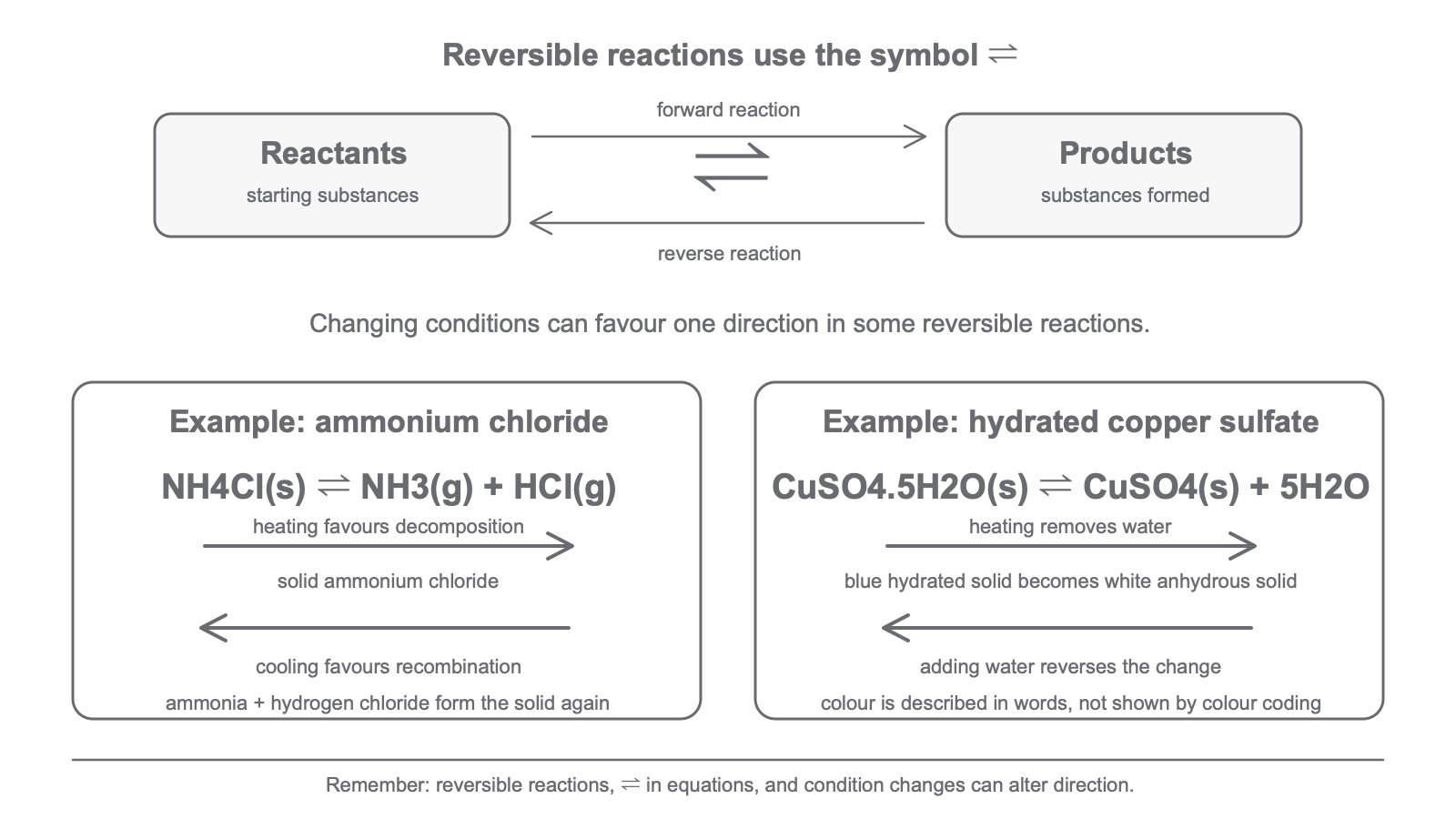
In a reversible reaction, the products can react to form the original reactants again. The two directions are shown by the symbol ⇌.
For A + B ⇌ C + D, the forward reaction changes A and B into C and D. The reverse reaction changes C and D back into A and B. The labels refer to the equation as written.
A one-way arrow, →, shows only one direction. The reversible arrow shows that both directions are possible; it does not by itself say that the two reactions are happening at equal rates.
Changing conditions
Changing conditions can favour one direction of a reversible reaction. For example, heating may make a solid break down, while cooling allows its gaseous products to recombine. This means there is an overall chemical change in one direction; it does not mean the equation has been rewritten.
[DIAGRAM: asset_name: reversible_reaction_direction: Reversible reaction symbol and condition changes - diagram 1; asset_slug: 115_4_13_chemical_reactions_are_reversible_the_use_of_the_symbol_in_equations_and_t_diagram1; file: diagram_assets/115_4_13_chemical_reactions_are_reversible_the_use_of_the_symbol_in_equations_and_t_diagram1.png; recommended_method: deterministic_drawn; description: Exact monochrome teaching diagram for Edexcel 1CH0 4.13. Shows reactants and products linked by the reversible symbol ⇌, labels the forward reaction and reverse reaction, and gives two simple reversible examples: ammonium chloride, NH4Cl(s) ⇌ NH3(g) + HCl(g), where heating favours decomposition and cooling favours recombination; hydrated copper sulfate, CuSO4.5H2O(s) ⇌ CuSO4(s) + 5H2O, where heating removes water and adding water reverses the change. Assessed formula and direction visual, so deterministic drawing is required. Uses white background with #6A6B6E linework/text and very light neutral grey fills only. Colour information appears only as words in labels, not coloured fills.]
Continue this lesson.
You’re previewing NovaLearn without an account. Create a free account to read the rest.
Create free account