9.18C - Ethene polymerisation to poly(ethene)
Follow ethene molecules as they join into poly(ethene), then learn how a repeating-unit diagram represents the long chain.
Joining ethene molecules
Ethene, , is a small monomer molecule. Many ethene molecules can react to form a long-chain polymer called poly(ethene).
Addition polymerisation
Many unsaturated monomer molecules join to form a polymer, with no small molecule produced as a by-product.
Ethene has a carbon-carbon double bond. During polymerisation, the bond between those two carbon atoms becomes a single bond and new single bonds join them to neighbouring units. Each carbon still forms four bonds, and each keeps its two hydrogen atoms. No atoms are removed from the ethene molecules.
[DIAGRAM: asset_name: ethene_to_polyethene_reaction: Ethene molecules combining to form poly(ethene) - diagram 1; asset_slug: 222_9_18c_ethene_polymerisation_to_poly_ethene_diagram1; file: diagram_assets/222_9_18c_ethene_polymerisation_to_poly_ethene_diagram1.png; recommended_method: deterministic_drawn; description: Exact monochrome structural diagram showing ethene molecules with C=C bonds on the left, an arrow labelled polymerisation, and on the right a short section of a poly(ethene) chain with only single C-C bonds, continuation marks, and label poly(ethene). The visual teaches that ethene molecules combine into one addition polymer; no reaction conditions or mechanism steps are shown. Deterministic drawing is used because formulae, bonds, labels, and continuation marks must be exact.]
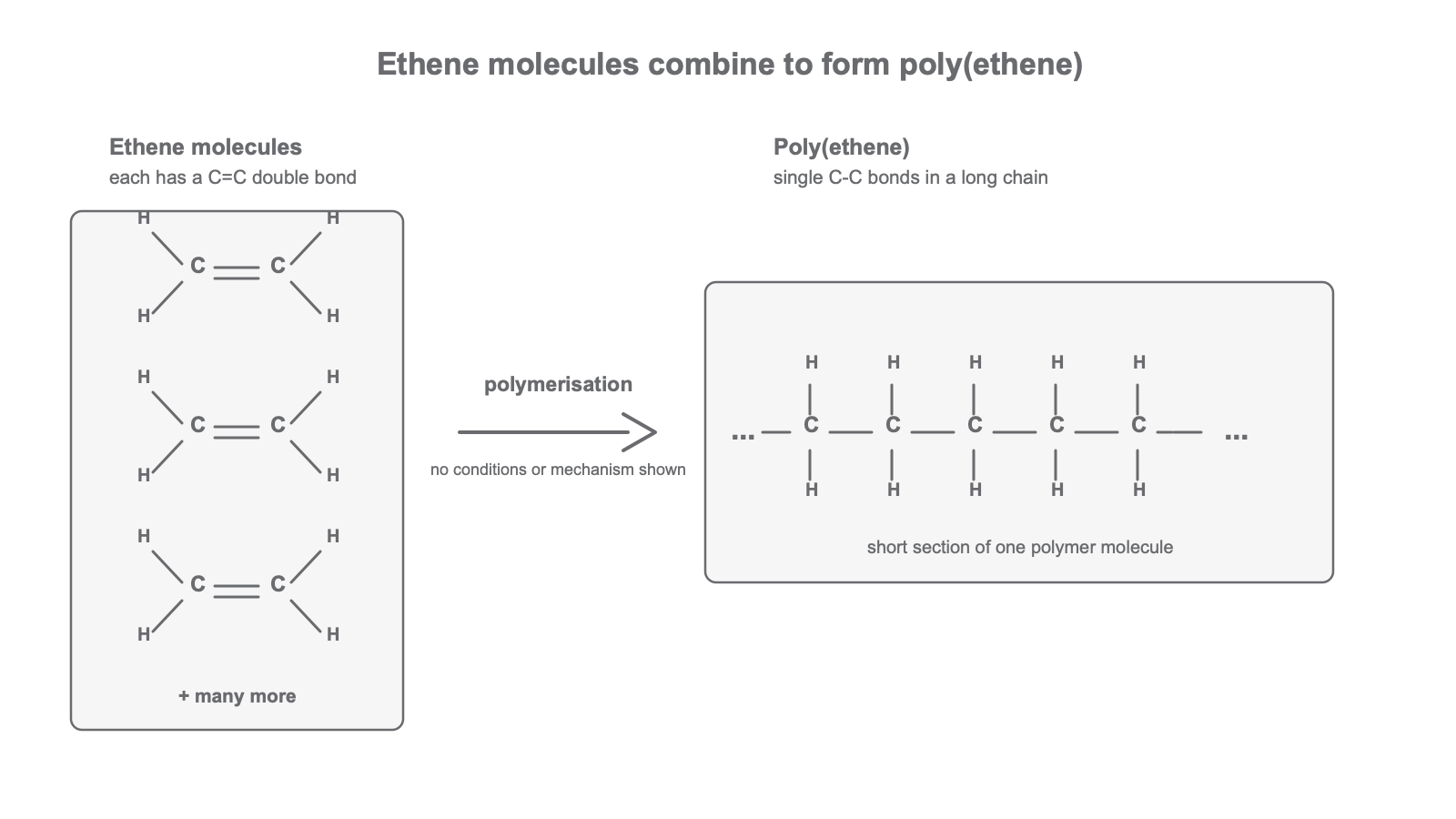
The right side shows only a section of a much longer chain, not the complete product of just three ethene molecules. Conditions and mechanisms are not required for this specification point.
Continue this lesson.
You’re previewing NovaLearn without an account. Create a free account to read the rest.
Create free account