6.16 - Physical property trends in noble gases
Boiling point and density change down Group 0. You will use data to describe those patterns, interpret temperatures below zero and predict missing values for other noble gases.
Reading the patterns
A physical property can be observed or measured without forming a new substance. Boiling point and density are physical properties; chemical reactivity is not.
The table lists noble gases in order down Group 0. Boiling points are rounded to the nearest °C at atmospheric pressure. Densities are reference gas values at room temperature; compare gas densities at the same temperature and pressure.
| Noble gas | Boiling point / °C | Density / g dm⁻³ |
|---|---|---|
| helium | −269 | 0.164 |
| neon | −246 | 0.825 |
| argon | −186 | 1.633 |
| krypton | −153 | 3.425 |
| xenon | −108 | 5.366 |
| radon | −62 | 9.074 |
[DIAGRAM: asset_name: noble_gas_boiling_density_trends: Noble gas boiling point and density trends - diagram 1; asset_slug: 162_6_16_physical_property_trends_in_noble_gases_diagram1; file: 162_6_16_physical_property_trends_in_noble_gases_diagram1.png; recommended_method: deterministic_drawn; description: Exact monochrome two-panel trend graph for Group 0 noble gases He, Ne, Ar, Kr, Xe and Rn. Left panel plots rounded boiling points in degrees C: He -269, Ne -246, Ar -186, Kr -153, Xe -108, Rn -62, with a horizontal room-temperature reference line at 20 degrees C. Right panel plots gas densities in g dm-3: He 0.164, Ne 0.825, Ar 1.633, Kr 3.425, Xe 5.366, Rn 9.074. Students should see that boiling point and density both increase down Group 0, while the 20 degrees C line shows these examples are gases at room temperature. Deterministic drawing is used because axes, values, labels and trend positions are assessed data content.]
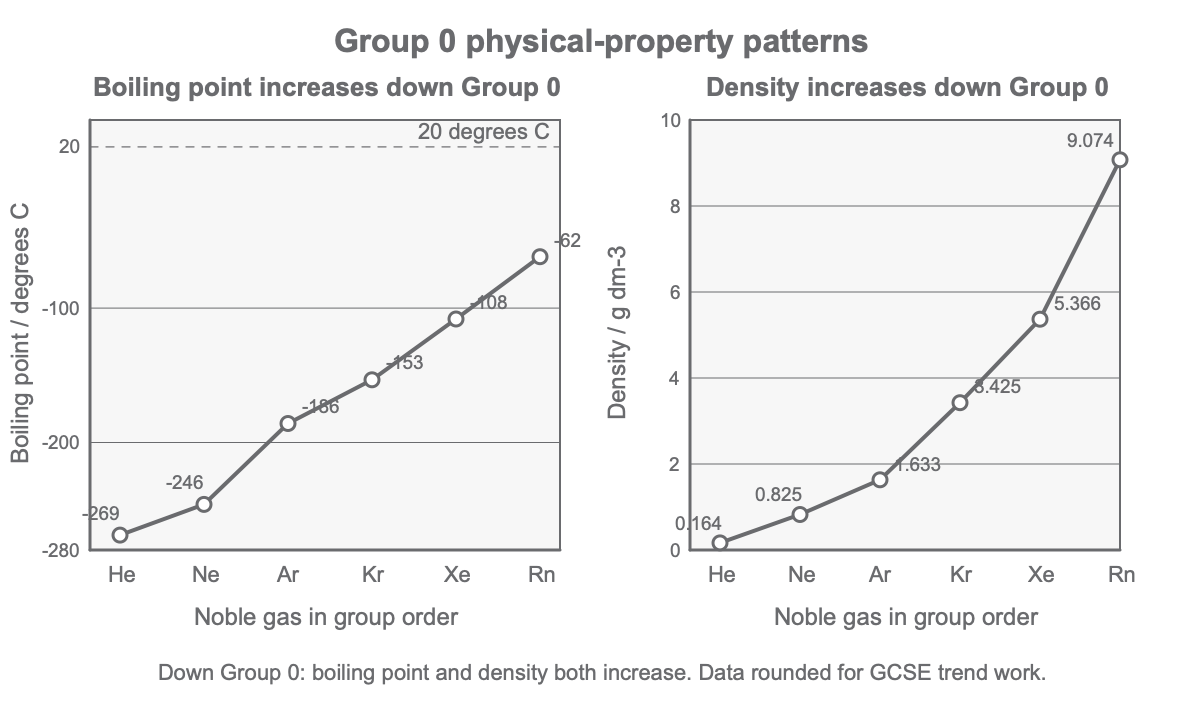
Both boiling point and density increase down Group 0. For negative temperatures, a value closer to zero is higher: −108 °C is warmer than −186 °C. The graph's upward slope shows this increase.
Density is mass per unit volume. Down this group, atoms become heavier. At the same temperature and pressure, equal volumes of these gases contain approximately the same number of atoms, so the mass per unit volume increases.
Data: Royal Society of Chemistry periodic table, converted to g dm⁻³ and rounded for boiling points.
Continue this lesson.
You’re previewing NovaLearn without an account. Create a free account to read the rest.
Create free account