3.31 - Investigating copper sulfate electrolysis
This Pearson Edexcel core practical investigates copper sulfate solution in two ways. With copper electrodes, you measure how the mass of each electrode changes when the current is changed. With inert graphite electrodes, you observe the products formed at the electrodes and explain why they form.
Planning the two investigations
The aim is to electrolyse copper sulfate solution using both copper electrodes and inert graphite electrodes.
The electrode material matters.
| Electrode material | Main purpose in this practical | Main evidence collected |
|---|---|---|
| copper electrodes | quantitative investigation | mass change of anode and cathode at different currents |
| graphite electrodes | qualitative investigation | observations and products at each electrode |
Copper sulfate solution is the electrolyte. It contains mobile ions, including ions and ions from copper sulfate, and small amounts of and ions from water. The power supply must be low-voltage d.c. because electrolysis needs a direct current.
Electrolyte
An electrolyte is an ionic substance in the molten state or dissolved in water that conducts electricity because its ions can move.
The negative electrode is the cathode. The positive electrode is the anode. During electrolysis, cations move towards the cathode and anions move towards the anode.
Apparatus and variables
For the copper-electrode section, use:
- eye protection
- copper sulfate solution
- 100 cm³ beaker
- two pieces of copper foil
- emery paper
- low-voltage d.c. supply
- ammeter
- variable resistor
- connecting leads and crocodile clips
- stop clock
- balance
- distilled water
- access to propanone in a fume cupboard
- graph paper or graphing software
[DIAGRAM: asset_name: electrolysis_setup_1; asset_slug: 102_3_31_core_practical_electrolysis_of_copper_sulfate_solution_diagram1; file: 102_3_31_core_practical_electrolysis_of_copper_sulfate_solution_diagram1_imagegen_v2.png; recommended_method: imagegen; description: Copper electrodes connected in series with an ammeter and variable resistor. Positive anode loses mass; negative cathode gains mass.]
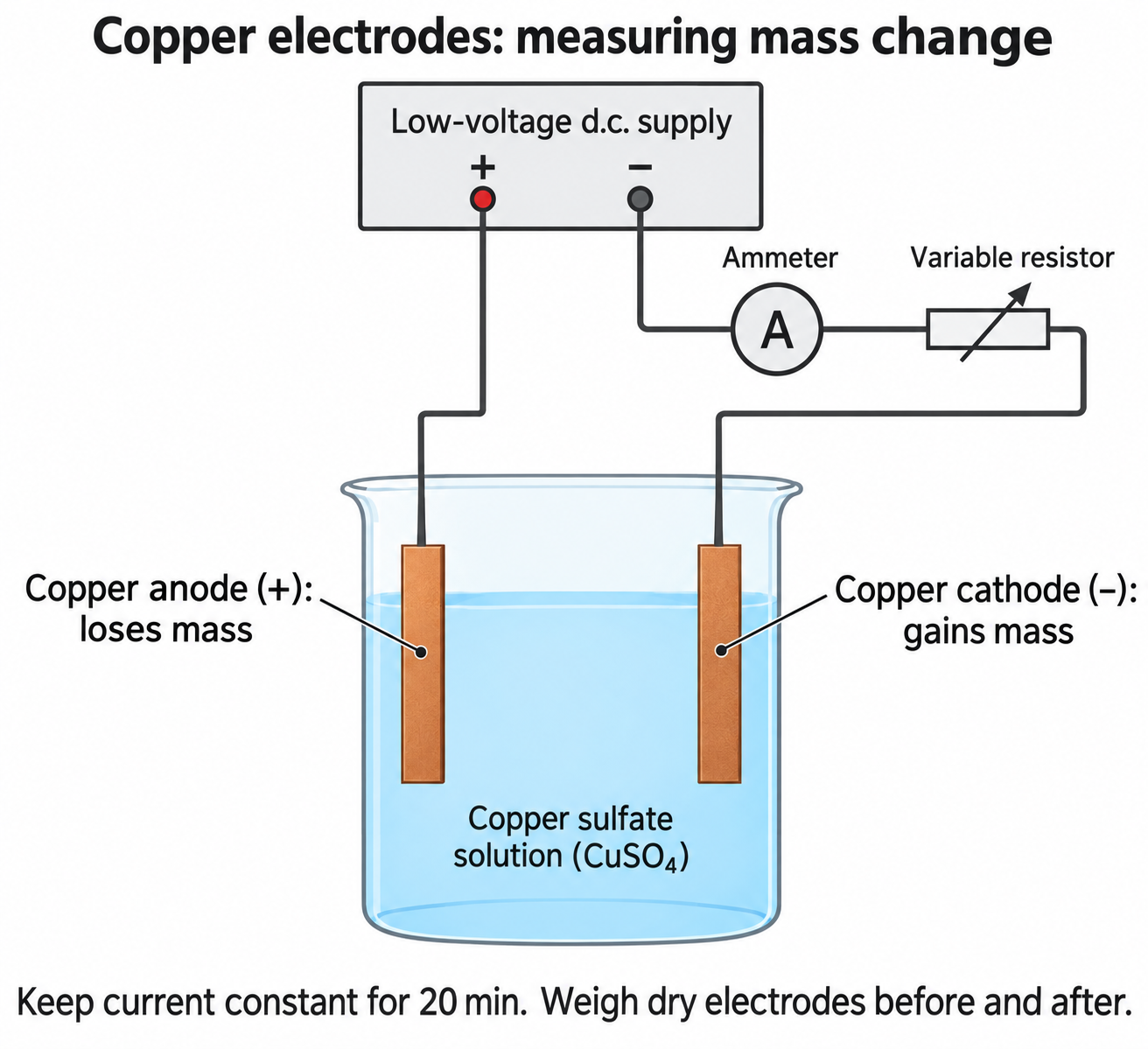
Clean the copper electrodes with emery paper before weighing them. This removes oxide or loose material that would make the starting mass less reliable. Label one electrode as the anode and the other as the cathode before the experiment starts, because the mass changes have opposite meanings.
Use fresh solution of the same volume and concentration for each run. Begin each run with similarly prepared electrodes and a new starting mass measurement.
The key variables are:
| Variable type | In this practical |
|---|---|
| Independent variable | current, for example 0.2 A, 0.3 A, 0.4 A and 0.5 A |
| Dependent variables | change in mass of the copper anode and copper cathode |
| Control variables | time powered, volume and concentration of copper sulfate solution, electrode material, electrode surface area, distance between electrodes, depth of electrodes in solution, drying method and temperature |
Copper Electrode Method
Use this Edexcel method for the copper-electrode section.
- Put on eye protection.
- Select two pieces of copper foil and clean them with emery paper.
- Label one electrode
anodeand the othercathode. - Measure and record the starting mass of each dry electrode.
- Half-fill a 100 cm³ beaker with copper sulfate solution.
- Connect the copper anode to the positive terminal of the low-voltage d.c. supply.
- Connect the copper cathode to the negative terminal through the ammeter and variable resistor in one series circuit. Keep the electrodes apart, immerse them to the same depth, and keep clips above the liquid.
- Switch on and adjust the variable resistor to give a current of
0.2 A. - Keep the current constant for
20 min, adjusting the variable resistor if needed. - Switch off the power before removing the electrodes.
- Rinse the electrodes gently with distilled water to remove electrolyte, then use the instructed propanone drying procedure in a fume cupboard. Allow all liquid to evaporate before weighing. Propanone helps remove water and evaporates readily; there must be no naked flames in the laboratory while it is in use.
- Measure and record the final mass of each dry electrode.
- Repeat the experiment at
0.3 A,0.4 Aand0.5 A, preparing the electrodes and recording new starting masses for each run. Repeat each current to assess variation and calculate means.
Do not wipe the electrodes clean after electrolysis. Wiping can remove copper deposited on the cathode or loose copper from the anode, so the final mass would not represent the electrolysis result.
The current must be kept constant because the mass change depends on the charge passed. For this core practical, you do not need to calculate charge from first principles unless a question supplies the relationship. The required data analysis is to compare electrode mass change with current.
Copper Electrode Results
A results table should include starting mass, final mass and change in mass for each electrode. Use signed changes if you calculate:
change in mass = final mass − starting mass
For the anode, the signed change should usually be negative because the copper anode loses mass. For the cathode, the signed change should usually be positive because copper is deposited on it.
Example results might look like this. These synthetic numbers are only for practising the analysis pattern, not expected results; real class values depend on the electrodes, solution, drying and current control.
| Current in A | Anode change in mass in g | Cathode change in mass in g |
|---|---|---|
0.2 | -0.05 | +0.04 |
0.3 | -0.09 | +0.08 |
0.4 | -0.14 | +0.12 |
0.5 | -0.18 | +0.16 |
To process the data:
- plot current in
Aon the horizontal axis - plot change in mass in
gon the vertical axis - use a positive series for the cathode and a negative series for the anode when plotting signed changes; if plotting the magnitude of mass loss instead, label it explicitly
- draw a suitable best-fit line or trend line if the pattern is close to linear
- describe the relationship between current and mass change
For a fixed time, a larger current should usually produce a larger mass change. The cathode gains more copper because more ions form copper metal on its surface. The anode loses more copper because more copper atoms from the anode enter the solution as ions.
The cathode gain may not exactly equal the anode loss. Deposit falling off, loose material leaving the anode, residual liquid and balance uncertainty can cause a difference. A drifting current changes the amount transferred at both electrodes; by itself it does not explain unequal gain and loss.
To estimate a value between two measured currents, interpolate along the best-fit line. For example, the anode changes in the table are −0.09 g at 0.3 A and −0.14 g at 0.4 A. A straight-line estimate at 0.35 A is halfway between them: (−0.09 − 0.14) ÷ 2 = −0.115 g, or about −0.12 g. This is an estimate, not an extra measurement.
Continue this lesson.
You’re previewing NovaLearn without an account. Create a free account to read the rest.
Create free account