2.4 - Predicting physical state from conditions
Use melting and boiling points to predict a substance’s state at a specified temperature and pressure. Practise comparisons involving negative temperatures, then examine what can and cannot be concluded at an exact change-point.
Comparing temperature with two boundaries
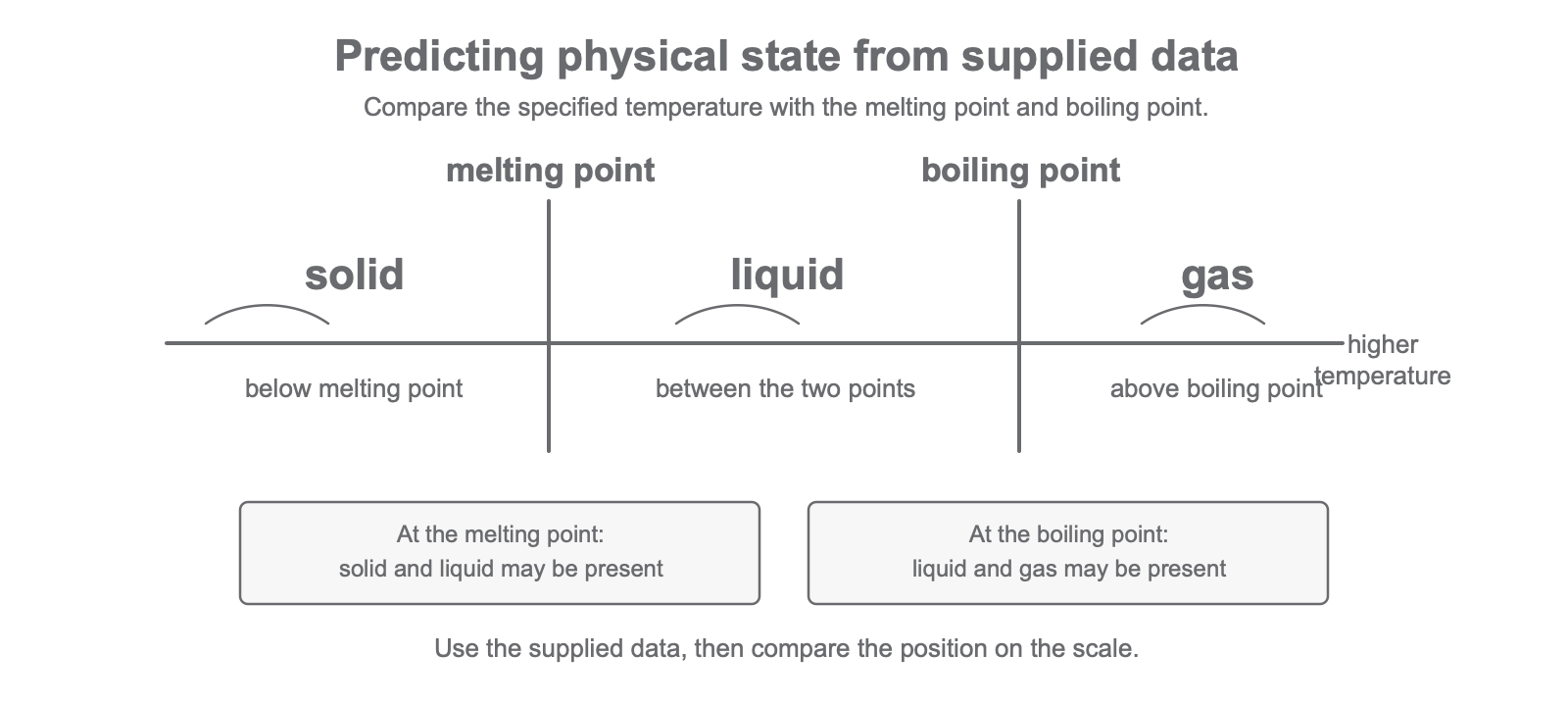
A melting point marks the solid–liquid boundary; a boiling point marks the liquid–gas boundary. Use values for the same pressure as the sample. In the examples below, assume a pure substance has reached the stated temperature and the data apply at the stated pressure.
[DIAGRAM: asset_name: physical_state_temperature_number_line: Physical state from melting and boiling point data - diagram 1; asset_slug: 063_2_4_physical_state_of_a_substance_under_specified_conditions_diagram1; file: 063_2_4_physical_state_of_a_substance_under_specified_conditions_diagram1.png; recommended_method: deterministic_drawn; description: Exact monochrome number-line decision diagram for predicting physical state from data. Temperature increases from left to right. A vertical marker labelled "melting point" separates the "solid" region from the "liquid" region, and a vertical marker labelled "boiling point" separates the "liquid" region from the "gas" region. Boundary notes say "at melting point: solid and liquid may be present" and "at boiling point: liquid and gas may be present". Deterministic drawing is used because positions, labels and decision regions are assessed data-comparison content. The visual is a one-dimensional comparison scale, and nearby prose states all assessed information for accessibility.]
| Temperature | Expected state |
|---|---|
| below melting point | solid |
| above melting point but below boiling point | liquid |
| above boiling point | gas |
For a liquid prediction, check both boundaries. Being above the melting point alone does not rule out a gas.
Negative temperatures
At the stated pressure, a substance melts at −215 °C and boils at −175 °C. At −190 °C it is liquid because −215 < −190 < −175. On a temperature scale, −190 °C is warmer than −215 °C even though 190 is a smaller number than 215.
A second substance melts at 320 °C and boils at 980 °C. At 25 °C it is solid because 25 < 320. A third melts at −10 °C and boils at 55 °C: at 80 °C it is gas because 80 > 55.
Continue this lesson.
You’re previewing NovaLearn without an account. Create a free account to read the rest.
Create free account