3.27 - Writing electrode half-equations
Higher tier. Learn to write electrode half-equations by balancing atoms first and then total charge. You will use metal, hydrogen, halogen and oxygen examples.
Balancing a cathode half-equation
A normal symbol equation shows all the reactants and products in a reaction. A half equation is narrower. It shows only the chemical change at one electrode, with electrons included so the electron transfer is visible.
In electrolysis, the two electrode reactions happen separately:
- at the cathode, a positive ion or hydrogen ion can gain electrons
- at the anode, a negative ion can lose electrons
Half equation
A half equation is an equation that shows the reaction at one electrode and includes electrons to show the electron transfer.
The half equation must be balanced in two ways:
- the number of each atom must match on both sides
- the total charge must match on both sides
Do not include spectator ions just to make a full equation look complete. For example, sulfate ions in sodium sulfate solution may be present, but if they do not react at the electrode they do not belong in the half equation for hydrogen or oxygen formation.
The cathode is the negative electrode in electrolysis. Positive ions are attracted to it. When a positive ion reacts at the cathode, it gains electrons to form a neutral atom or molecule.
For a metal ion, use this pattern:
positive ion + electrons -> atom
The number of electrons must cancel the positive charge on the ion.
Worked example: copper ions forming copper atoms
Why this is balanced:
- atoms: one copper atom on each side
- charge on the left:
+2from and-2from2e-, giving 0 - charge on the right: neutral copper, giving 0
Another cathode example is hydrogen formation:
The 2 in front of is needed because hydrogen gas is , not H.
At the cathode, electrons are on the left because the reacting ion gains electrons.
Now apply the same pattern to a different metal ion. Balanced multiples are equivalent unless a question asks for the smallest whole-number coefficients.
Diatomic products at the anode
The anode is the positive electrode in electrolysis. Negative ions are attracted to it. When a negative ion reacts at the anode, it loses electrons, so the electrons appear on the right-hand side of the half equation.
For a halide ion such as chloride or bromide, the product is a diatomic molecule:
Why this is balanced:
- atoms: two chlorine atoms on the left and two chlorine atoms in
- charge on the left: gives
-2 - charge on the right: neutral plus
2e-gives-2
Bromide ions follow the same pattern:
Do not write as the final answer for chlorine gas. Chlorine is present as , so the atom count has to be doubled.
Balancing oxygen and water
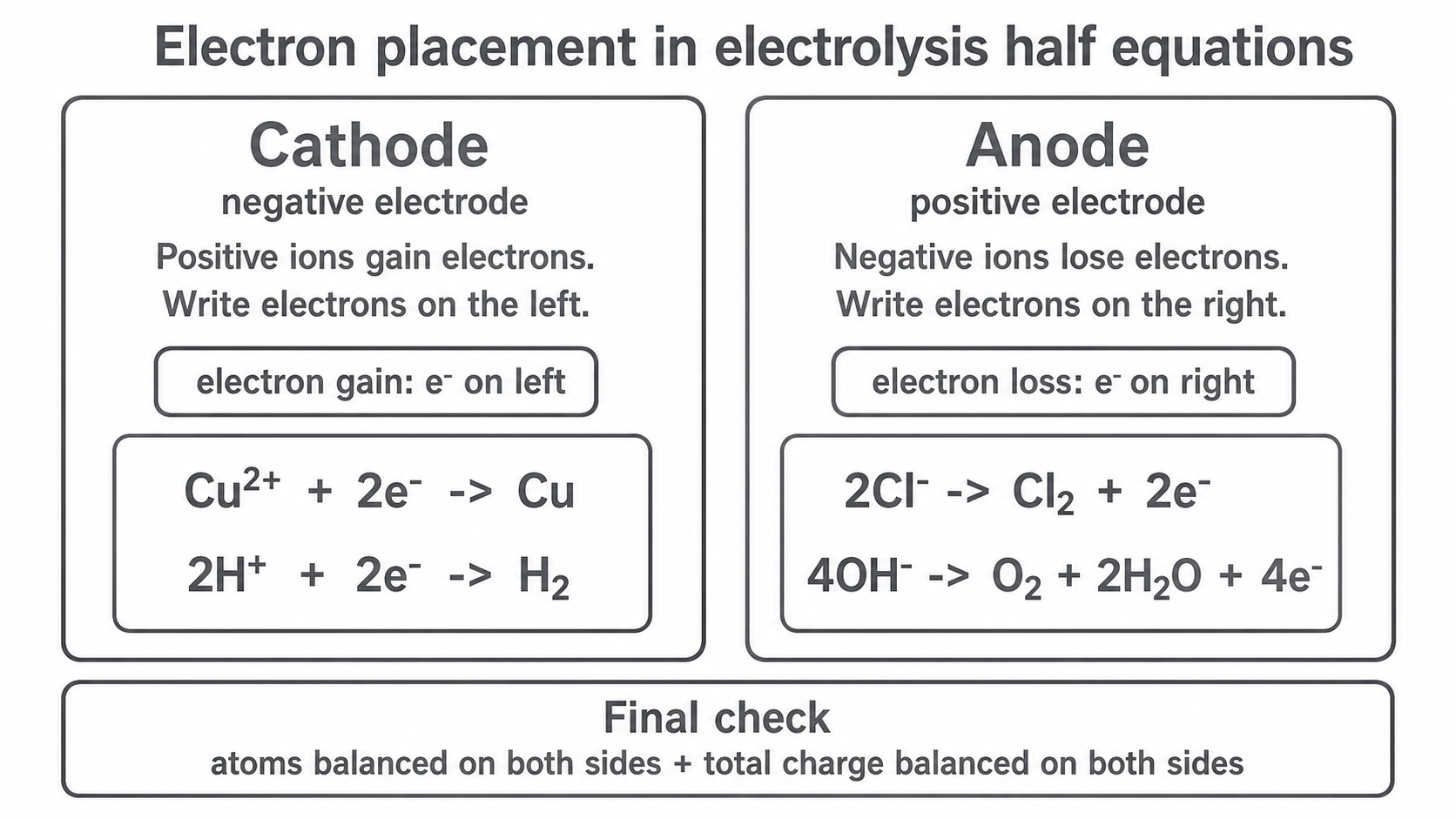
A half equation is not finished until both atom balance and charge balance work. The side the electrons go on depends on the electrode reaction:
- cathode: electrons are reactants, so they are written on the left
- anode: electrons are products, so they are written on the right
[DIAGRAM: asset_name: half_equation_electron_placement: Electron placement in cathode and anode half equations - diagram 1; asset_slug: 098_3_27_half_equations_for_reactions_occurring_at_the_anode_and_cathode_in_electro_diagram1; file: 098_3_27_half_equations_for_reactions_occurring_at_the_anode_and_cathode_in_electro_diagram1_imagegen_v1.png; recommended_method: deterministic_drawn; description: Exact monochrome teaching visual with two side-by-side panels. Left panel is labelled cathode, negative electrode, positive ions gain electrons, electrons on left, with equations Cu^2+ + 2e- -> Cu and 2H+ + 2e- -> H2. Right panel is labelled anode, positive electrode, negative ions lose electrons, electrons on right, with equations 2Cl- -> Cl2 + 2e- and 4OH- -> O2 + 2H2O + 4e-. Bottom check strip says atoms balanced and total charge balanced. Assessed formula visual, generated deterministically because labels, ions, charges and electron positions must be exact.]
Continue this lesson.
You’re previewing NovaLearn without an account. Create a free account to read the rest.
Create free account