7.7 - How catalysts lower activation energy
Use activation energy to explain why a catalyst can speed up a reaction without raising its temperature.
The energy barrier and alternative pathway
Not every collision forms products. Reacting particles need enough energy to start the reaction. This minimum is the activation energy. Collisions with less energy cannot overcome the barrier.
At a given temperature particles have a range of energies. A lower barrier allows a greater proportion of their collisions to lead to reaction; it does not make every collision successful.
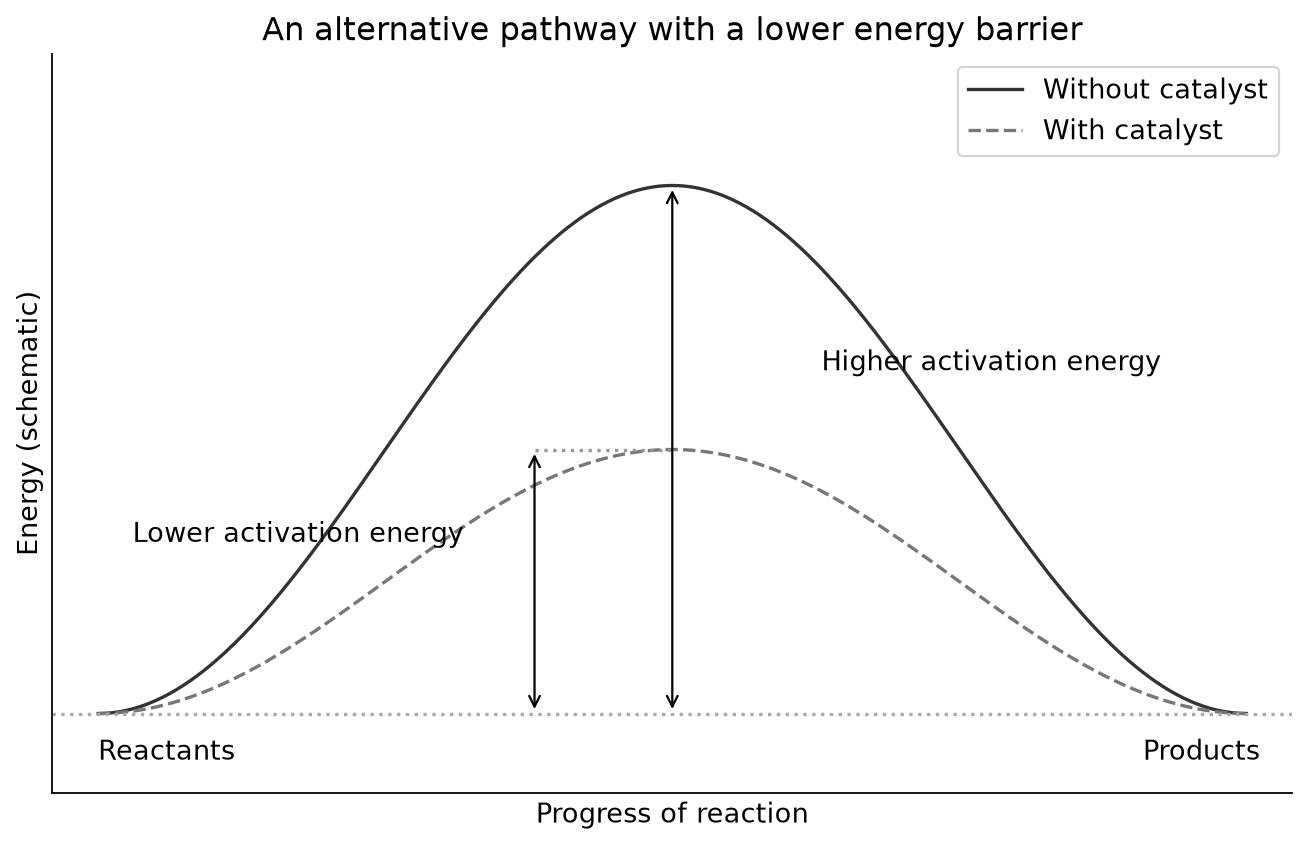
A catalyst provides an alternative reaction pathway with a lower activation energy. It is regenerated overall, and the same reaction products form.
[DIAGRAM: asset_name: catalysed_energy_barrier: Catalysed and uncatalysed activation-energy barriers - diagram 1; asset_slug: 169_7_7_addition_of_a_catalyst_increases_the_rate_of_a_reaction_in_terms_of_activa_diagram1; file: 169_7_7_addition_of_a_catalyst_increases_the_rate_of_a_reaction_in_terms_of_activa_diagram1_corrected.png; recommended_method: deterministic_drawn; description: Exact monochrome reaction-profile teaching diagram for Edexcel 7.7. It shows energy against progress of reaction, the same reactants and products, a higher uncatalysed pathway, a lower catalysed pathway, and vertical arrows comparing higher activation energy without a catalyst with lower activation energy with a catalyst. The visual is used only to explain the catalyst/activation-energy link, not to teach the separate skill of drawing endothermic or exothermic reaction profiles. Deterministic drawing is used because the axes, labels, pathway comparison, and activation-energy arrows must be exact.]
Continue this lesson.
You’re previewing NovaLearn without an account. Create a free account to read the rest.
Create free account