5.24C - Making ammonium sulfate in the lab and industry
Learn how to prepare ammonium sulfate crystals by titration and crystallisation, then compare this small-scale method with the multi-stage industrial route used to make fertiliser.
The reaction and purpose
Ammonia solution is alkaline. Dilute sulfuric acid is acidic. When the two react in the correct proportions, hydrogen ions from the acid are accepted by ammonia molecules, forming ammonium ions. The solution contains ammonium and sulfate ions. Crystallisation brings these ions into the solid ammonium sulfate lattice.
Ammonia solution and sulfuric acid
The coefficient 2 matters: one sulfuric acid molecule can supply two hydrogen ions, so two ammonia molecules are needed to form two ammonium ions. At this level, the reaction is usually written using for ammonia solution. The sulfate ion is SO₄²⁻, so two NH₄⁺ ions are needed for each sulfate ion to make a neutral salt.
Ammonium sulfate
Ammonium sulfate, , is a soluble ammonium salt used as a fertiliser.
Ammonium ions supply nitrogen needed for plant growth.
Preparing pure crystals
In the laboratory, both reactants are already available as solutions. The practical problem is not making ammonia or sulfuric acid from raw materials; it is finding the correct volumes so no excess acid or ammonia remains in the final salt solution.
[DIAGRAM: asset_name: laboratory ammonium sulfate preparation - diagram 1; asset_slug: 143_5_24c_laboratory_and_industrial_production_of_ammonium_sulfate_diagram1; file: 143_5_24c_laboratory_and_industrial_production_of_ammonium_sulfate_diagram1_imagegen_v1.png; recommended_method: deterministic_drawn; description: Monochrome assessed apparatus/process diagram showing two panels. Panel 1 labels a burette containing dilute sulfuric acid above a conical flask containing ammonia solution plus a few drops of suitable indicator on a white tile, with a swirl arrow and end-point note. Panel 2 shows repeating the measured volumes without indicator, then evaporating basin/water bath, cooling, filtering crystals and drying. The visual teaches why titration finds the proportions and why indicator is omitted from the final preparation.]
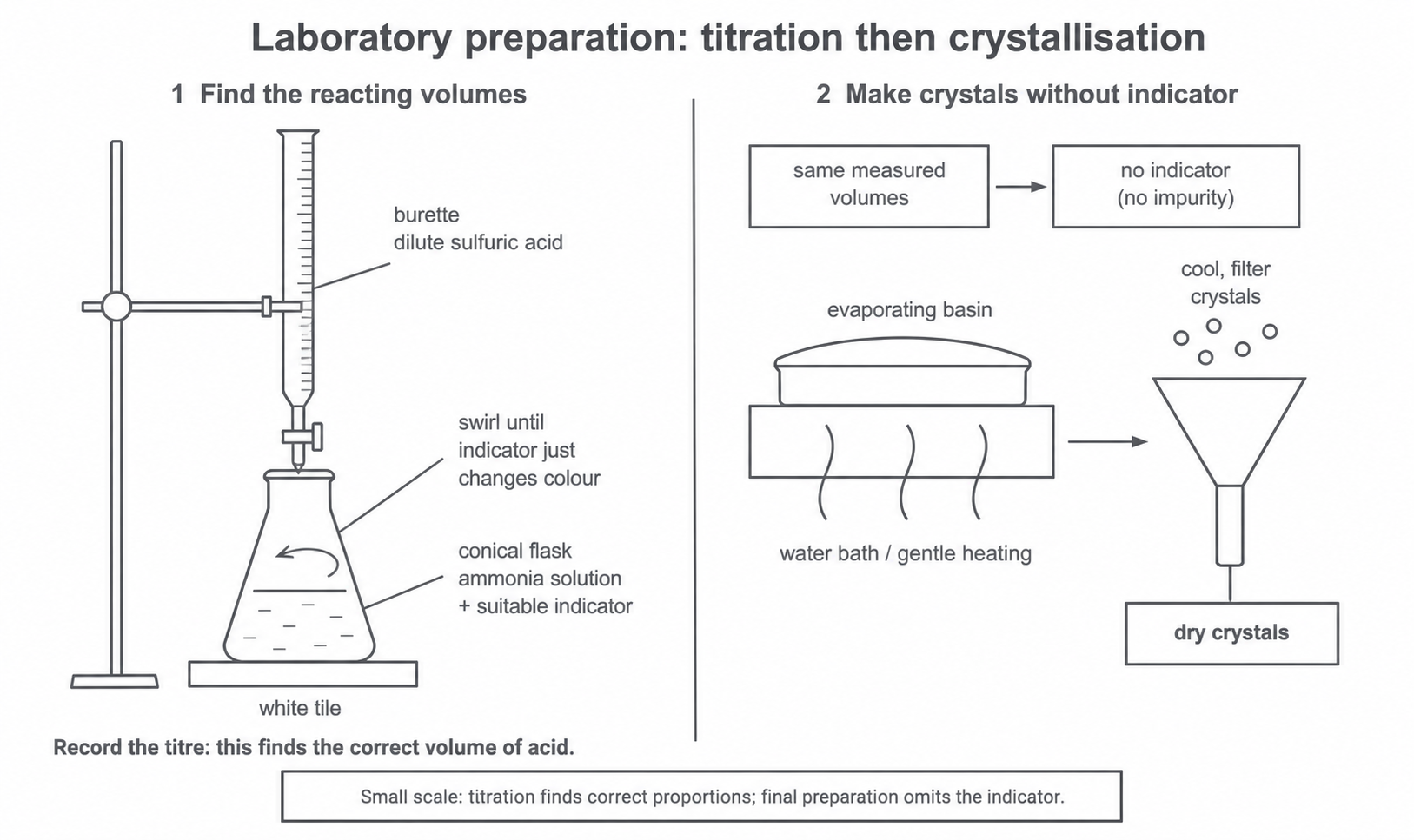
A good small-scale method has three stages.
First, carry out a titration. Measure a fixed volume of ammonia solution with a pipette into a conical flask. Add a few drops of a suitable indicator, such as methyl orange, and place the flask on a white tile. Add dilute sulfuric acid from a burette while swirling until the indicator just changes colour. Read the burette at eye level. Subtract the initial reading from the final reading to obtain the titre, the volume of acid delivered. First find an approximate end point with a rough titration, then repeat carefully, adding acid dropwise near the end point. Use fresh identical portions of ammonia solution until repeat titres agree closely.
Calculate the mean of the close repeat titres, leaving out the rough titre. For example, repeat titres of 20.10, 20.15 and 20.20 cm³ have a mean of (20.10 + 20.15 + 20.20) ÷ 3 = 20.15 cm³. A mean uses the repeat measurements to estimate the reacting volume more reliably.
Second, repeat the preparation using that mean acid volume and the original measured ammonia volume, but without the indicator. This produces a purer ammonium sulfate solution because the indicator would be an impurity in the crystals.
Third, crystallise the salt. Gently heat the ammonium sulfate solution in an evaporating basin to remove some water. Stop when the solution is concentrated enough for crystals to form on cooling; do not boil it dry. Cool to form crystals, filter the mixture, and collect the crystals on the filter paper, not in the filtrate. Rinse them with a little cold distilled water to remove solution containing soluble impurities, then dry them between filter papers or in a warm place. Use little cold water because ammonium sulfate is soluble.
Safety should be linked to the hazards. Dilute sulfuric acid can irritate or damage eyes and skin, so use eye protection and rinse spills with plenty of water as instructed. Ammonia solution releases irritating ammonia vapour, so avoid inhaling it and keep the container stoppered when not in use. Heating should be gentle because spitting solution can carry acid, alkali or salt solution out of the evaporating basin.
Continue this lesson.
You’re previewing NovaLearn without an account. Create a free account to read the rest.
Create free account