3.8 - Weak and strong acids
This Higher-tier lesson explains acid strength through ionisation, distinguishes it from concentration, and links the two ideas to hydrogen ion concentration and pH.
How much of the acid forms ions?
A strong acid dissociates completely into ions in aqueous solution. A weak acid dissociates only partially. Here, dissociation (also called ionisation for molecular acids) describes forming ions when the acid is dissolved in water.
Hydrochloric acid is a strong acid:
HCl(aq) → H⁺(aq) + Cl⁻(aq)
Ethanoic acid is weak:
CH₃COOH(aq) ⇌ H⁺(aq) + CH₃COO⁻(aq)
The reversible arrow shows that ions also recombine. At equilibrium, most ethanoic acid remains as molecules, while a smaller proportion is ionised. A weak acid still supplies H⁺; “weak” does not mean no ions.
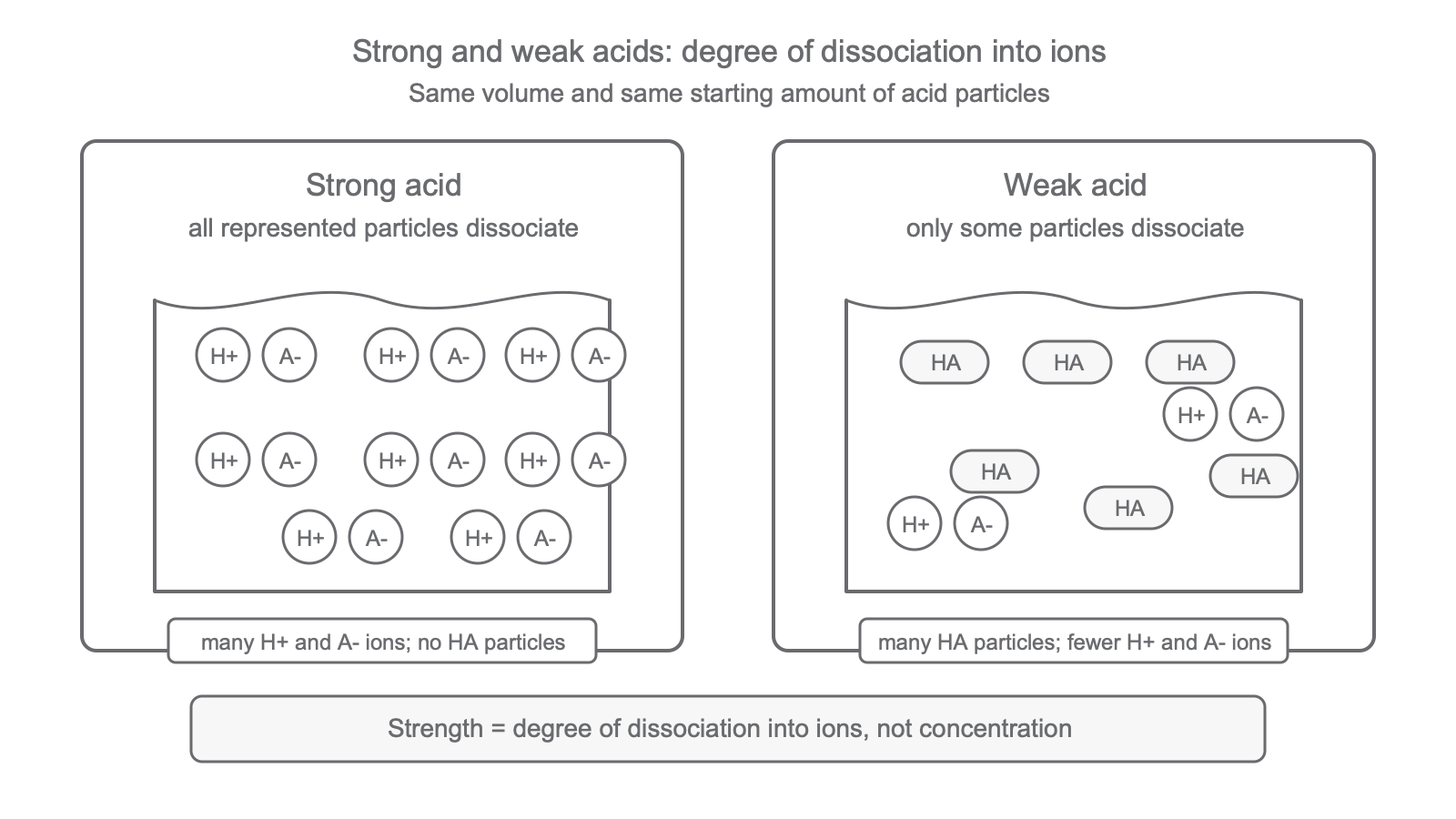
In this simplified figure, HA represents one acid molecule that can supply one H⁺. The strong-acid panel has eight H⁺ and eight A⁻ ions. The weak-acid panel has six HA molecules and two H⁺/A⁻ pairs: both represent eight original acid molecules. Each panel has equal positive and negative charge. Water is omitted; the chosen fraction illustrates partial ionisation and is not a measured value for ethanoic acid.
Strength and concentration describe different things
Concentration describes the total amount of acid per unit volume, including both ionised and unionised acid. Strength describes the proportion that forms ions.
Continue this lesson.
You’re previewing NovaLearn without an account. Create a free account to read the rest.
Create free account