6.11 - Halogen displacement reactions
Use displacement reactions to compare chlorine, bromine and iodine, write equations for successful reactions and predict the behaviour of astatine.
The displacement rule
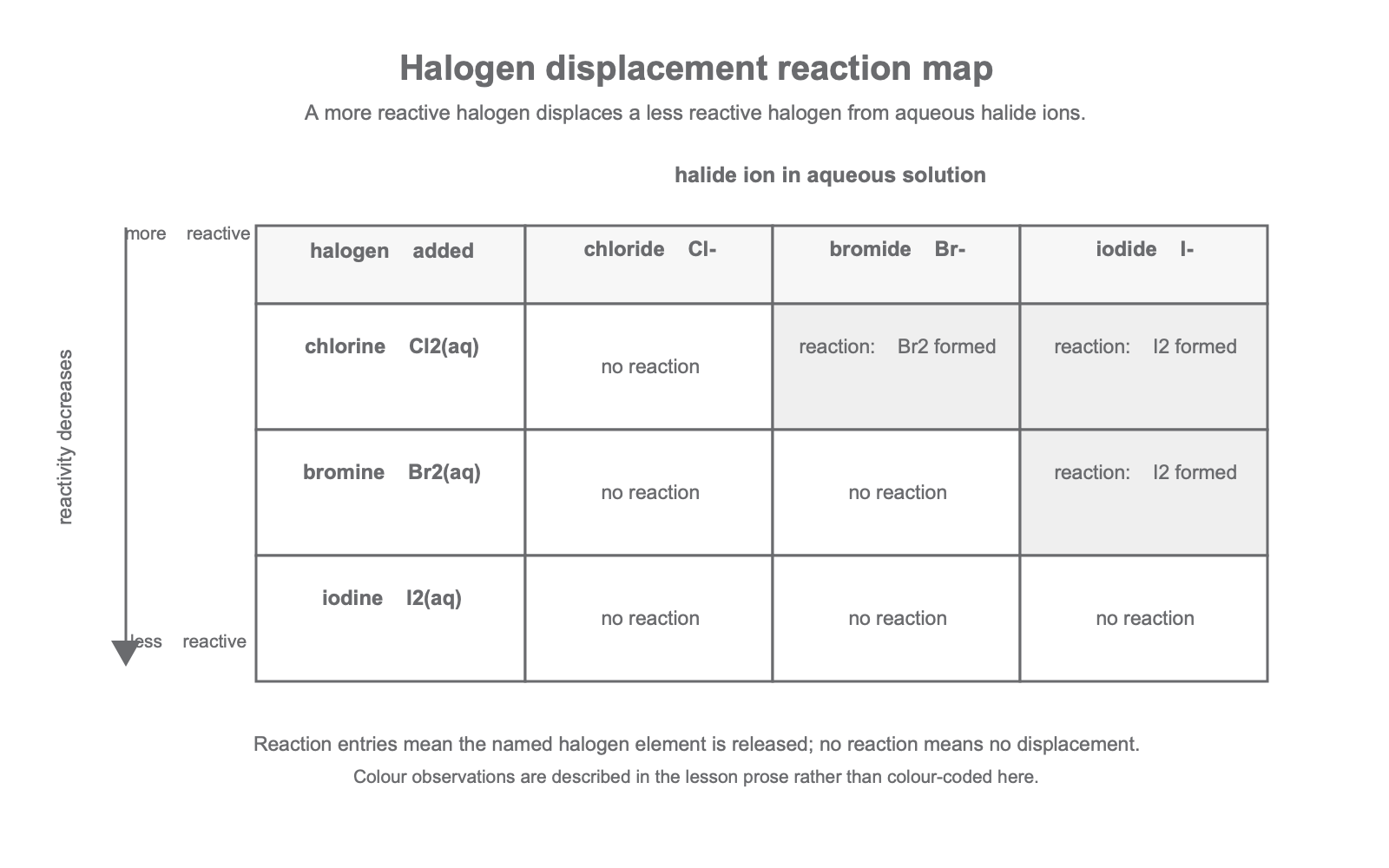
A halogen displacement reaction happens when a more reactive halogen is added to a solution containing halide ions from a less reactive halogen. The more reactive halogen takes the place of the less reactive one in the compound, so the less reactive halogen is formed as an element.
Halide ion
A halide ion is a negative ion formed from a halogen atom, such as chloride, Cl-, bromide, Br-, or iodide, I-.
The halogens in this lesson are diatomic molecules:
chlorine = Cl2
bromine = Br2
iodine = I2
The halide ions are usually present in colourless aqueous solutions of salts such as potassium chloride, potassium bromide and potassium iodide. The potassium ions are not the part that decides whether displacement happens. The decision is made by comparing the halogen added with the halogen already present as a halide ion.
The reactivity order is:
chlorine > bromine > iodine
This means chlorine is the most reactive of the three, bromine is in the middle, and iodine is the least reactive of the three. A halogen can displace halide ions below it in this order, but not halide ions above it.
Evidence from displacement reactions
The displacement pattern is found by adding chlorine water, bromine water and iodine solution to aqueous chloride, bromide and iodide solutions. A reaction is shown by the formation of a different halogen, often seen as a colour change.
[DIAGRAM: asset_name: halogen_displacement_reaction_map: Halogen displacement reaction map - diagram 1; asset_slug: 157_6_11_halogen_displacement_reactions_diagram1; file: diagram_assets/157_6_11_halogen_displacement_reactions_diagram1.png; recommended_method: deterministic_drawn; description: Exact monochrome matrix for Edexcel 6.11. Rows show halogen added: chlorine Cl2(aq), bromine Br2(aq), iodine I2(aq). Columns show halide ion solution: chloride Cl-, bromide Br-, iodide I-. Entries show no reaction for chlorine with chloride, bromine with chloride or bromide, and iodine with chloride, bromide or iodide; reaction forms bromine for chlorine plus bromide; reaction forms iodine for chlorine plus iodide and bromine plus iodide. A side arrow states reactivity decreases from chlorine to bromine to iodine. Deterministic drawing is required because the row/column labels and reaction/no-reaction pattern are assessed content.]
The observed evidence can be described in prose:
| Halogen added | Aqueous halide solution | What happens |
|---|---|---|
| chlorine, Cl2 | chloride, Cl- | no displacement reaction |
| chlorine, Cl2 | bromide, Br- | bromine is formed; an orange or yellow-orange colour appears |
| chlorine, Cl2 | iodide, I- | iodine is formed; a brown colour appears |
| bromine, Br2 | chloride, Cl- | no displacement reaction |
| bromine, Br2 | bromide, Br- | no displacement reaction |
| bromine, Br2 | iodide, I- | iodine is formed; the mixture becomes brown or darkens |
| iodine, I2 | chloride, Cl- | no displacement reaction |
| iodine, I2 | bromide, Br- | no displacement reaction |
| iodine, I2 | iodide, I- | no displacement reaction |
These results show the order because chlorine displaces both bromide and iodide ions, bromine displaces iodide ions only, and iodine does not displace chloride or bromide ions. Therefore chlorine is more reactive than bromine and iodine, and bromine is more reactive than iodine.
Continue this lesson.
You’re previewing NovaLearn without an account. Create a free account to read the rest.
Create free account