9.34C - Concentrating ethanol by fractional distillation
Use boiling-point differences and repeated evaporation and condensation to separate an ethanol-rich liquid from a fermentation mixture. Understand what the column, thermometer and condenser each do.
Why ethanol can be concentrated
A fermentation mixture contains ethanol mixed with water. They are miscible: they mix as one liquid phase. Fractional distillation is a physical separation, so it does not make new ethanol.
At normal atmospheric pressure, pure ethanol boils at about 78 °C and water at about 100 °C. Ethanol is more volatile, meaning it evaporates more readily. Vapour above an ordinary dilute ethanol–water mixture contains a higher proportion of ethanol than the liquid. Both substances enter the vapour; water does not wait until 100 °C before any evaporates.
Separating and condensing the vapour
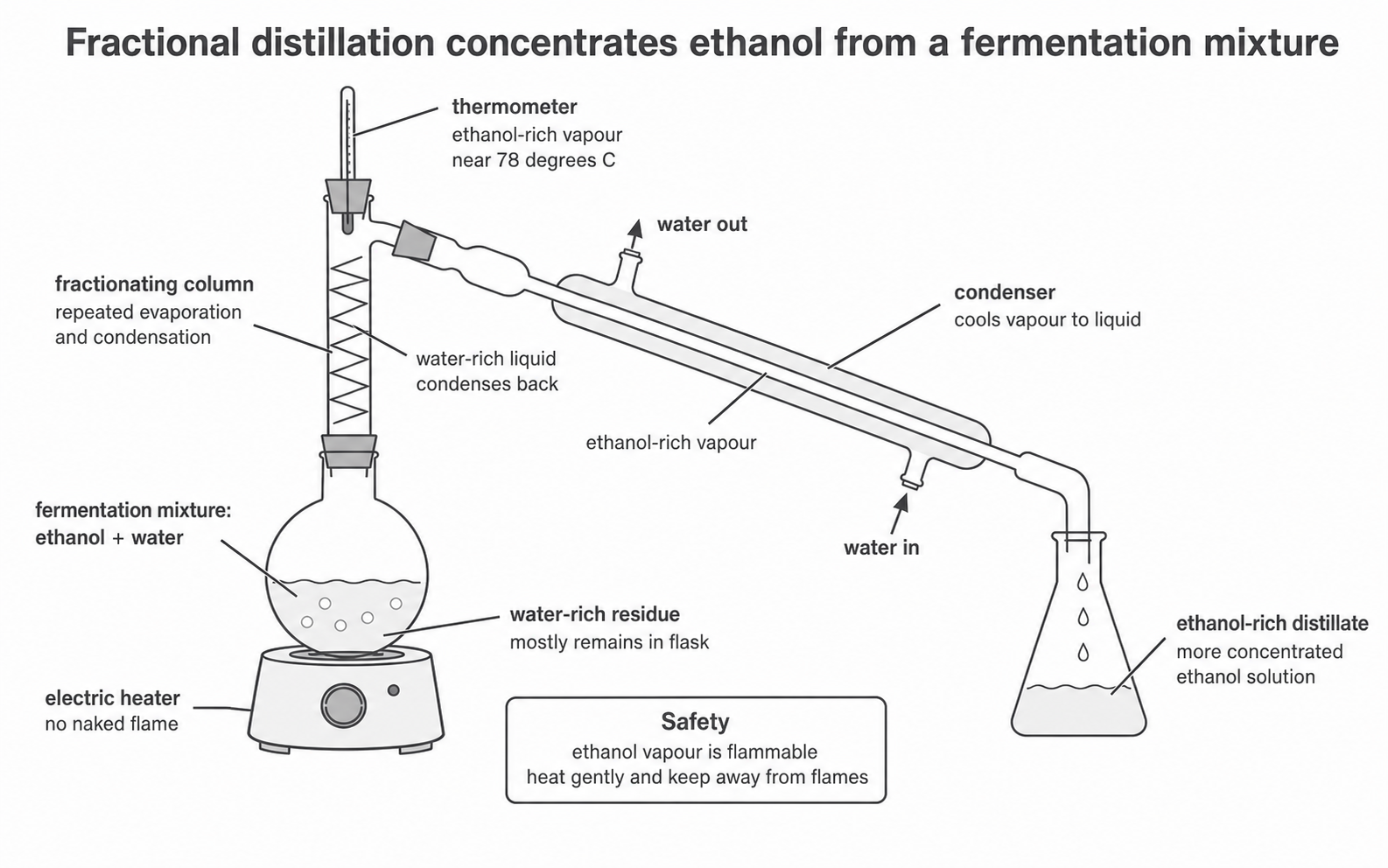
[DIAGRAM: asset_name: ethanol_fractional_distillation_apparatus: Concentrating ethanol by fractional distillation - diagram 1; asset_slug: 238_9_34c_to_obtain_a_concentrated_solution_of_ethanol_by_fractional_distillation_of_diagram1; file: 238_9_34c_to_obtain_a_concentrated_solution_of_ethanol_by_fractional_distillation_of_diagram1_imagegen_v1.png; recommended_method: deterministic_drawn; description: Exact monochrome lab-apparatus diagram for Edexcel 9.34C. It shows a fermentation mixture in a round-bottom flask heated electrically, a vertical fractionating column, thermometer at the top, condenser, receiver, ethanol-rich distillate, water-rich liquid left in the flask/returning down the column, water in at the lower condenser inlet and water out at the upper outlet, and arrows for ethanol-rich vapour. Assessed process/apparatus visual; deterministic drawing is used to keep apparatus labels, vapour path and safety details exact. Accessibility: nearby prose gives the same step sequence and explains that the product is a more concentrated ethanol solution, not pure ethanol.]
Continue this lesson.
You’re previewing NovaLearn without an account. Create a free account to read the rest.
Create free account