3.25 - Predicting electrolysis products with inert electrodes
In electrolysis, the products are the substances formed at the electrodes. This lesson focuses on the five electrolytes named by Pearson Edexcel for this point: copper chloride solution, sodium chloride solution, sodium sulfate solution, water acidified with sulfuric acid, and molten lead bromide. You will use the ions present and the reactivity series to explain these products.
Choosing which ions form products
Electrolysis uses a direct current to decompose an electrolyte. The electrolyte contains mobile ions, so charge can move through the liquid or solution.
Inert Electrode
An inert electrode conducts electricity but does not react with the electrolyte or with the products during electrolysis.
Graphite or platinum can be used as inert electrodes in these examples. Because the electrodes do not react, the products come from the electrolyte, including its water where present, rather than the electrode material.
At the negative electrode, positive ions are attracted; negative ions are attracted to the positive electrode. An ion is discharged when it reacts by gaining or losing electrons to form an electrode product.
Discharge involves electron transfer. Positive ions gain electrons at the cathode to form neutral products. Negative ions lose electrons at the anode to form neutral products. You do not need to write full half-equations here, but the words gain electrons and lose electrons help explain product formation.
For this lesson, keep the electrode signs fixed in your mind:
| Electrode | Charge in electrolysis | Ions attracted |
|---|---|---|
| Cathode | negative | positive ions |
| Anode | positive | negative ions |
Do not swap the signs with simple chemical cells. In electrolysis, the cathode is negative and the anode is positive.
An aqueous solution is more complicated than a molten ionic compound because water is present. The dissolved compound provides ions, and water also provides small amounts of and ions. That means there is often a choice of possible products at each electrode.
Aqueous
Aqueous means dissolved in water.
Use these GCSE product-choice rules for the named aqueous electrolytes in this lesson. The chloride examples assume solutions sufficiently concentrated for chlorine to be the expected anode product. Chloride concentration and electrode conditions can affect the anode products.
At the cathode:
- if the metal is less reactive than hydrogen, the metal forms
- if the metal is more reactive than hydrogen, hydrogen gas forms from ions
- if there is no metal ion to discharge, hydrogen gas forms
At the anode:
- chloride ions form chlorine gas
- if there is no halide ion in these named aqueous examples, oxygen gas forms from hydroxide ions or water
[DIAGRAM: asset_name: electrolysis_product_choice_map: Product choices with inert electrodes - diagram 1; asset_slug: 096_3_25_electrolysis_products_with_inert_electrodes_diagram1_imagegen_v1; file: diagram_assets/096_3_25_electrolysis_products_with_inert_electrodes_diagram1_imagegen_v1.png; recommended_method: deterministic_drawn; description: Exact monochrome decision-map diagram for Edexcel GCSE Chemistry 1CH0 3.25. Shows inert electrodes connected to a direct-current supply, with the negative cathode attracting positive ions and the positive anode attracting negative ions. It then shows two product-choice routes: aqueous solutions contain ions from water, so at the cathode copper ions form copper if the metal is less reactive than hydrogen, otherwise hydrogen forms; at the anode chloride ions form chlorine, while sulfate/acidified water routes form oxygen. A separate molten lead bromide route states that no ions from water are present, so Pb2+ forms lead at the cathode and Br- forms bromine at the anode. Deterministic drawing is required because electrode signs, ion charges, product names and named-electrolyte mapping are assessed chemistry.]
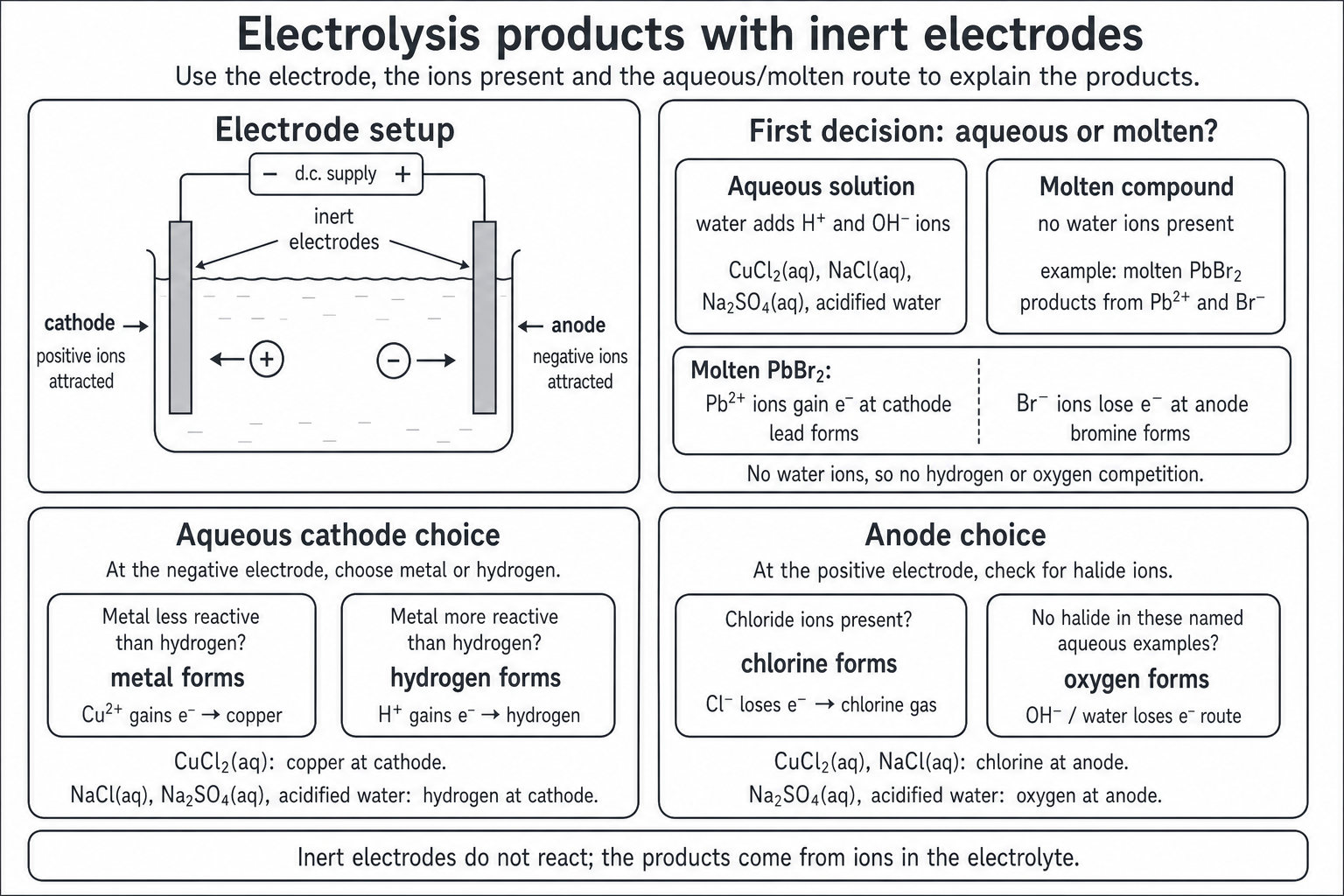
To explain a product choice, identify the relevant particles and why they react at that electrode.
Comparing chloride solutions
Copper chloride solution and sodium chloride solution both contain chloride ions, so they both form chlorine gas at the positive anode.
The difference is at the negative cathode.
| Electrolyte | Main positive ions considered at cathode | Cathode product | Why |
|---|---|---|---|
| copper chloride solution, | and | copper | copper is less reactive than hydrogen, so copper ions are discharged |
| sodium chloride solution, | and | hydrogen gas | sodium is more reactive than hydrogen, so hydrogen ions are discharged |
For copper chloride solution, copper forms as a solid coating on the cathode. Chlorine gas bubbles form at the anode because chloride ions are discharged there.
For sodium chloride solution, sodium metal does not form in the aqueous solution. Sodium is too reactive compared with hydrogen, so hydrogen gas forms at the cathode instead. Chlorine gas forms at the anode because chloride ions are present.
Use precise names. Chloride means the ion ; chlorine means the element, usually gas in this electrolysis example. Examiners often penalise answers that mix up the ion and the product.
The comparison therefore depends on reactivity at the cathode: copper is below hydrogen; sodium is above it.
Continue this lesson.
You’re previewing NovaLearn without an account. Create a free account to read the rest.
Create free account