9.22C - Polyesters as condensation polymers
In this Higher-tier lesson, explain how diacid and diol monomers form polyester chains and account for the water released at every ester link.
Why each monomer needs two reactive groups
A polyester contains ester links along its chain. This Higher-tier lesson uses a dicarboxylic acid and a diol:
| Monomer | Functional groups | General structure |
|---|---|---|
| dicarboxylic acid | two carboxylic acid groups | HOOC-R-COOH |
| diol | two alcohol groups | HO-R'-OH |
R and R' stand for carbon-based groups that may differ. A carboxylic acid group can react with an alcohol group. Having two reactive groups means each monomer can join at both ends: after one link forms, another reactive group is available to extend the chain.
An acid with only one carboxylic acid group and no other reactive group can form an ester, but it cannot continue this chain through a second end. This is why using two monofunctional molecules makes a small ester rather than a long polyester.
An ester link forms and water is released
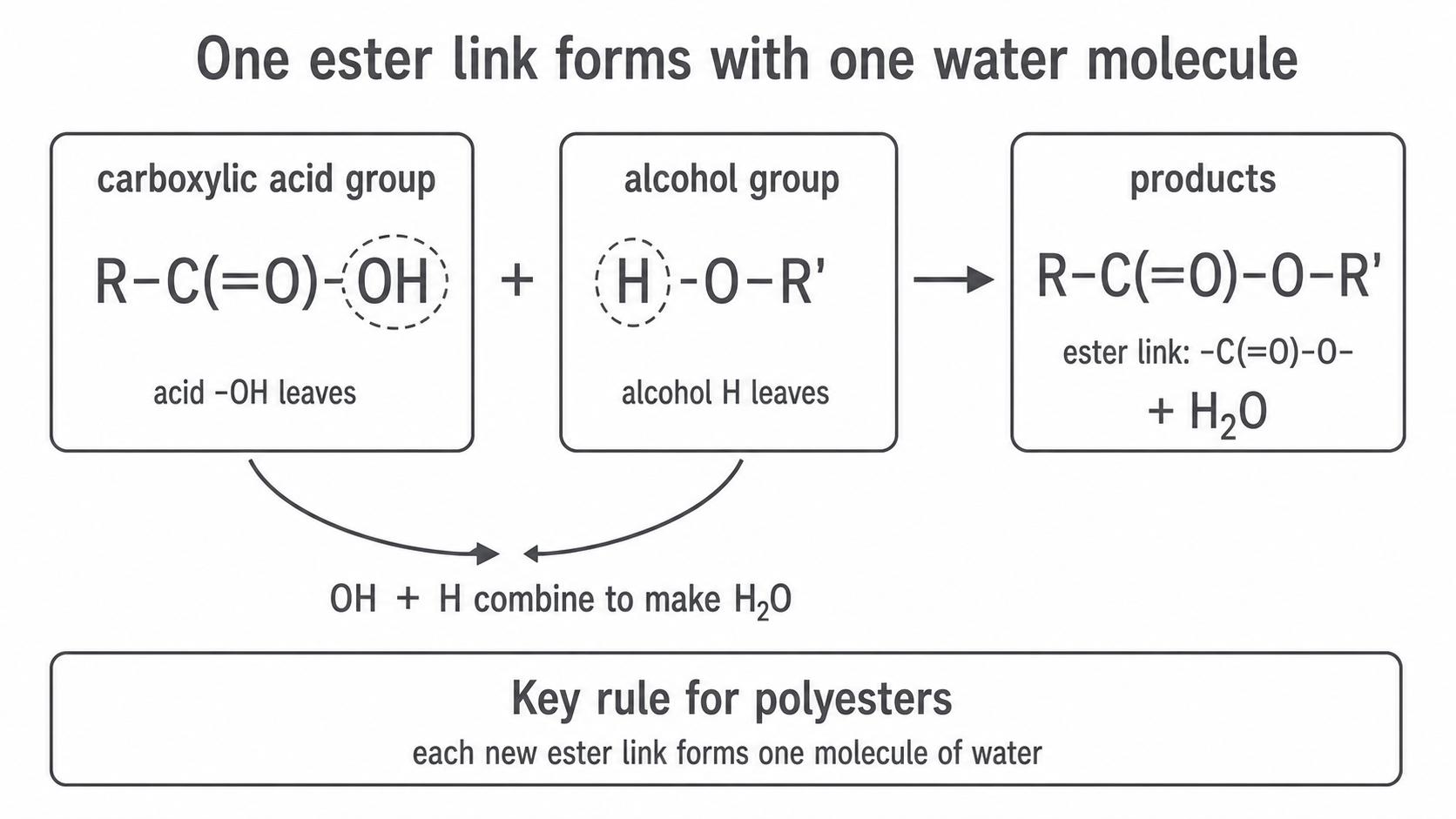
A carboxylic acid group reacts with an alcohol group to form an ester link, , often written .
[DIAGRAM: asset_name: ester_link_water_formation: Ester link and water formation - diagram 1; asset_slug: 226_9_22c_polyesters_as_condensation_polymers_diagram1; file: diagram_assets/226_9_22c_polyesters_as_condensation_polymers_diagram1_imagegen_v1.png; recommended_method: deterministic_drawn; description: Exact monochrome structure diagram showing R-C(=O)-OH reacting with H-O-R' to form R-C(=O)-O-R' plus H2O. The diagram labels the ester link, shows that the acid -OH and alcohol -H make water, and states that one water molecule forms per ester link. Assessed formula-heavy visual, deterministic SVG to PNG, white background with #6A6B6E linework and text.]
Continue this lesson.
You’re previewing NovaLearn without an account. Create a free account to read the rest.
Create free account