7.3 - Reactions occur when particles collide
Learn why collisions are necessary for reactions and how collision frequency and energy affect the number of successful reactions each second.
Collisions and products
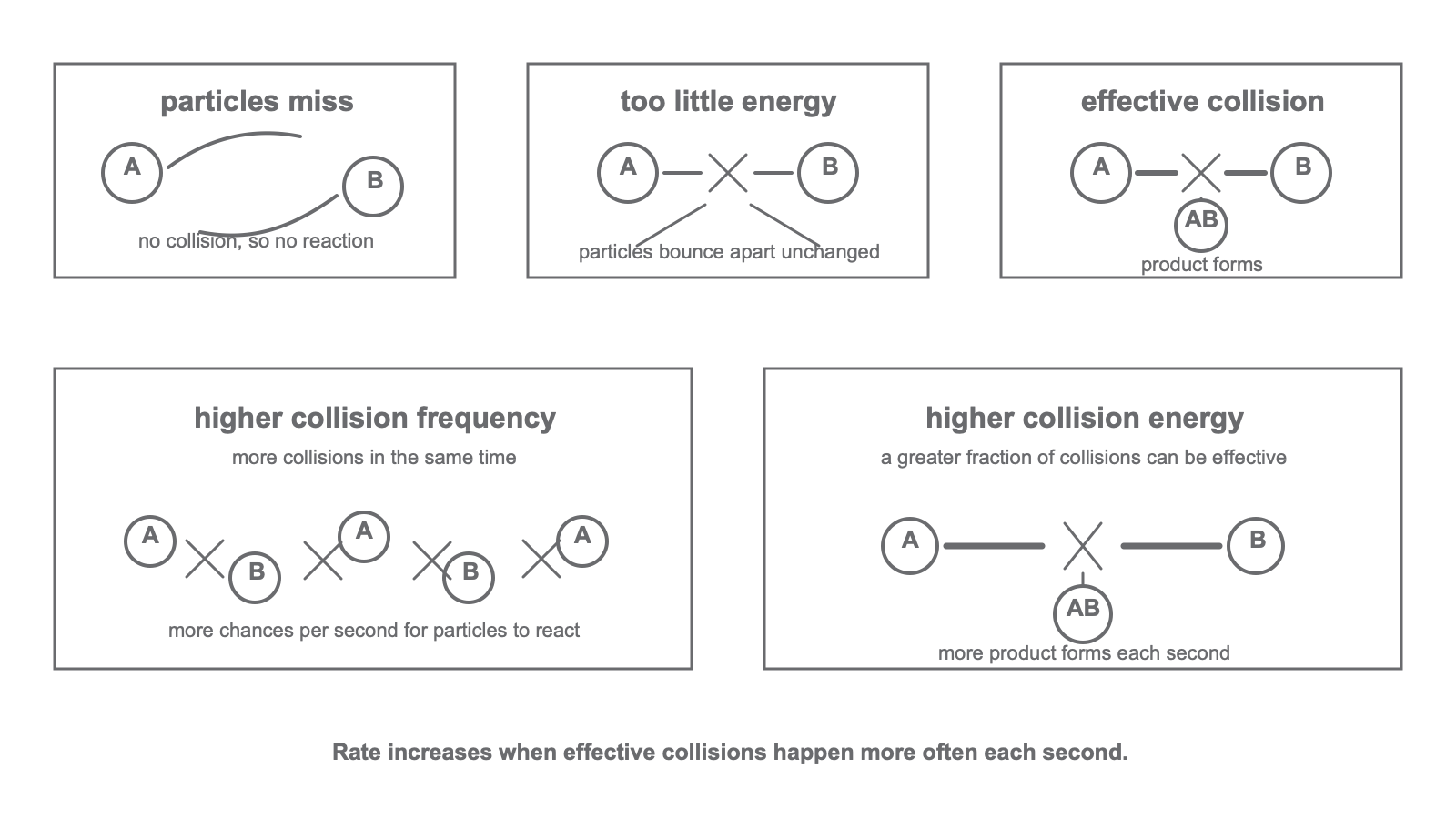
Reacting particles must meet before they can rearrange into products. Collision theory explains reaction rates in terms of these encounters. Some particles miss each other; others collide but separate unchanged. An effective collision forms products.
Colliding particles need enough energy to react. A collision with too little energy cannot overcome the energy barrier. Having particles in the same container therefore does not mean that every encounter makes a product.
[DIAGRAM: asset_name: particle_collision_outcomes: Particle collision outcomes and reaction rate - diagram 1; asset_slug: 165_7_3_reactions_occur_when_particles_collide_and_that_rates_of_reaction_are_incr_diagram1; file: diagram_assets/165_7_3_reactions_occur_when_particles_collide_and_that_rates_of_reaction_are_incr_diagram1.png; recommended_method: deterministic_drawn; description: Monochrome deterministic particle diagram for Edexcel GCSE Chemistry 1CH0 7.3. The visual shows three particle encounters: particles missing so no reaction occurs, particles colliding with too little energy and bouncing apart, and an effective collision forming product AB. A lower row shows that higher collision frequency means more collisions in the same time, and higher collision energy means a greater fraction of collisions can be effective. Labels must use particles A, B and product AB, with particle paths and collision marks in #6A6B6E only. The diagram is exact teaching support because particle labels, collision outcomes and rate wording are assessed content.]
Continue this lesson.
You’re previewing NovaLearn without an account. Create a free account to read the rest.
Create free account