8.10 - Incomplete combustion and appliance safety
Connect incomplete combustion in appliances to the different problems caused by carbon monoxide gas and soot particles.
Two products, different problems
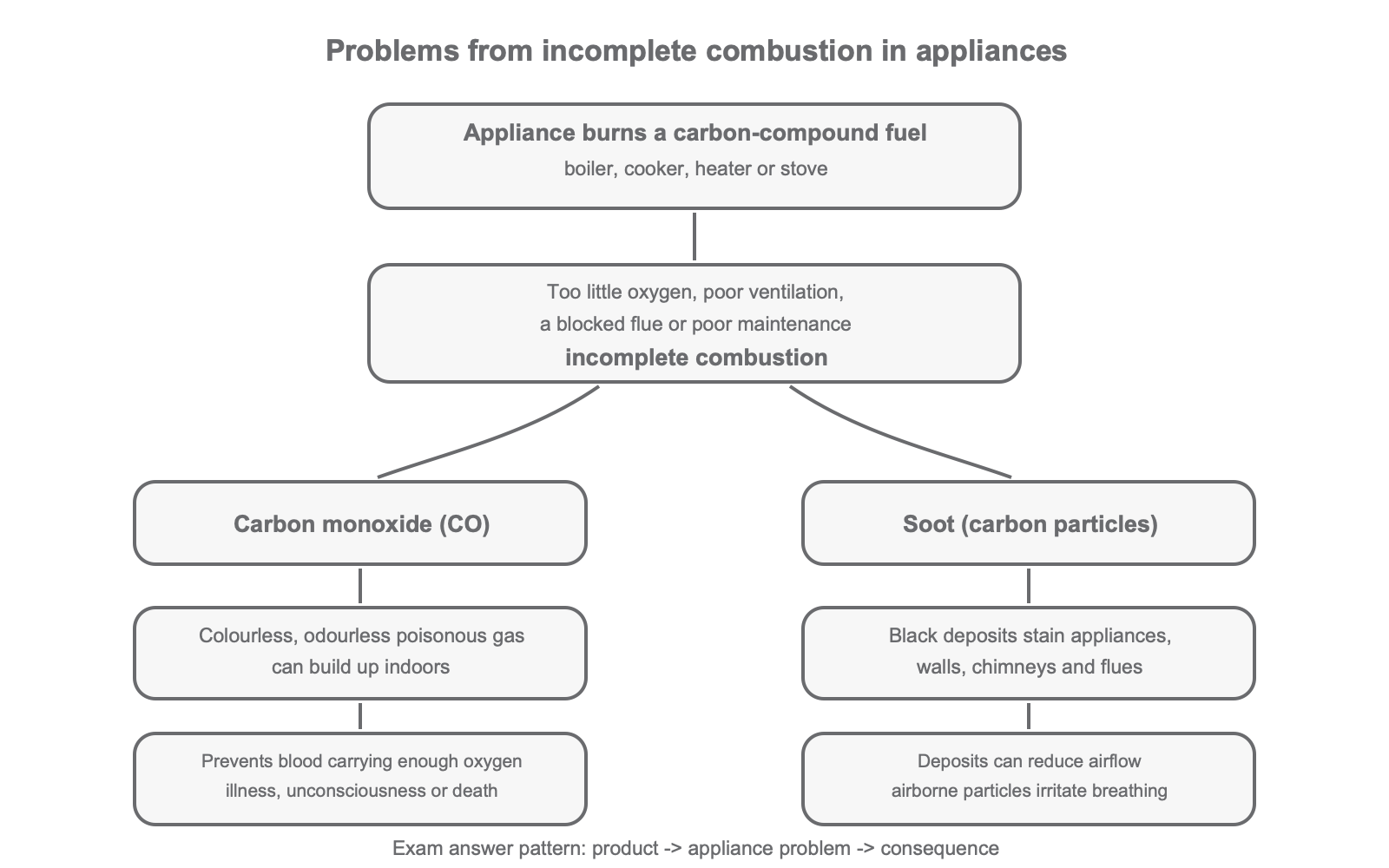
A fuel-burning appliance needs an adequate oxygen supply. A blocked air inlet or faulty burner can cause incomplete combustion. Poor removal of exhaust gases creates another risk: combustion products can build up indoors.
Incomplete combustion can produce carbon monoxide (CO) and soot. They cause different problems:
| Product | Main problems |
|---|---|
| Carbon monoxide | Colourless, odourless gas that can accumulate unnoticed; binds to haemoglobin and reduces oxygen delivery to cells |
| Soot | Fine carbon-rich particles; black staining, deposits that can restrict burners or flues, and harm to breathing if inhaled |
[DIAGRAM: asset_name: appliance_incomplete_combustion_problem_chain: Incomplete combustion in appliances problem chain - diagram 1; asset_slug: 188_8_10_problems_caused_by_incomplete_combustion_producing_carbon_monoxide_and_soo_diagram1; file: 188_8_10_problems_caused_by_incomplete_combustion_producing_carbon_monoxide_and_soo_diagram1.png; recommended_method: deterministic_drawn; description: Exact monochrome flow diagram for Edexcel 8.10 showing an appliance burning a carbon-compound fuel, too little oxygen or poor ventilation causing incomplete combustion, then two branches: carbon monoxide as a colourless, odourless poisonous gas that can build up indoors and prevent blood carrying oxygen, and soot as black carbon particles that stain appliances/flues, reduce airflow, and irritate breathing. Deterministic drawing is used because the labels and cause-effect arrows are assessed content; white background and #6A6B6E linework/text only.]
Continue this lesson.
You’re previewing NovaLearn without an account. Create a free account to read the rest.
Create free account