7.16 - Reading and drawing reaction profiles
Read, label and draw reaction profiles for exothermic and endothermic reactions. Learn to distinguish activation energy from overall energy change, then practise the drawings in an ungraded notebook activity.
What a reaction profile shows
A reaction profile has two axes:
| Axis | Usual label | What it means |
|---|---|---|
| vertical axis | energy (sometimes labelled heat energy) | the relative energy of the reacting chemicals |
| horizontal axis | progress of reaction | the reaction moving from reactants to products |
The horizontal axis is not time. It shows the reaction pathway: reactants on the left, products on the right.
Reaction profile
A reaction profile is a graph that shows the energy changes during a chemical reaction.
Every complete reaction profile for this point needs:
- labelled axes
- reactants shown and labelled on the left
- products shown and labelled on the right
- a curve that rises to a peak before reaching the products
- activation energy identified from the reactants' energy level to the peak of the curve
The peak matters because reactions need energy to start. Even an exothermic reaction, which gives out heat energy overall, still has to climb the energy barrier first.
Comparing exothermic and endothermic profiles
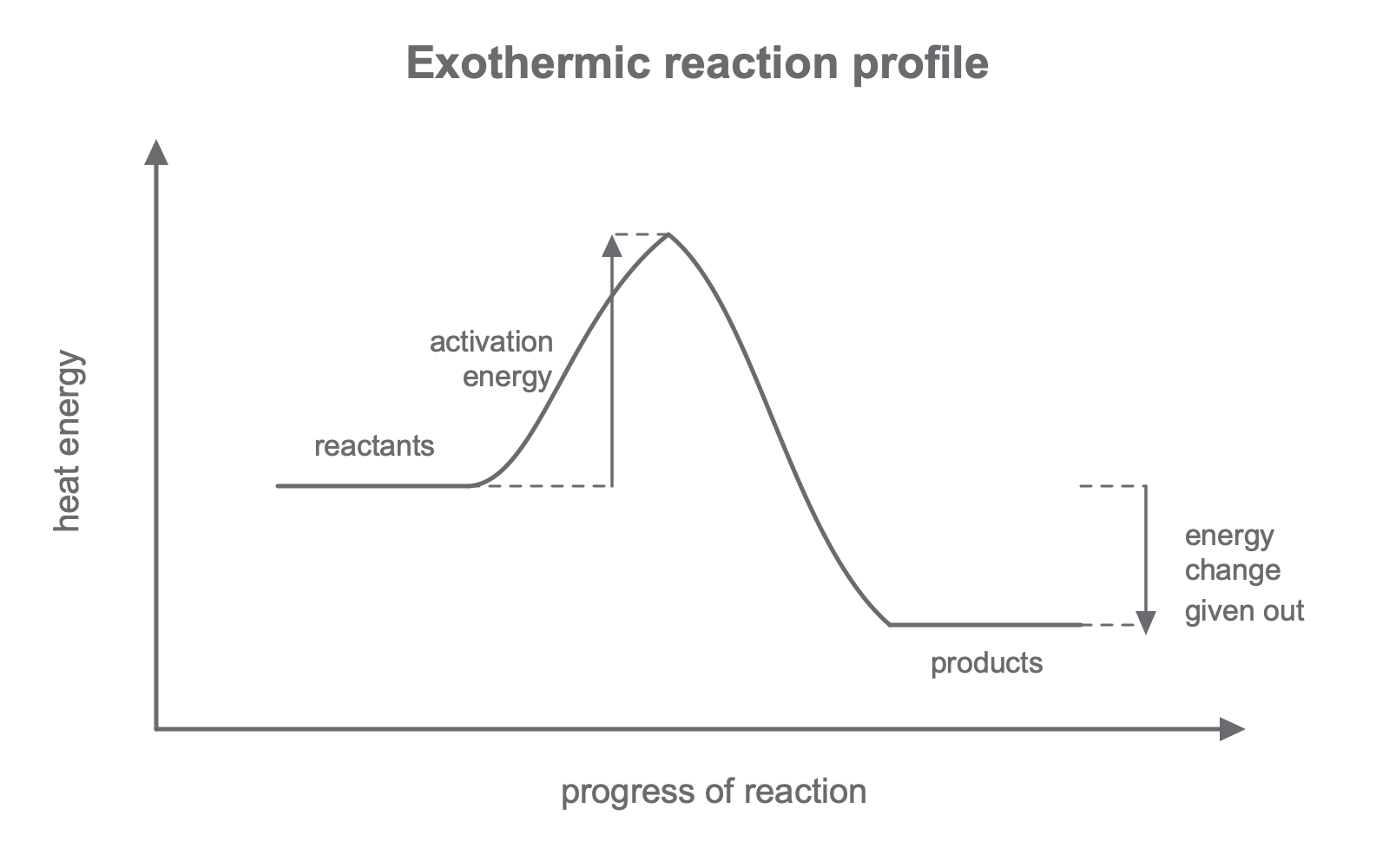
An exothermic reaction gives out heat energy. On a reaction profile, that means the products are at a lower energy level than the reactants.
[DIAGRAM: asset_name: exothermic_reaction_profile: Exothermic reaction profile - diagram 1; asset_slug: 178_7_16_reaction_profiles_for_endothermic_and_exothermic_reactions_diagram1; file: diagram_assets/178_7_16_reaction_profiles_for_endothermic_and_exothermic_reactions_diagram1.png; recommended_method: deterministic_drawn; description: Exact monochrome reaction-profile graph for an exothermic reaction. It has a vertical axis labelled heat energy, a horizontal axis labelled progress of reaction, a reactants level on the left, a products level on the right lower than the reactants, a single curve rising to a peak and falling to products, a vertical activation energy arrow from the reactants energy level to the peak, and a downward energy change arrow from reactants level to products level. Assessed visual because labels, relative levels and arrow positions are Edexcel 7.16 content; deterministic drawing is used for exact geometry and labels.]
The key comparison is:
exothermic profile: products lower than reactants
The overall energy change is shown by the difference between the reactants' level and the products' level. For an exothermic profile, this arrow points down because energy is given out to the surroundings.
Do not make the products higher just because the surroundings get hotter. The profile shows the energy of the chemicals, not the temperature of the surroundings. In an exothermic reaction, the products have less energy than the reactants because some energy has been transferred away.
Endothermic comparison
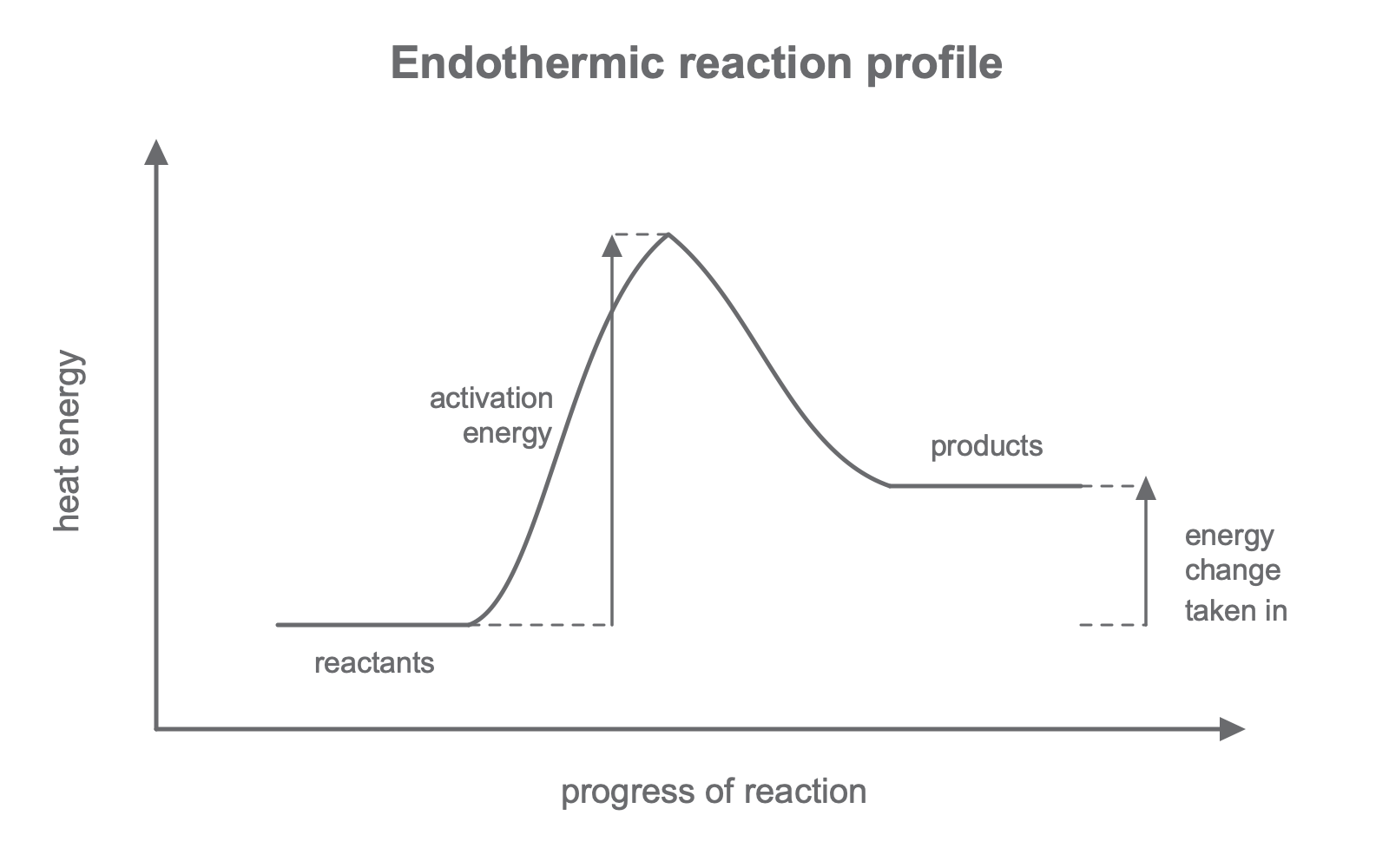
An endothermic reaction takes in heat energy. On a reaction profile, that means the products are at a higher energy level than the reactants.
[DIAGRAM: asset_name: endothermic_reaction_profile: Endothermic reaction profile - diagram 2; asset_slug: 178_7_16_reaction_profiles_for_endothermic_and_exothermic_reactions_diagram2; file: diagram_assets/178_7_16_reaction_profiles_for_endothermic_and_exothermic_reactions_diagram2.png; recommended_method: deterministic_drawn; description: Exact monochrome reaction-profile graph for an endothermic reaction. It has a vertical axis labelled heat energy, a horizontal axis labelled progress of reaction, a reactants level on the left, a products level on the right higher than the reactants, a single curve rising to a peak and falling to products, a vertical activation energy arrow from the reactants energy level to the peak, and an upward energy change arrow from reactants level to products level. Assessed visual because labels, relative levels and arrow positions are Edexcel 7.16 content; deterministic drawing is used for exact geometry and labels.]
Continue this lesson.
You’re previewing NovaLearn without an account. Create a free account to read the rest.
Create free account