3.4 - Hydrogen ion concentration and pH
This Higher-tier lesson connects pH with hydrogen and hydroxide ion concentrations, and explains why the amount of solution is different from its concentration.
Concentration and pH
Ion concentration is the amount of a named ion per unit volume of solution. A larger sample can contain more ions without having a higher concentration: compare equal volumes or compare amount divided by volume.
pH is a scale reading, not an amount or a concentration unit. For solutions at the same temperature:
| Change in ion concentration | Change in pH |
|---|---|
| Higher H⁺ concentration | Lower pH |
| Lower H⁺ concentration | Higher pH |
| Higher OH⁻ concentration | Higher pH |
| Lower OH⁻ concentration | Lower pH |
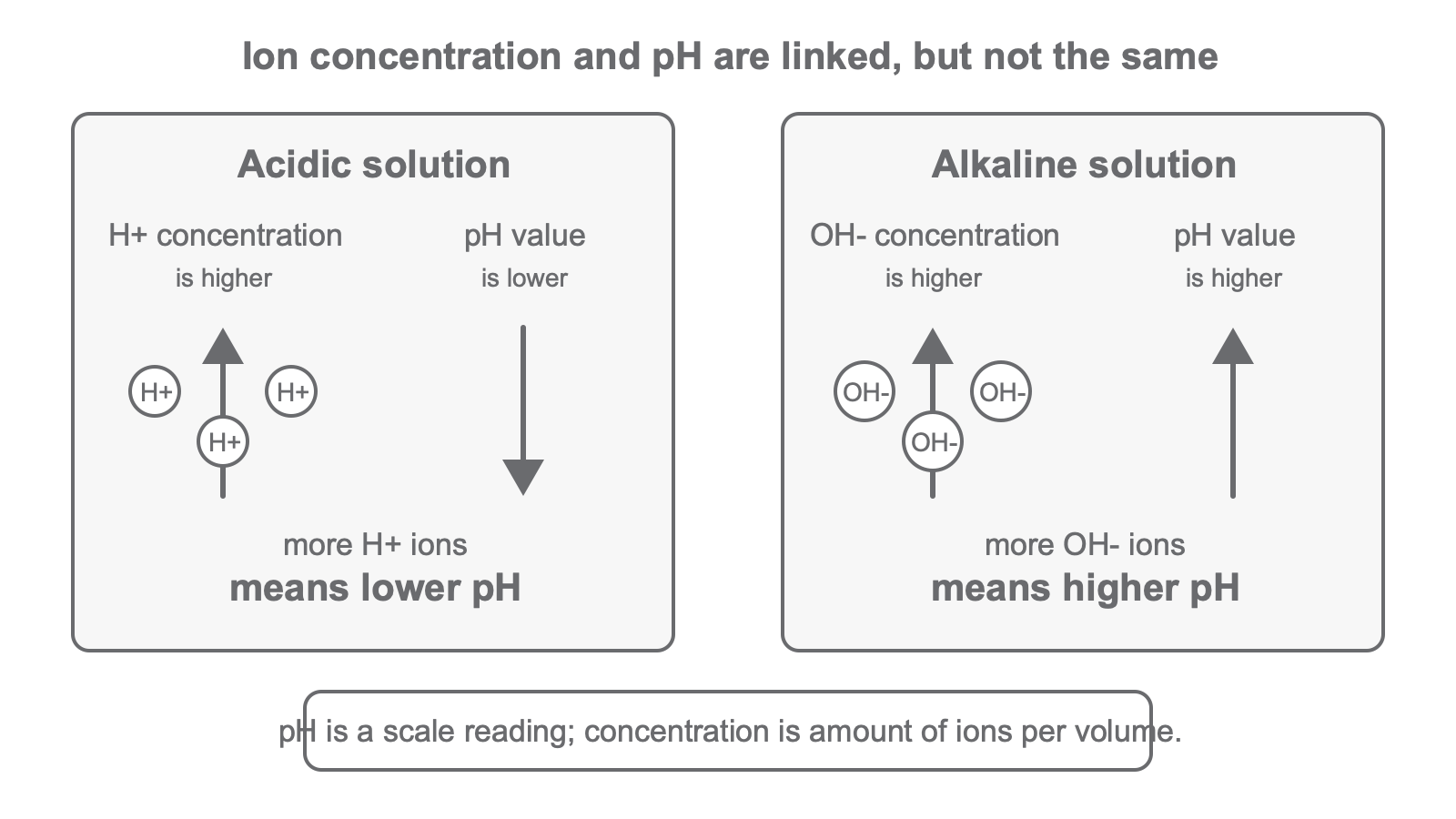
“More ions” in this figure means more of the named ions per unit volume. Both H⁺ and OH⁻ are present in aqueous solutions: acidic solutions have more H⁺ than OH⁻, while alkaline solutions have more OH⁻ than H⁺. Neutral solutions have equal concentrations. At a fixed temperature, increasing one of these concentrations lowers the other. This is why the two rows have opposite directions.
Continue this lesson.
You’re previewing NovaLearn without an account. Create a free account to read the rest.
Create free account