8.17 - Why cracking is necessary
Fractional distillation does not always supply crude-oil products in the proportions people need. Explain how cracking converts surplus larger hydrocarbons into useful fuels and chemical feedstock.
Why separation is not enough
Supply is the amount available; demand is the amount people want to use. Distilling a fixed amount of crude oil separates the hydrocarbons already in it. The resulting proportions depend on the crude oil and may not match demand.
There can be a shortage of smaller hydrocarbon molecules used in high-demand fuels such as petrol, alongside a surplus of larger hydrocarbons in heavier fractions. Heavier fractions still have uses; lower demand does not mean they are useless.
Repeating fractional distillation of the same material cannot turn its larger molecules into smaller ones. Cracking can: it breaks larger alkane molecules into smaller hydrocarbon molecules, including alkenes.
[DIAGRAM: asset_name: cracking_supply_demand_balance: Why cracking is necessary - diagram 1; asset_slug: 195_8_17_cracking_is_necessary_diagram1; file: 195_8_17_cracking_supply_demand_repaired_v2.png; recommended_method: imagegen; description: Supply-demand process diagram: a surplus of larger hydrocarbons and shortage of smaller fuel hydrocarbons can be addressed by cracking, producing smaller fuel molecules and alkene feedstock. No quantitative scale or molecular structures.]
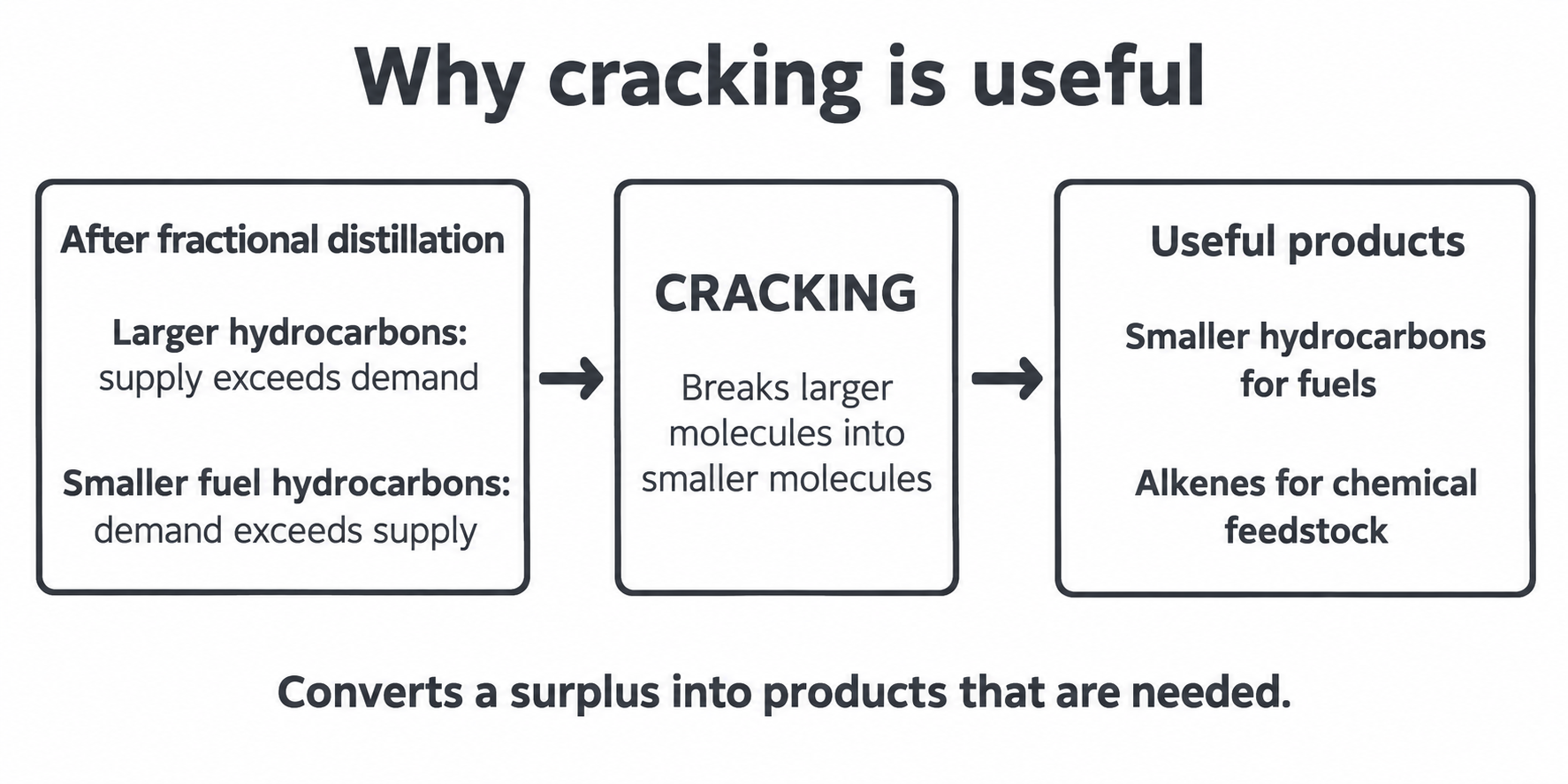
The diagram describes a common mismatch, not an identical supply pattern at every refinery. Cracking helps adjust the product mix, but still requires energy and uses finite fossil feedstock.
Two useful kinds of product
Smaller hydrocarbons can contribute to fuel supplies. 'Smaller' is relative to the large starting molecules; it does not mean only methane or ethane is useful.
Feedstock
A starting material used to make other substances.
Alkenes from cracking are useful chemical feedstock. For example, ethene can be used to make poly(ethene). Cracking therefore helps supply materials as well as fuels. Its value depends on demand for the products, the available feedstock and the cost of processing.
Continue this lesson.
You’re previewing NovaLearn without an account. Create a free account to read the rest.
Create free account