9.35C - The size of nanoparticles
Learn how nanoparticles compare in size with atoms and simple molecules, how to convert nanometres into metres, and how to calculate a diameter ratio.
Separate Chemistry.
Atoms, molecules and the nanoscale
A nanometre (nm) is one billionth of a metre. Nanometres describe lengths such as a particle's diameter.
Nanometres and metres
Multiply a length in nm by to express it in metres.
Nanoparticle
A nanoparticle has a size of about 1–100 nm. For a roughly spherical particle, this usually means its diameter.
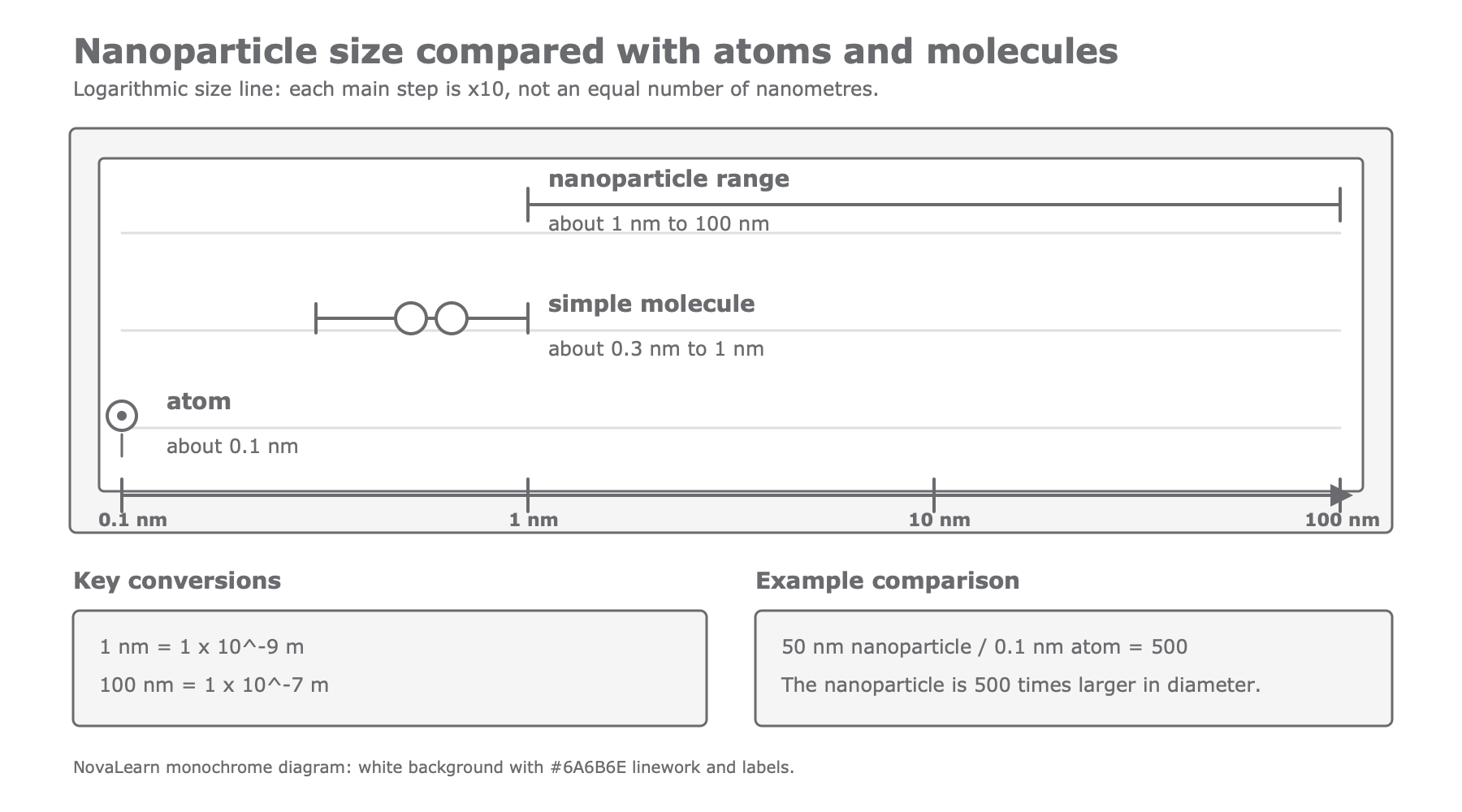
The range is m to m. A typical atom is about 0.1 nm across: smaller than a nanoparticle. A nanoparticle usually contains many atoms.
| Object | Approximate size |
|---|---|
| Typical atom | 0.1 nm |
| Many simple molecules | A few tenths of a nm to about 1 nm |
| Nanoparticle | 1–100 nm |
Simple molecules contain a small number of bonded atoms and are usually smaller than nanoparticles. This is a comparison with simple molecules: large molecules, such as some polymers, can be much bigger.
[DIAGRAM: asset_name: nanoparticle_size_scale: Nanoparticle size scale - diagram 1; asset_slug: 239_9_35c_nanoparticle_size_compared_with_atoms_and_molecules_diagram1; file: 239_9_35c_nanoparticle_size_compared_with_atoms_and_molecules_diagram1.png; recommended_method: deterministic_drawn; description: Exact monochrome logarithmic size line from 0.1 nm to 100 nm. It labels a typical atom at about 0.1 nm, a simple molecule at about 0.3 to 1 nm, and the nanoparticle range at 1 to 100 nm. It also shows the conversion 1 nm = 1 x 10^-9 m and a worked comparison, 50 nm / 0.1 nm = 500 times larger in diameter. Deterministic drawing is required because the scale labels and comparison values are assessed.]
Continue this lesson.
You’re previewing NovaLearn without an account. Create a free account to read the rest.
Create free account