3.15 - Making salts with insoluble reactants
A soluble salt can be made by reacting an acid with an insoluble reactant, then separating the useful salt solution from anything left over. You will connect each separation step to the solubility of the substances present. The important idea is that an insoluble excess solid is easy to remove, while leftover acid would stay dissolved and contaminate the salt solution.
Method overview
This method is used when the salt wanted is soluble in water, but one reactant can be chosen so that it is insoluble. The insoluble reactant may be a suitable metal oxide, metal hydroxide, metal carbonate or metal. Choose one that reacts with the acid to make the required soluble salt; insolubility alone is not enough. Copper metal, for example, does not react with dilute sulfuric acid in this method, whereas copper oxide does. Some acid reactions also produce a gas. After reaction and filtration, the solution should contain only the dissolved salt and water.
The general sequence is:
- Warm dilute acid gently in a beaker.
- Add the insoluble reactant a little at a time, stirring after each addition.
- Keep adding the insoluble reactant until a small amount remains unreacted.
- Filter the mixture to remove the excess solid.
- Evaporate some water from the filtrate, then allow the salt to crystallise.
- Separate and dry the crystals.
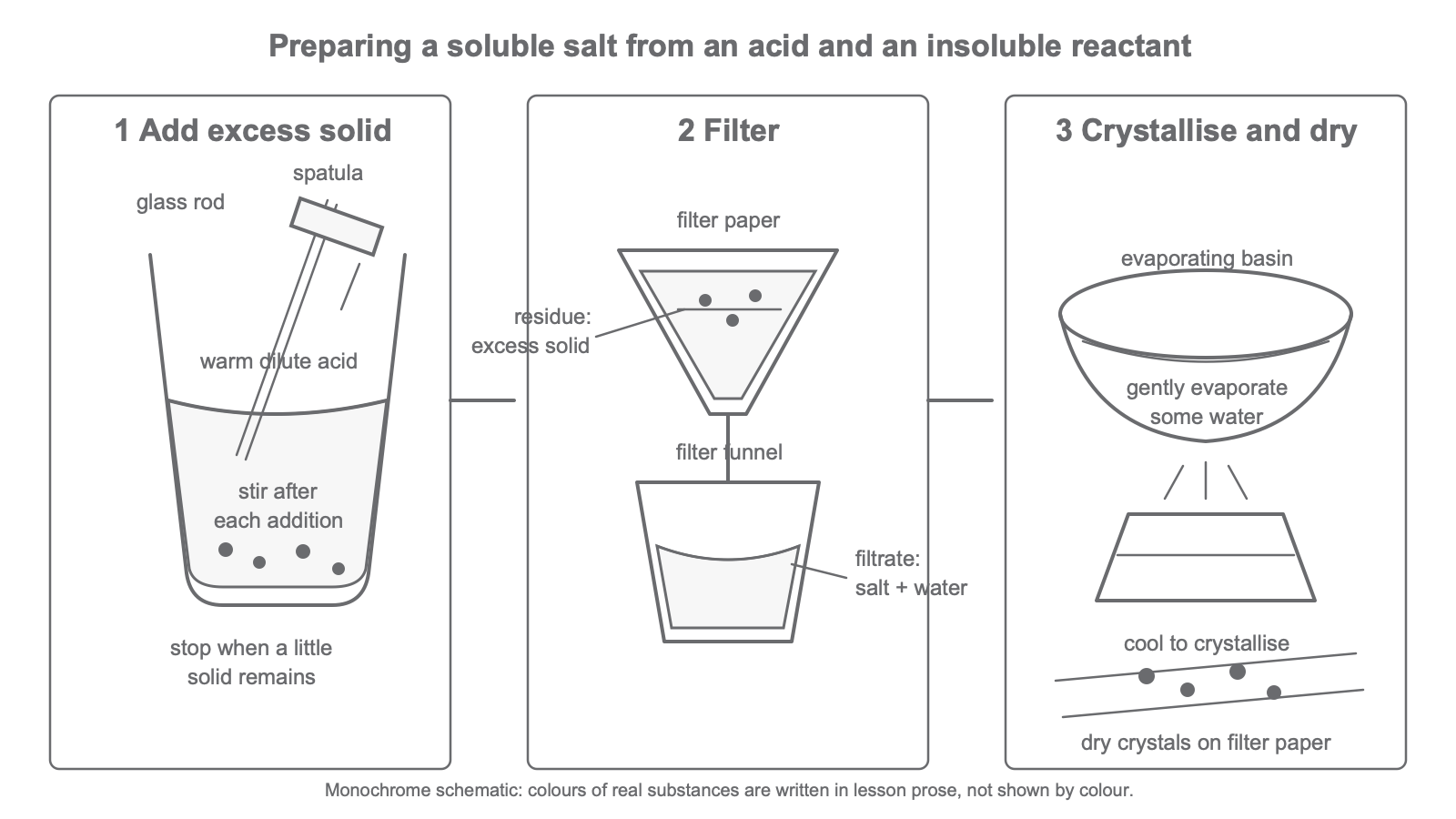
If a metal produces hydrogen, keep naked flames away during the reaction. Use controlled warming only where needed for the chosen reactants.
Why add excess insoluble reactant
The acid is dissolved in water, so any unreacted acid would stay in the solution. You cannot filter out leftover acid. The safer and cleaner plan is to make the acid the limiting reactant by adding more insoluble reactant than is needed.
Excess Reactant
An excess reactant is present in more than the amount needed to react completely with the other reactant.
For this salt-preparation method, the excess reactant is deliberately chosen to be insoluble. That means it does not dissolve into the final salt solution. Once all the acid has reacted, extra solid stays as solid.
The practical sign of excess is usually that a small amount of solid remains even after stirring and gentle warming. If the insoluble reactant is a carbonate or a metal, fizzing may slow and then stop because no acid is left to react with it. The most reliable final sign is still unreacted solid left in the mixture.
Safety is part of the reason. If acid were left over, evaporating water would make that acid more concentrated. Adding excess insoluble reactant reduces that risk because the acid is used up before the solution is concentrated.
Continue this lesson.
You’re previewing NovaLearn without an account. Create a free account to read the rest.
Create free account