9.04c - Area and volume scale factors
A model is twice as tall, twice as wide and twice as deep. Does it hold twice as much? This Higher lesson explains why similar areas use the square of the length factor and similar volumes use its cube. You will use those relationships forwards and backwards, and compare capacity with surface area.
Why areas scale by the square
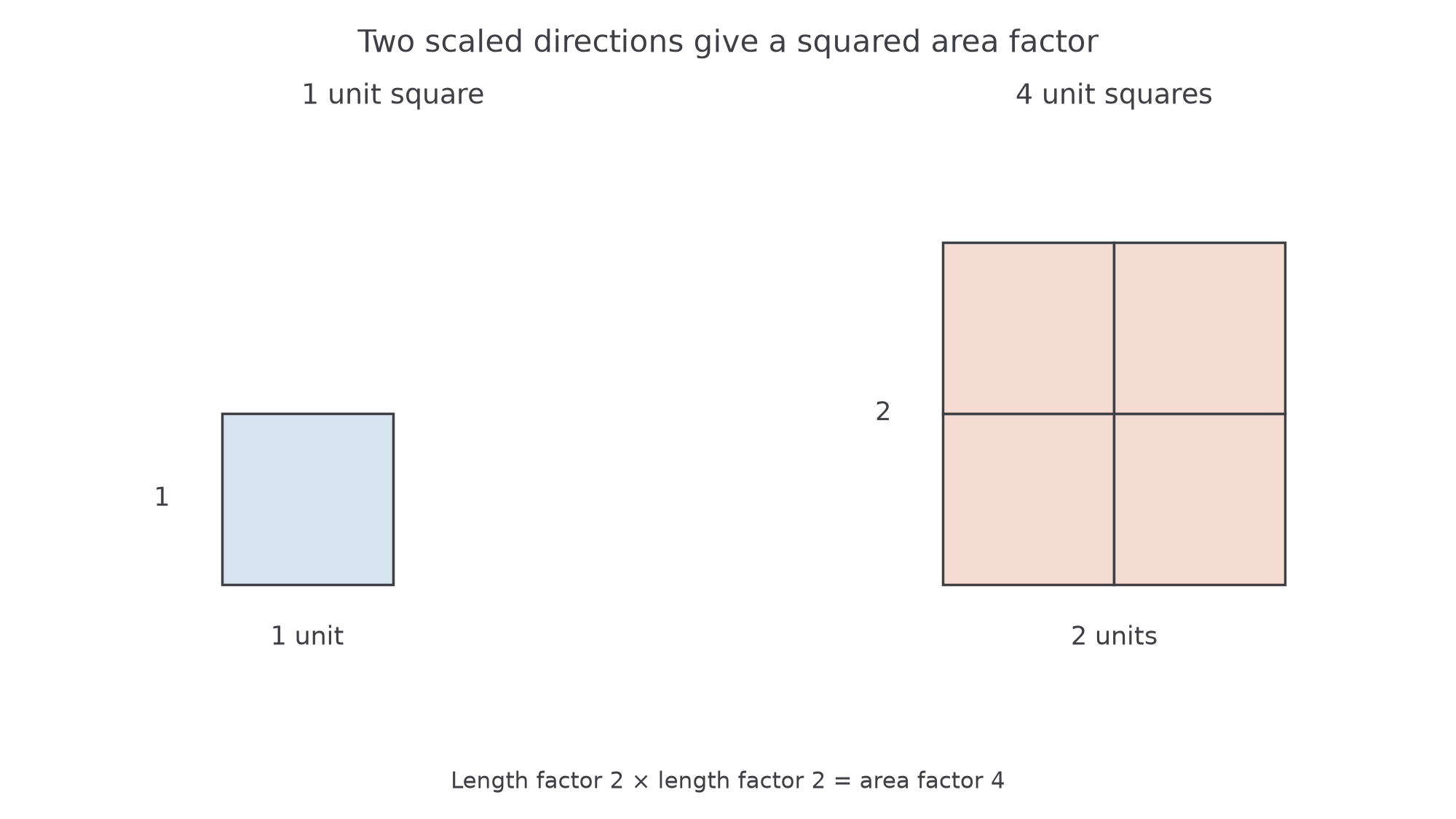
A square of side one contains one unit square. A square of side two contains four, so doubling a length does not merely double an area.
[DIAGRAM: asset_name: Counting squared scale factors; asset_slug: area-square-factor; caption: Doubling each perpendicular direction gives four times as many unit squares.; description: A one-by-one square and a two-by-two square are shown on equal-scale grids. Each unit cell is visible, with one and four unit-square counts. Corresponding horizontal and vertical lengths are labelled one and two, and the length factor two and area factor four are stated.]
For a rectangle of base and height , an enlargement with positive length factor gives base and height . Hence
A triangle behaves the same way: . Splitting polygons into triangles extends the result to their areas. Curved similar shapes obey the same relationship: for a circle, replacing by gives . Surface areas of similar solids also scale by , because every corresponding face or surface patch scales in two directions.
Area scale factor
For similar figures with positive length scale factor ,
The same rule applies to surface areas of similar solids. The similarity condition is essential. This relationship is not supplied on the 2027 formula sheet: learn it.
The word “similar” guarantees that all corresponding lengths share the factor. Doubling only the width of a rectangle while keeping its height fixed doubles its area, but does not give a similar rectangle.
Worked example 1: an increased area
Question. A decorative panel has area . A similar image has length scale factor . Find its area.
Plan. Square the length factor before multiplying the area.
Answer. .
Check. A -by- rectangle has area . Scaling its dimensions by gives -by-, with area , confirming the two-direction multiplication.
Change only the length factor to its reciprocal. A smaller image now has a smaller area factor.
Worked example 2: a decreased area
Question. A panel has area . A similar image has length scale factor . Find its exact area.
Plan. Square the fractional length factor, keeping exact fractions.
Answer. .
Check. The fraction is less than one, so the answer must be below . Reversing by length factor multiplies this area by , recovering .
Length ratios square in the same way: corresponding lengths give areas . Keep the ratio direction consistent.
Watch out
An area factor is not a length factor. Multiplying by would scale only one dimension in the panel calculation, giving the wrong result.
Use another fractional reduction.
Why volumes scale by the cube
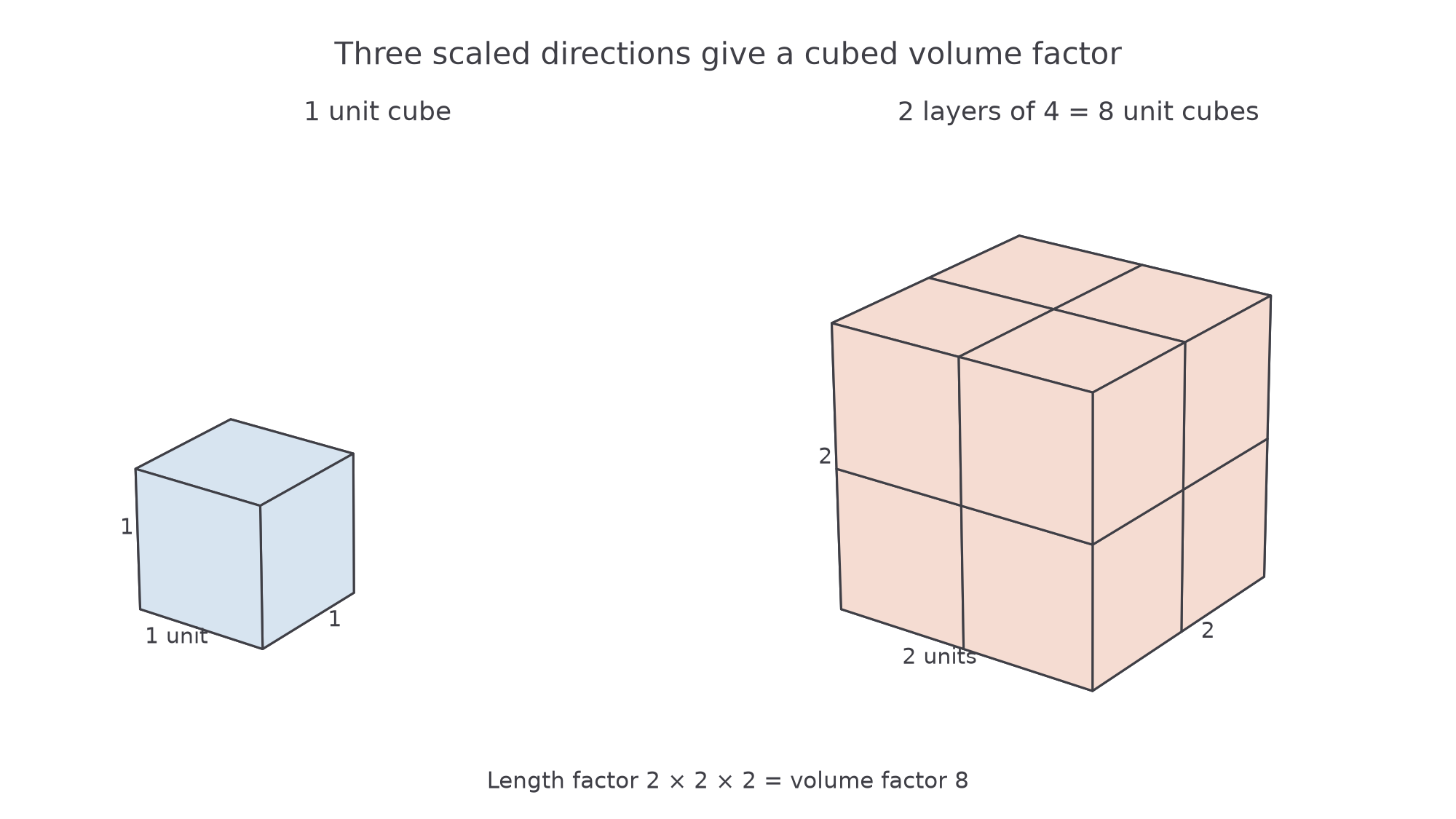
A cube doubled in all directions contains four unit cubes in each horizontal layer and two layers: eight cubes altogether.
[DIAGRAM: asset_name: Counting cubed scale factors; asset_slug: volume-cube-factor; caption: Doubling width and depth gives four cubes per layer, and doubling height gives two layers.; description: A unit cube is compared with a two-by-two-by-two cube assembled from eight visible or indicated unit cubes. All three dimensions are labelled, with two layers of four described. The length factor is two and the volume factor is eight.]
For a cuboid with dimensions , the scaled volume is
For any prism, the cross-sectional area scales by and its length scales by , giving . The same three-direction relationship holds for other similar solids. Similarity includes every relevant dimension: cylinders with doubled radius but unchanged height are not similar cylinders.
Volume scale factor
For similar solids with positive length scale factor ,
Length ratio gives volume ratio . This relationship is not supplied on the 2027 formula sheet: learn it.
Capacity follows internal volume when the internal shapes are similar. Do not assume that a stated outside length factor also scales the inside exactly if wall thickness or internal design changes.
Continue this lesson.
You’re previewing NovaLearn without an account. Create a free account to read the rest.
Create free account