8.01a–8.01c, 8.01e, 8.01f - Geometrical language and measurement
A diagram can communicate a whole set of instructions, provided its labels mean the same thing to everyone. Learn the language for lines, angles and polygons, then use rulers, protractors and compasses to turn a written description into a clear figure.
Points, lines and planes
A carpenter is told, “Put a bar through A and B, then put another bar perpendicular to it.” What information does that give, and what information is still missing?
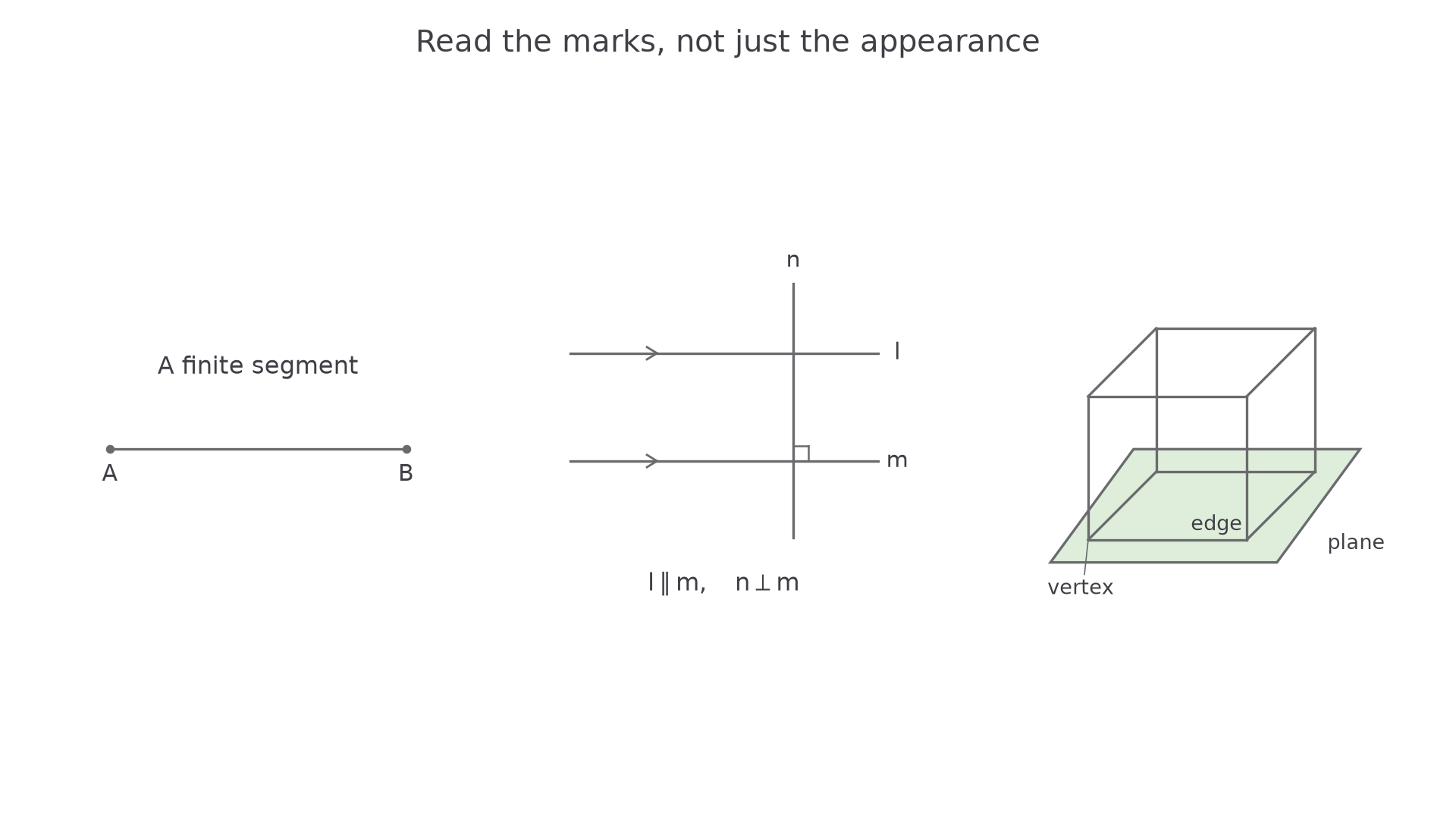
A point gives an exact position and has no size. A dot marks it on a drawing; a capital letter names it. A line segment has two endpoints. Segment AB runs from A to B and has a finite length. A line through A and B continues without end in both directions; the short piece of ink on the page represents that whole line. A ray has one endpoint and continues indefinitely in one direction.
[DIAGRAM: asset_name: Lines and a plane; asset_slug: lines-and-plane; caption: Endpoints, arrows and a right-angle square communicate different facts.; description: Three panels show a finite segment AB, two parallel lines l and m crossed by a perpendicular line n, and a cuboid with a labelled vertex and edge, standing in a pale plane extending beyond its base. Parallel arrows and a right-angle square identify the stated relationships.]
Parallel and perpendicular
Parallel lines lie in the same plane and never meet, however far they are extended. Perpendicular lines meet at a right angle, . A plane is a flat surface extending without end in all directions within that surface.
The face of a tabletop models part of a plane; the plane itself does not stop at the table's edge. In three dimensions, two lines which do not meet need not be parallel: they might lie in different planes. Here, a flat geometry diagram represents one plane unless the question says otherwise.
A vertex is a corner where sides or edges meet; the plural is vertices. In a solid, an edge is a line where two faces meet. A polygon's straight boundary pieces are usually called its sides. Capital letters can name their endpoints: side AB joins vertices A and B.
One arrow on each of two lines marks them as parallel. Matching short ticks on segments mark equal lengths. Different numbers of ticks distinguish different equal-length groups. A small square marks a right angle. These marks are mathematical information; a line merely looking horizontal, equal or perpendicular is not enough.
Key idea
“Through A and B” fixes a line when A and B are distinct. “Perpendicular to AB” fixes a direction, but you still need a point to fix where the new line goes.
Choose the statement which uses the information correctly.
Naming and labelling angles
An angle measures the turn between two rays with a common endpoint, called its vertex. One complete turn is ; a quarter-turn is .
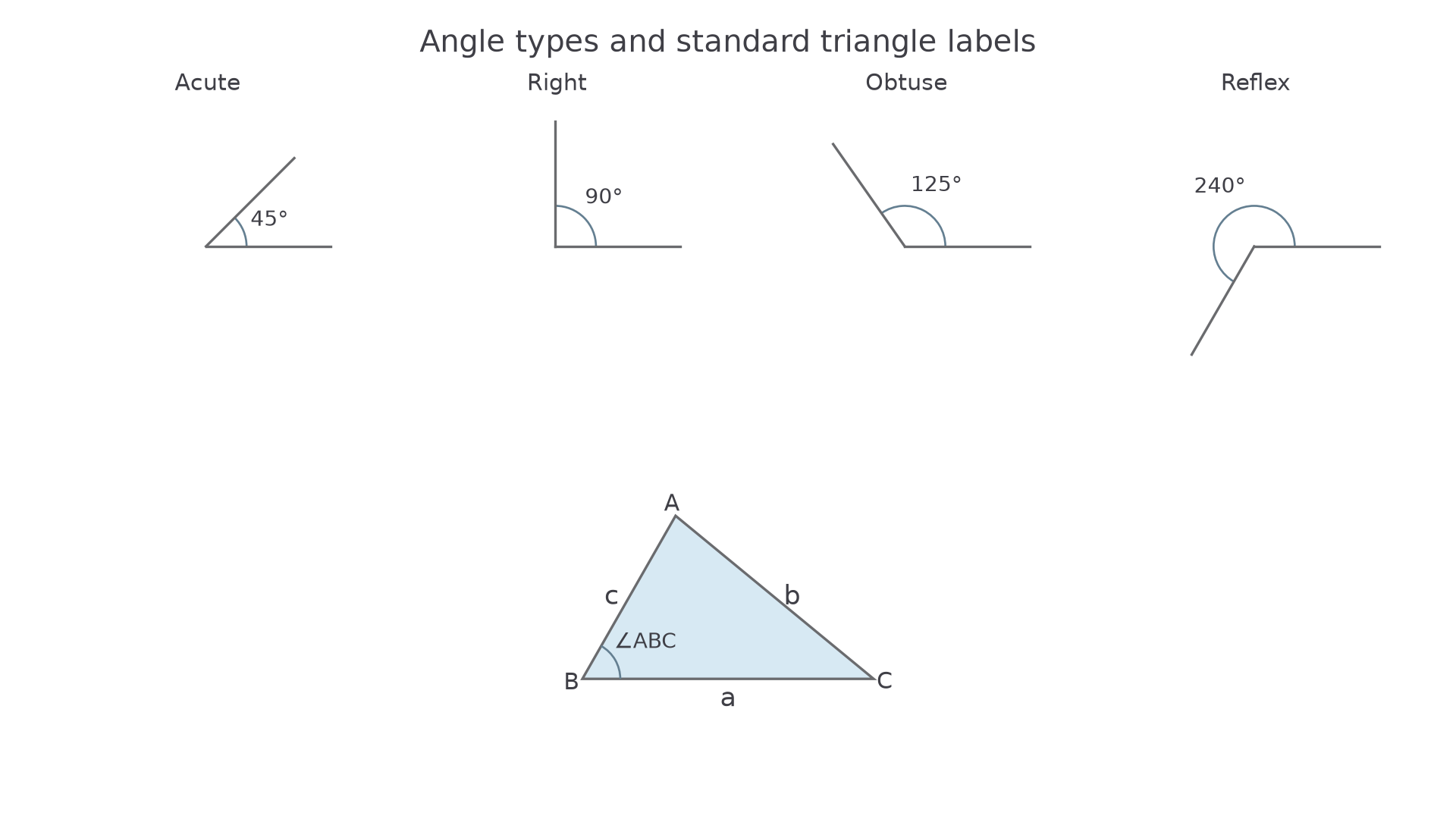
[DIAGRAM: asset_name: Angle names and triangle labels; asset_slug: angle-names-and-labels; caption: The middle letter names an angle's vertex. A side's lower-case letter sits opposite its matching capital.; description: Four small ray diagrams show acute, right, obtuse and reflex angles, with the measured turns highlighted. A separate triangle ABC has side a on BC, side b on AC and side c on AB, and an arc at B.]
Angle types
An acute angle is greater than and less than . A right angle is exactly . An obtuse angle is greater than and less than . A reflex angle is greater than and less than . A straight angle is .
The boundaries matter: is right, not acute or obtuse, and is straight, not reflex. Two rays can describe a smaller angle and the reflex turn the other way. An arc or the wording tells you which is intended.
In , B is the vertex: the angle is between BA and BC. Reversing the outside letters gives the same smaller angle, . Do not move the middle letter. You may write “angle B” if only one angle at B is possible; three letters remove ambiguity when several rays meet there.
In triangle ABC, the standard convention puts side opposite angle A, so . Similarly, and . Upper-case letters name vertices and their angles; lower-case letters name opposite side lengths. A length and an angle are different quantities even when they share a letter's name.
Watch out
In triangle ABC, is at A, and its opposite side is BC. The side AB touches angle A; it is not opposite A.
Read the letters before imagining the picture's orientation.
Naming polygons
A shape's name describes its properties, even when the shape is tilted or stretched on the page.
Polygon
A polygon is a closed, flat shape bounded by straight line segments. Here polygons have non-crossing sides. A regular polygon has all sides equal and all interior angles equal.
A circle is not a polygon because its boundary is curved. An open chain of four segments is not a quadrilateral because it is not closed. Equal sides alone do not make a polygon regular: a sloping rhombus has equal sides but unequal angles.
[DIAGRAM: asset_name: Naming polygon families; asset_slug: polygon-families; caption: Count sides, then use equality and parallel marks to identify special families.; description: A labelled gallery shows scalene, isosceles and equilateral triangles, a square, rectangle, parallelogram, rhombus, kite and trapezium, and a pentagon, hexagon and octagon. Equal-side ticks, parallel arrows and right-angle squares show the defining information rather than relying on orientation.]
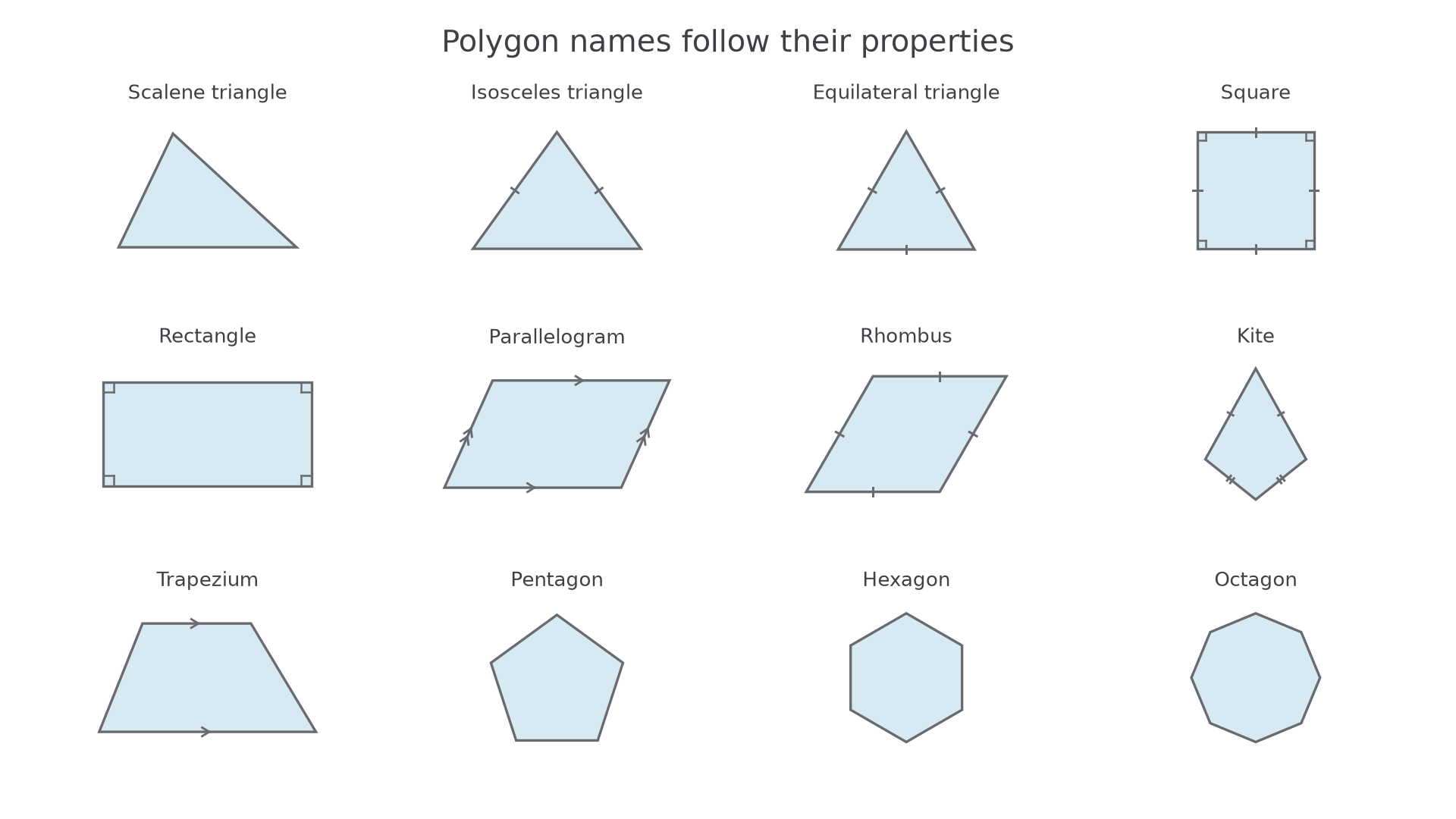
A triangle has three sides. A scalene triangle has three different side lengths; an isosceles triangle has at least two equal sides; an equilateral triangle has three equal sides. Thus an equilateral triangle has the equal-side property of an isosceles triangle too. A right-angled triangle has a right angle: this describes angles rather than side equality, so a triangle can be both right-angled and isosceles.
A quadrilateral has four sides. Learn these descriptions:
| Name | Defining properties |
|---|---|
| Parallelogram | Both pairs of opposite sides are parallel. |
| Rectangle | All four angles are right angles. |
| Rhombus | All four sides are equal. |
| Square | Four equal sides and four right angles. |
| Trapezium | One pair of opposite parallel sides; in this lesson, exactly one pair. |
| Kite | Two pairs of adjacent equal sides; the familiar kite has different lengths in the two pairs. |
A square also satisfies the rectangle, rhombus and parallelogram properties. Names can overlap; “rectangle” does not mean “a shape which cannot be a square”. The properties lesson will examine their angles and diagonals in detail.
For larger polygons, a pentagon has five sides, a hexagon has six and an octagon has eight. These names count sides; they do not imply regularity. For example, an irregular pentagon still has five sides.
Key idea
For a regular polygon you need equal sides and equal angles. A square passes both tests; a non-square rectangle passes only the angle test.
Check both requirements rather than choosing by appearance.
Using geometric instruments
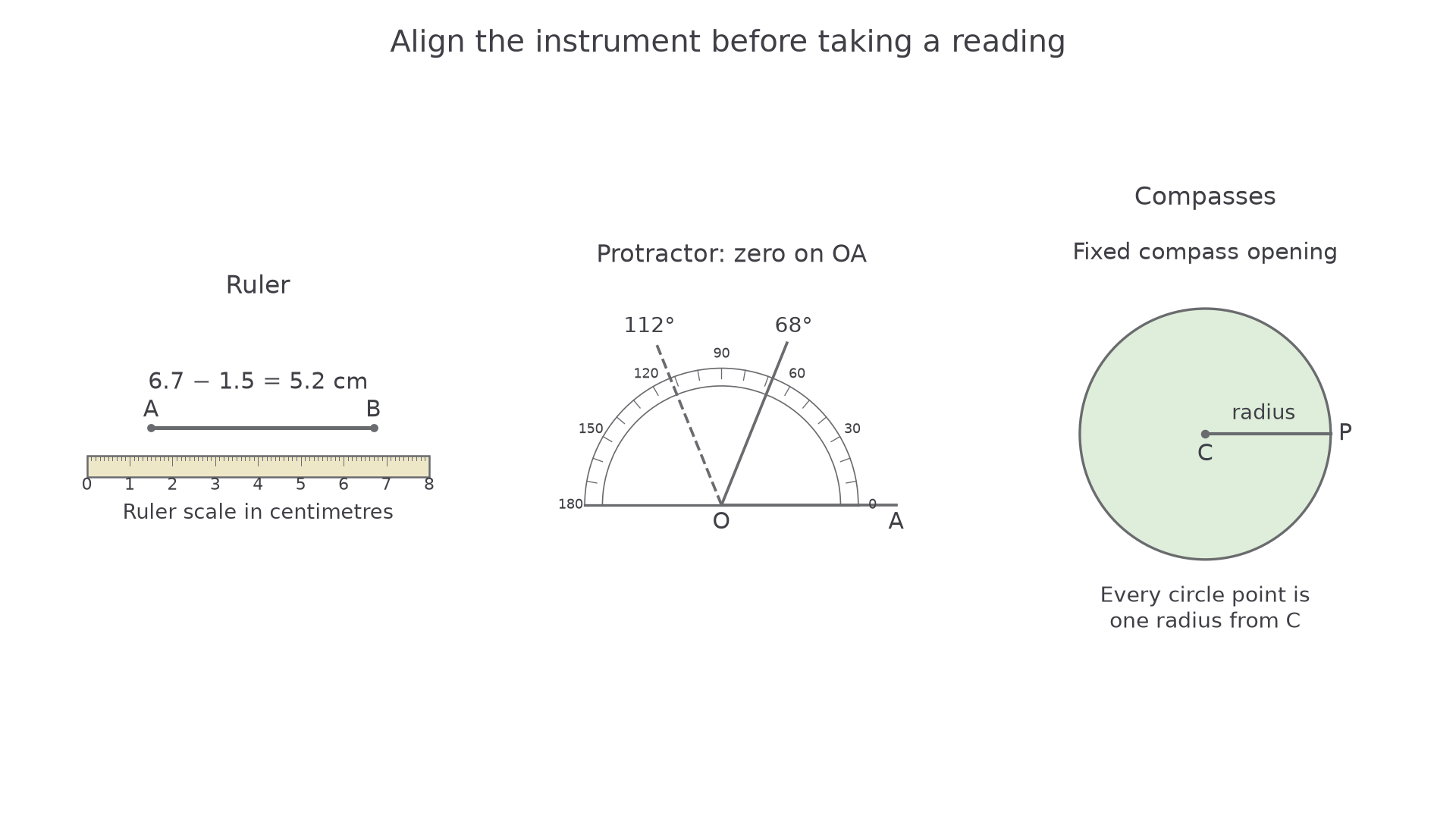
Use each instrument for the information it controls: a ruler for length, a protractor for angle and compasses for a fixed distance from a centre.
To measure a segment, place the ruler's zero mark at one endpoint and read the other endpoint, looking straight down. The physical end of a ruler is not necessarily zero. If zero is damaged or inconvenient, subtract the two readings: endpoints at and are apart. To construct a specified segment, mark its endpoints against the scale, then join them with the ruler.
[DIAGRAM: asset_name: Ruler protractor and compass methods; asset_slug: geometric-instruments; caption: Align the zero, the protractor centre and the compass point before making a mark.; description: Three panels show a ruler with segment endpoints at 1.5 cm and 6.7 cm, a semicircular protractor centred at O with baseline OA and rays at 68 degrees and 112 degrees on the scale starting at zero on the right, and a circle with centre C, a radius CP, and a fixed compass opening.]
Continue this lesson.
You’re previewing NovaLearn without an account. Create a free account to read the rest.
Create free account