9.01d - Combining transformations
Does “flip, then slide” give the same result as “slide, then flip”? In this Higher lesson you will follow sequences of isometries, test whether their order matters and describe an equivalent single move when one exists. You will also distinguish a property that stays unchanged from a point that stays in the same place.
Applying transformations in order
A tile is reflected in the vertical axis, then moved three squares right. Reversing those instructions can send it to a different position.
Call the original shape , the first image , and the final image . The second transformation acts on , not on the original shape again. Work vertex by vertex, recording the intermediate coordinates before the next move.
[DIAGRAM: asset_name: Reversing transformation order; asset_slug: order-of-transformations; caption: Reflect then translate and translate then reflect give different final triangles.; description: Two coordinate panels start with the same triangle at one comma one, two comma one, one comma three. The left panel reflects in the vertical axis and then translates three right. The right panel translates three right and then reflects in the vertical axis. Original, intermediate and final shapes are labelled in each panel.]
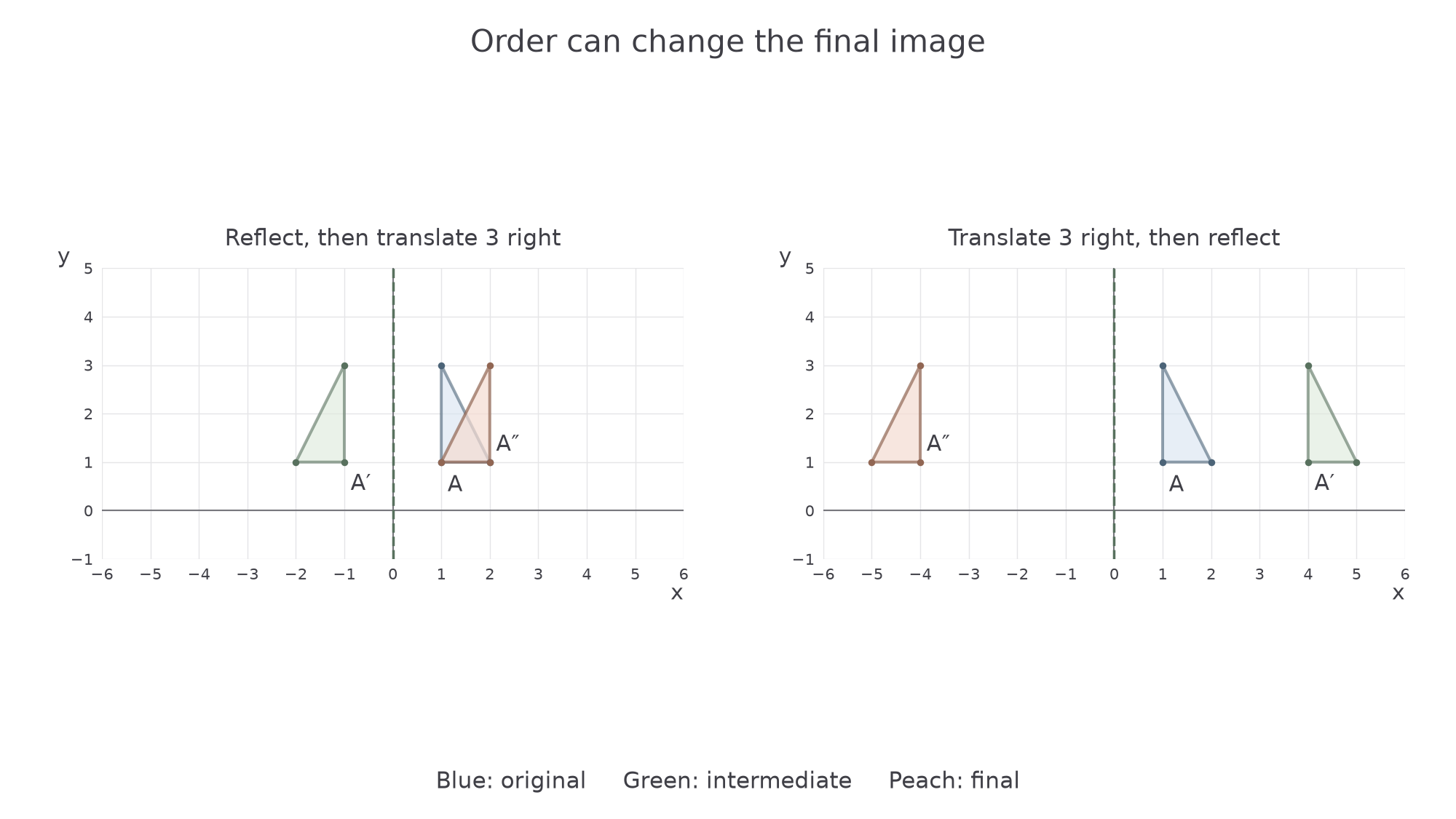
Worked example 1: reflect, then translate
Question. Reflect in , then translate its image by .
Plan. Apply the reflection first and use its output as the starting point for the translation.
Answer. The final image is .
Check. Undo the moves in reverse order: move three left to , then reflect to recover .
Change only the order. Both moves themselves stay the same.
Worked example 2: translate, then reflect
Question. Translate by , then reflect the image in .
Plan. Keep the new intermediate point visible before reflecting it.
Answer. The final image is .
Check. Reflect back to , then move three left to . The final image differs from example 1, proving that these moves do not commute: their order matters.
Some sequences do give the same result in either order. Two translations add their horizontal and vertical components: three right followed by two up is two up followed by three right. Rotations about the same centre add signed angles: take anti-clockwise as positive and clockwise as negative. For instance, anti-clockwise followed by clockwise gives , a clockwise rotation about that same centre. You cannot use this shortcut for different centres.
Watch out
“Followed by” means apply the stated moves from first to last. Transforming the original point twice separately does not produce a sequence.
Try the first order with a new point and vector.
Finding an equivalent transformation
An equivalent single transformation must take every original vertex to the correct final vertex, even though the intermediate journey may be different.
First follow the sequence. Then compare original and final vertices using the reflection, rotation and translation tests you already know. One matching vertex is insufficient: two different transformations can send a particular point to the same destination.
[DIAGRAM: asset_name: Two reflections giving one move; asset_slug: double-reflections; caption: Parallel mirrors produce a translation, while perpendicular mirrors produce a half-turn about their intersection.; description: Two coordinate panels show original, intermediate and final triangles. The first reflects in x equals zero then x equals three. The second reflects in x equals zero then y equals zero, with the origin marked as the half-turn centre.]
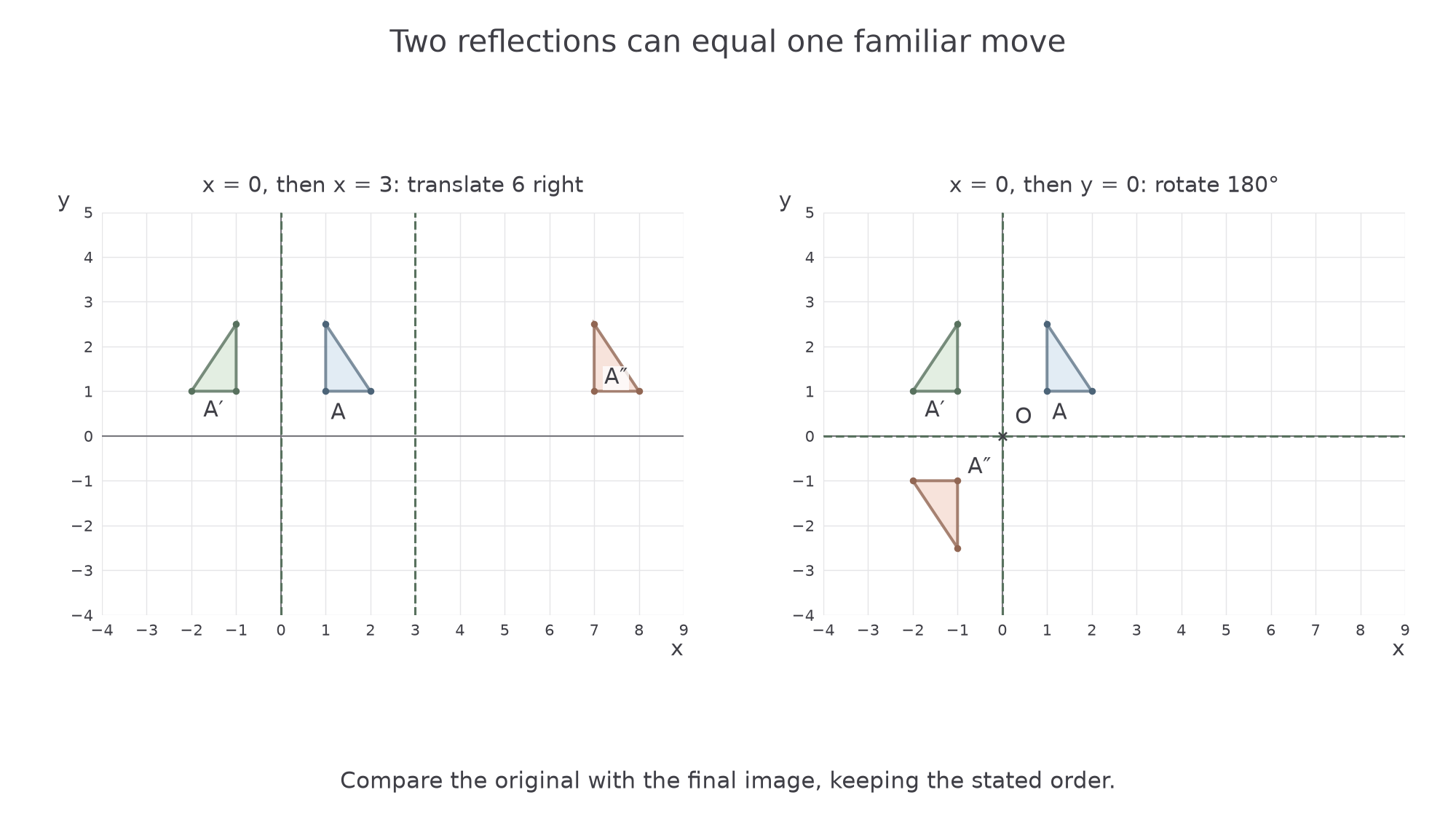
Worked example 3: two parallel mirror lines
Question. A shape is reflected in , then in . Describe the equivalent single transformation.
Plan. Track a general point so the result applies to the whole shape.
Answer. Translation by .
Check. maps to , then , a move six right. The mirror lines are three apart, and the resulting translation is twice that gap in the direction from the first mirror to the second.
Continue this lesson.
You’re previewing NovaLearn without an account. Create a free account to read the rest.
Create free account