12.01a - Populations, samples and bias
Can asking more people make a survey less misleading? You will identify the population a study concerns, select a simple random sample and judge how far sample results support a population conclusion. The selection method matters as well as the number of responses.
Population and sample
Suppose a school wants to know how all its students travel to school. Asking the students at one cycle rack is convenient, but it does not answer the whole school's question fairly. First decide exactly whose journeys the study concerns.
Population and sample
The population is the complete group of people or objects about which a study wants information. A sample is a selected part of that population used to investigate it. A census collects information from every member of the population.
For a study of all 600 registered students, the population is those 600 students, even if only 60 are asked. For a study about Year 10 only, the population is all the Year 10 students; students in other years are outside that particular population. The population depends on the research question, not on who happens to respond.
A population need not contain people. It might be all light bulbs produced by a factory in one day, with a sample of 50 tested for lifetime. A destructive test is one reason a census may be impractical.
[DIAGRAM: asset_name: Population and a selected sample; asset_slug: population-sample-selection; caption: A sample supplies information about a larger target population.; description: A large rectangle labelled population all 600 registered students contains many small dots. Six darker selected dots are linked to a separate box labelled sample 60 selected students. A note says dots are schematic and not one dot per student.]
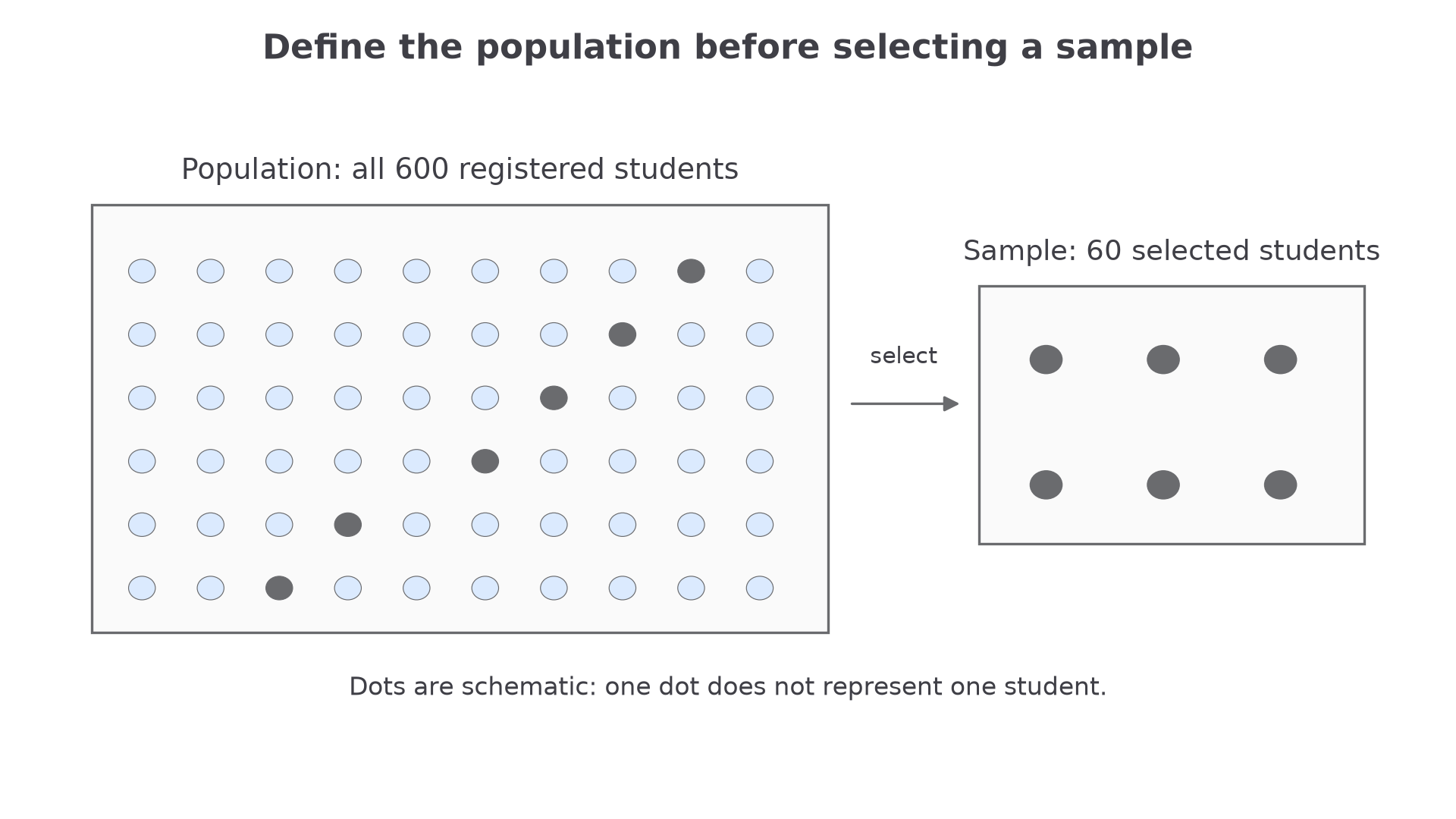
The population should have usable boundaries: location, membership and time period where relevant. “Everyone” is usually too vague. The sampling frame is the list or other practical record used to identify population members. An outdated student roll may omit newcomers, so even a random choice from that list could miss part of the target population.
Key idea
The population is the group you want to learn about. The sample is the group selected for the study. A large sample does not become the population merely because many people reply.
Distinguish these roles in a new context.
Simple random sampling
A choice made casually is not automatically random. Selecting your friends or the first people you notice gives some population members more opportunity to enter the sample. A simple random sample uses a chance procedure applied to the complete population frame.
Simple random sample
For a sample of a fixed size, a simple random sample gives every possible sample of that size an equal chance of selection. In particular, every individual has an equal chance of inclusion. Select distinct members, so choosing one person twice does not fill two sample places.
A practical method is to number all population members once, generate random numbers over those labels, reject numbers outside the range and reject repeats until the required number of distinct labels is reached. The random-number generator must treat all allowed labels equally. Do not replace an inconvenient selected person with a convenient friend; that changes the selection procedure.
Worked example 1: using random labels
Question. There are students on a complete roll. Select a simple random sample of four using these successive three-digit random numbers:
.
Plan. Label the students –, then read the random numbers in order, rejecting invalid labels and repeats.
Answer. Select students .
Check. There are four different valid labels. The procedure treats every valid label in the same way; the numbers do not depend on students' characteristics.
Change only the population size to 320 and keep the same random sequence. The label 287 is now valid, so we reach four selections earlier.
Worked example 2: changing the valid range
Question. Use the same sequence to select four students from a complete roll of .
Plan. Label students –, retaining the rejection rules for zero and repeats.
Answer. Select ; stop before using .
Check. All four labels are between and , with no duplicate. Stopping at the required size prevents the sequence from selecting an extra student.
Drawing four thoroughly mixed, otherwise identical labelled slips without replacement is another valid procedure. Choosing every tenth name from a fixed alphabetical list is a different sampling method; it is not automatically a simple random sample. Also, random selection does not guarantee a sample with exactly the population's proportions of every characteristic.
Continue this lesson.
You’re previewing NovaLearn without an account. Create a free account to read the rest.
Create free account