2.03c - Percentage change and original values
A price has been reduced by . Can you recover the old price by adding to the sale price? Learn to increase and decrease amounts, represent changes with multipliers and reverse a percentage change by finding the original whole.
Increasing and decreasing amounts
A coat costs after a reduction. Would adding recover its original price? Keep this question in mind: the answer depends on which price represents .
Start with a known original price. A increase means add of that original amount; a decrease means subtract the same share. Calculate the change before combining it with the starting amount.
Percentage increase and decrease
A percentage increase adds a stated percentage of the original amount. A percentage decrease subtracts a stated percentage of the original amount. For a positive original price, a decrease leaves zero; a decrease above would give a negative result and would not describe an ordinary sale price.
The original amount, not the final one, is the reference for the stated change.
Worked example 1: increasing a price
Question. Increase by .
Plan. Find of , then add it.
Answer. .
Check. The change is , and .
Change only the direction of the change. The percentage amount is still , but now it is taken away.
Worked example 2: decreasing a price
Question. Decrease by .
Plan. Use the same share and subtract it from the original price.
Answer. .
Check. , and the missing is of .
An increase can exceed : a increase adds more than the original amount, leaving of it. This is different from “becomes of the original”, which means a increase.
Watch out
of is , but the decreased price is . Read whether the question asks for the change or the amount after the change.
Keep the percentage and direction, but change the starting amount.
Percentage multipliers
A multiplier combines finding the change and adding or subtracting it into one multiplication.
For a decrease, remains. So multiplying by gives the final amount directly. A increase leaves , giving multiplier . This works because the original amount is one whole copy of itself.
Percentage multipliers
For an original amount and percentage number ,
For ordinary non-negative price reductions, . Not in the 2027 formula sheet: learn these single-change multipliers.
Use a fraction instead of a decimal when it makes the arithmetic easier.
Worked example 3: an increase multiplier
Question. Increase by , using a multiplier.
Plan. Convert the final percentage to a decimal or fraction.
Answer. .
Check. The rise is , which is of , or .
Change only the direction. Subtracting the same percentage makes the multiplier less than one.
Worked example 4: a decrease multiplier
Question. Decrease by , using a multiplier.
Plan. Convert the remaining percentage to a multiplier.
Answer. .
Check. , and , the stated fractional decrease.
You can also read the change from a multiplier. means an increase; means an decrease. For two known positive amounts, divide final by original to obtain the multiplier. For example, , so the decrease is . Equivalently, divide the size of the change by the original and multiply by .
Watch out
The multiplier for a decrease is , not . The latter finds only the amount removed.
Use the same fraction multiplier with a new original amount.
Finding the original amount
To reverse a percentage change, divide the final amount by the multiplier that produced it.
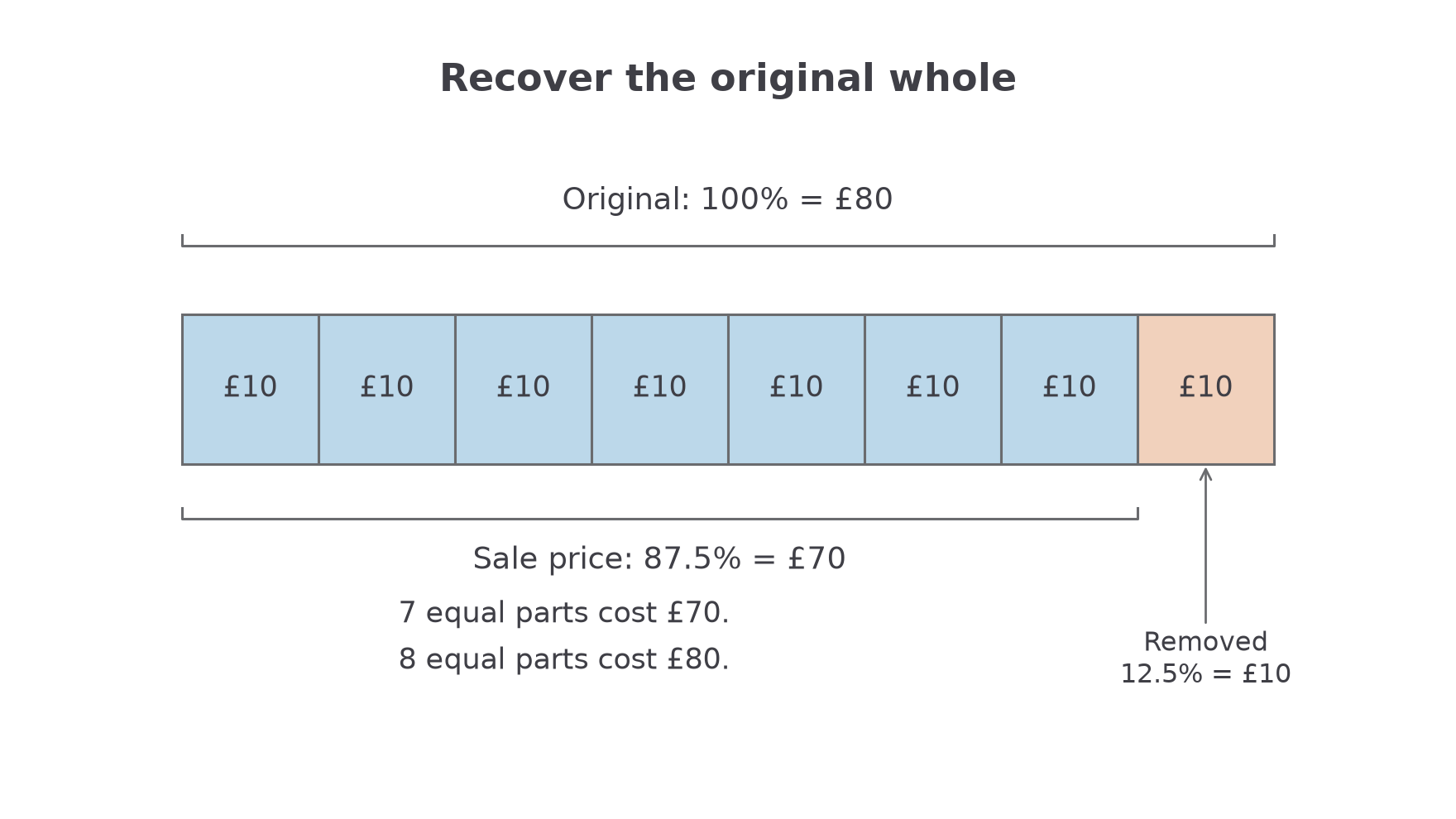
Return to the coat costing after a reduction. The represents , or seven eighths, of the old price. Dividing it into seven equal parts gives one eighth of the old price; taking eight such parts recovers the whole.
[DIAGRAM: asset_name: Recovering the original price; asset_slug: reverse-percentage-bar; caption: The sale price is seven eighths of the original, so each eighth is ten pounds.; description: An eight-cell horizontal bar. Seven equal pale blue cells represent the final 87.5 percent price of 70 pounds and the remaining pale peach cell represents the removed 12.5 percent. Each cell is labelled 10 pounds. A bracket across all eight cells identifies the original 100 percent price of 80 pounds.]
Reversing a percentage multiplier
The multiplier must be nonzero. A decrease gives zero whatever the original amount, so the original cannot be recovered from that final zero alone. Not in the 2027 formula sheet: learn it.
For a positive final amount and a multiplier between zero and one, dividing by the multiplier makes the amount larger, as an original sale price should be.
Worked example 5: reversing a decrease
Question. A coat costs after a reduction. Find its original price.
Plan. Divide the sale price by .
Answer. .
Check. . Applying the original reduction returns the given sale price.
Keep the final price at and change only the direction of the original change. We now reverse an increase, so the original amount must be smaller than the final amount.
Worked example 6: reversing an increase
Question. A coat costs after a increase. Find its original price.
Plan. The final price is , so divide by .
Answer. .
Check. , and is smaller than the increased .
The opening proposal fails because the percentage would use a different whole. Adding of gives , not . The reduction was of the old price, which was larger. The inverse of multiplying by is dividing by , not multiplying by .
Watch out
For an original-value question, first label the percentage represented by the given final amount. Do not automatically treat the given number as .
Reverse an increase with a new final price.
Quick Recap
- Calculate a percentage change from the original amount.
- An increase uses multiplier ; a decrease uses .
- Reverse a nonzero multiplier by division to recover the original whole.
- Equal percentage rises and falls are measured from their own starting amounts, so they do not generally undo each other.
The coat's original price was : divide by , rather than adding of the sale price.