5.02b - Inverse proportion
Learn why sharing a fixed task between more identical workers can reduce the time, and express that relationship as a constant product. You will use inverse-proportion equations and identify the conditions that make them suitable.
Keeping a product fixed
Can twice as many pumps empty a tank in half the time? Yes, if the tank holds the same amount, every pump works at the same constant rate, and using more pumps does not reduce each pump's output.
Imagine four identical pumps working for three hours. That is twelve pump-hours of work: . Six pumps could provide the same twelve pump-hours in two hours. The number of pumps increases, but the time decreases by the reciprocal factor.
Inverse proportion
Two quantities are in inverse proportion when their product is constant. Multiplying one nonzero quantity by a nonzero factor divides the other by that factor. In a positive-quantity context, doubling one halves the other.
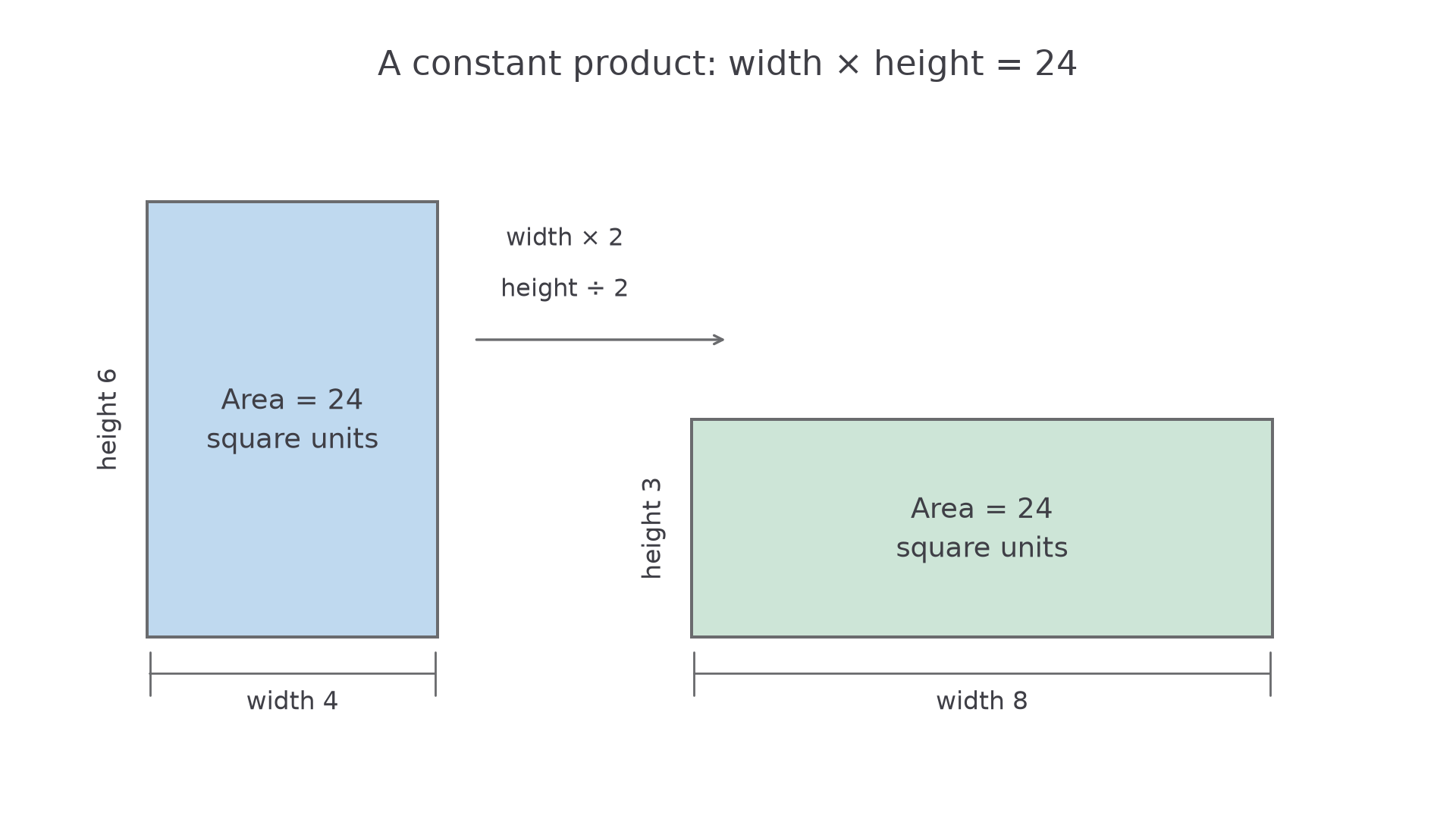
The picture represents a fixed total of 24 units. Changing the rectangle's width changes its height, while the product stays 24. This is the same arithmetic as sharing a fixed amount of work.
[DIAGRAM: asset_name: Rectangles with a constant product; asset_slug: inverse-constant-product; caption: Doubling one factor halves the other when their product stays fixed.; description: Two accurately scaled rectangles drawn on the same scale. The left rectangle is four units wide and six units high. The right is eight units wide and three units high. Each has an area label of twenty-four square units, and a central label states width times height equals twenty-four.]
Worked example 1: fewer pumps
Question. Six identical pumps empty a tank in 10 hours. Four pumps are used instead, under the same constant-rate conditions. How long will they take?
Plan. Find the fixed number of pump-hours, then share it between four pumps.
Answer. 15 hours.
Check. Four is of six, so the time should be multiplied by . Indeed, .
Change only the number of pumps to a larger value. The total work remains fixed.
Worked example 2: more pumps
Question. Six identical pumps empty the same tank in 10 hours. How long would 12 pumps take under the same constant-rate conditions?
Plan. Divide the fixed 60 pump-hours by the new number of pumps.
Answer. 5 hours.
Check. The pump number doubled and the time halved; pump-hours.
People are not automatically identical pumps. A claim about workers needs assumptions about equal rates, sharing the task and no delay caused by crowding. A fixed set-up time would also need separate treatment.
Watch out
The line scales the time in the same direction as the pump number. It would make more pumps take longer. Keep fixed instead.
Apply the same constant-work reasoning to a fresh task.
The equation of inverse proportion
A fixed product can be written algebraically, so you can find either of the two quantities.
If , divide by nonzero to obtain . Conversely, multiplying by gives . These are two forms of the same relationship, with the constant of proportionality.
Inverse proportion
Find using a known pair. These proportionality equations are not supplied on the 2027 formula sheets. Positive contexts such as speeds and times also require positive values; pure algebra may use negative nonzero inputs.
At , division is undefined. In the pump model, zero pumps do not give a very large finite completion time: the task is never completed by those pumps. Do not insert zero into the formula.
Worked example 3: finding an output
Question. is inversely proportional to . When , . Find when .
Plan. Find the product , then divide it by the new input.
Answer. .
Check. The input is four times as large, so the output is one quarter of 10. Also, .
Continue this lesson.
You’re previewing NovaLearn without an account. Create a free account to read the rest.
Create free account