9.02a, 9.02b - Congruent triangles
Two triangles can match exactly even when one is turned over or points in a different direction. Match their vertices correctly, use the four congruence tests, and transfer equal lengths and angles only after you have justified the match.
Matching congruent triangles
Two triangular support plates have sides , and , but one is upside down. Are they still the same shape and size? Their orientation is less important than which sides and vertices correspond.
Congruence
Two shapes are congruent if one fits exactly onto the other, allowing a move, a turn or a reflection. Corresponding lengths and angles are equal. Enlarging a shape changes its size, so does not generally give a congruent shape.
[DIAGRAM: asset_name: Matching rotated triangles; asset_slug: corresponding-triangles; caption: Match the side lengths meeting at each vertex rather than choosing the nearest-looking corner.; description: Two congruent scalene triangles ABC and QRP are drawn in different orientations. AB and QR have length 4 cm, BC and RP have length 6 cm, and AC and QP have length 7 cm. All vertices and lengths are clearly labelled.]
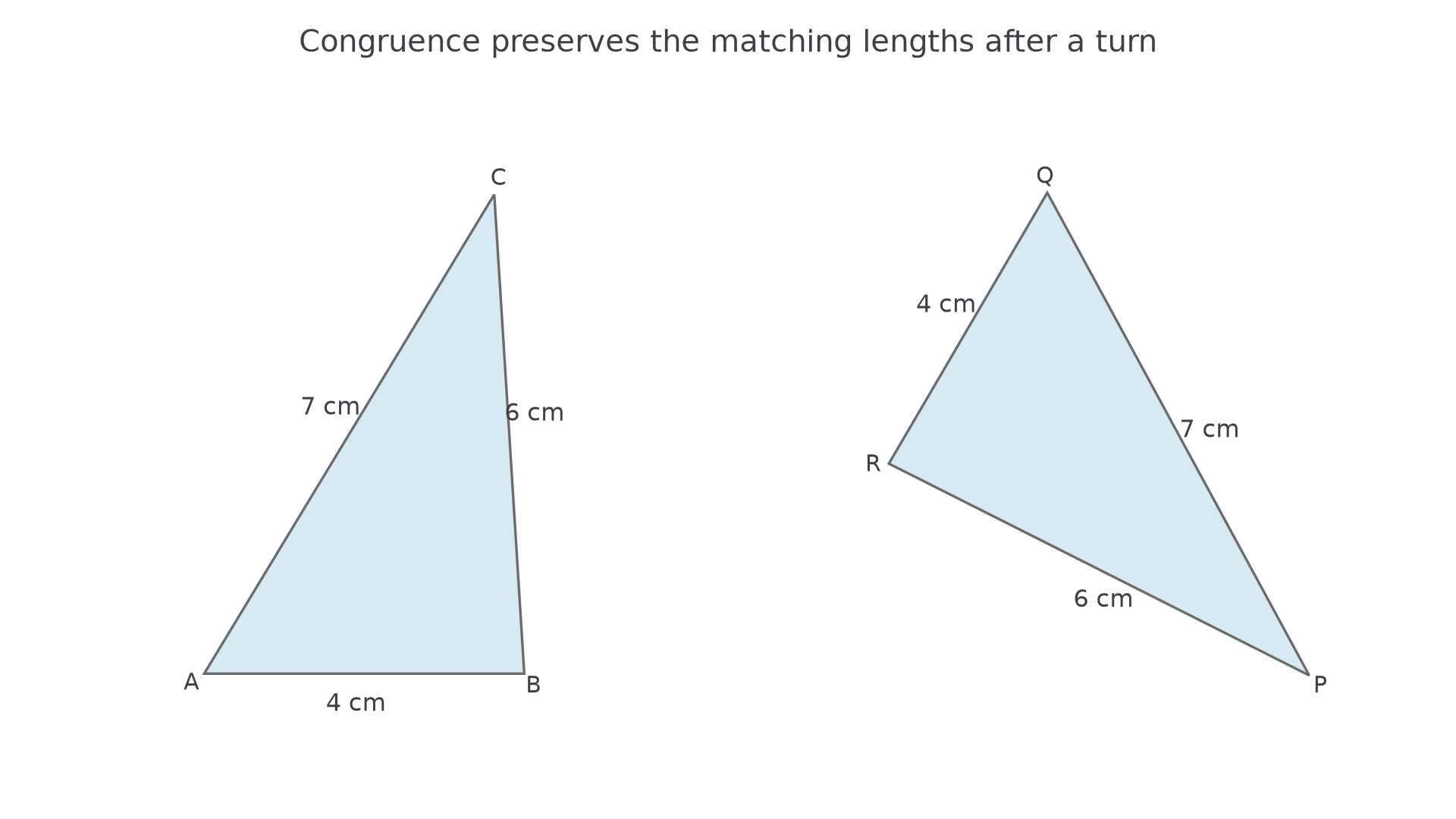
At A, the sides of lengths 4 and 7 meet. At Q, those same lengths meet, so A corresponds to Q. B, where lengths 4 and 6 meet, corresponds to R. C corresponds to P. Record the whole correspondence before copying an angle or length.
Worked example 1: matching the vertices
Question. In the diagram, triangles ABC and QRP are congruent. Which vertex matches B, and which angle matches ?
Plan. Use the two side lengths meeting at a vertex to match all three letters.
B meets the 4 cm and 6 cm sides, as R does. The letters B-A-C therefore match R-Q-P.
Answer. B matches R, and .
Check. The middle letters A and Q are corresponding vertices, and the two arms AB, AC match QR, QP respectively.
Change only the requested feature: keep the correspondence and match a side instead of an angle.
Worked example 2: matching a side
Question. In the same diagram, which side corresponds to AC, and what is its length?
Plan. Replace each endpoint by its matching vertex.
Answer. Side QP, of length .
Check. Both sides join the vertices at which the 4 cm and 7 cm sides meet to the vertices at which the 6 cm and 7 cm sides meet. The correspondence fits both endpoints.
When writing a congruence statement, put matching vertices in the same order: “triangle ABC is congruent to triangle QRP”. Writing triangle QPR instead would exchange the matches for B and C. A reflection can reverse the clockwise order on the page; it does not reverse which physical features match.
Watch out
Equal angles alone show that triangles have the same shape, but they can still have different sizes. Two equilateral triangles with sides 3 cm and 5 cm are not congruent.
Use a new correspondence, supplied explicitly, without needing a drawing.
The four congruence tests
You do not have to compare all six features. Certain combinations fix a triangle completely, apart from turning, moving or reflecting it.
[DIAGRAM: asset_name: Four triangle congruence tests; asset_slug: four-congruence-tests; caption: The position of the angle matters in SAS, and the hypotenuse must be identified in RHS.; description: Four panels illustrate matched triangle pairs for SSS, ASA, SAS and RHS. Matching ticks identify the three sides for SSS, two angles and a corresponding side for ASA, two sides with the angle between them for SAS, and right angles with matching hypotenuses and one other side for RHS.]
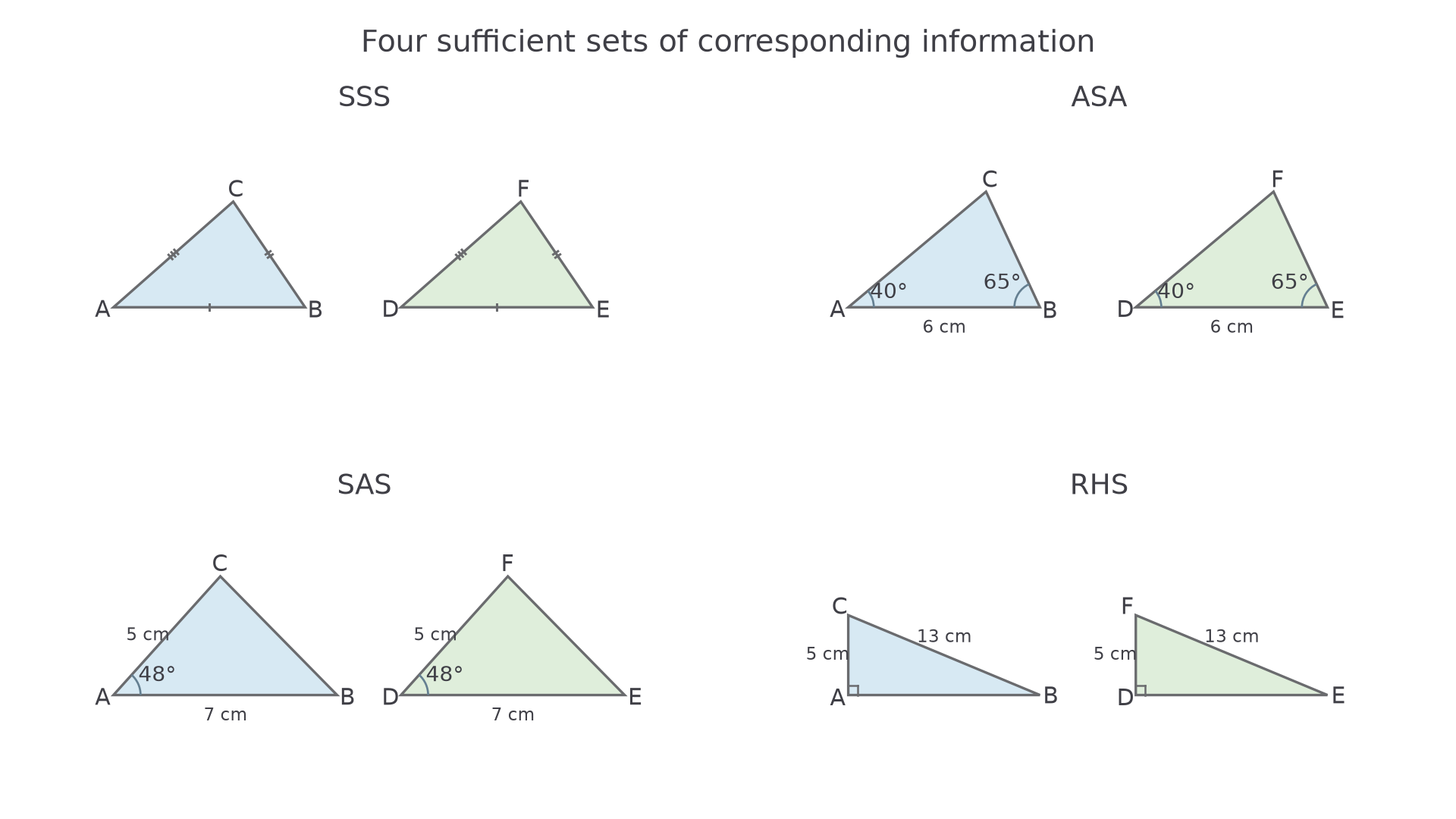
| Test | Sufficient matching information | Condition to check |
|---|---|---|
| SSS | Three corresponding sides equal. | The lengths form a genuine triangle: two shorter sides together must exceed the longest. |
| ASA | Two corresponding angles and one corresponding side equal. | The side occupies the same position relative to the equal angles. The third angles are equal because each triangle totals . |
| SAS | Two corresponding sides and their included angles equal. | The equal angle is between the two given sides. |
| RHS | Both right-angled, with equal hypotenuses and one other corresponding side equal. | The hypotenuse is the side opposite the right angle, not just any chosen side. |
OCR calls the two-angles-and-one-side case ASA. If the given side is not between the two known angles, find the equal third angles first; you can then arrange an ASA argument. The side must still correspond correctly.
Why do the tests work? For SSS, once one side is fixed, the third vertex must be at the specified distances from its endpoints; the two possible positions are mirror images. SAS fixes the opening between two fixed lengths. ASA fixes two directions and a scale. RHS fixes the longest side and a leg in a right-angled triangle, leaving no freedom to change its shape. None of these allows the third vertex to slide while preserving the given information.
Worked example 3: using the included angle
Question. Two non-degenerate triangles have , , and . Prove that they are congruent.
Plan. Identify the common vertex of each pair of equal sides, then check the angle between them.
The equal angle is between AB and AC, and between DE and DF.
Answer. Triangle ABC is congruent to triangle DEF by SAS, with , , .
Check. The included-angle vertices A and D match. Each named side therefore occupies the correct position in the stated correspondence.
Change only where the equal angle is given. The same two side lengths no longer automatically settle the question.
Continue this lesson.
You’re previewing NovaLearn without an account. Create a free account to read the rest.
Create free account