8.05h - Cyclic quadrilaterals
Four posts on a circular boundary form a quadrilateral. Why do an angle of and its opposite angle have to make ? You will recognise cyclic quadrilaterals, prove their opposite-angle relationship and combine it with other circle theorems.
Recognising a cyclic quadrilateral
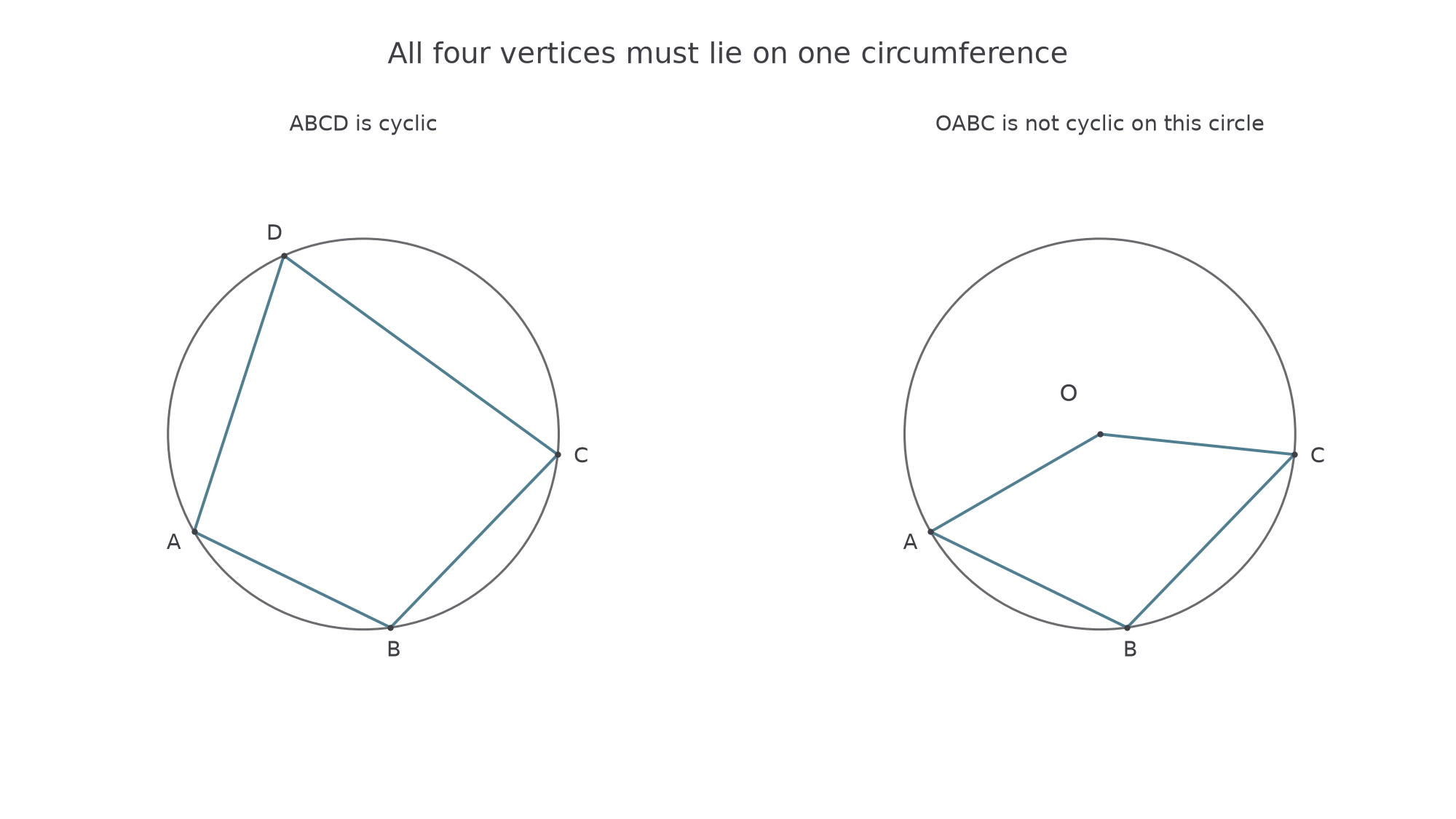
A quadrilateral belongs to a circle only when all four of its vertices lie on that circle's circumference.
Cyclic quadrilateral
A cyclic quadrilateral has four distinct vertices on one circle. In , list the vertices in order around the boundary. Its opposite pairs are with , and with .
The sides are chords. The circle's centre is inside the circular region, not on the circumference, so a quadrilateral using the centre as one of its vertices is not cyclic with respect to that circle.
[DIAGRAM: asset_name: Recognising four vertices on one circle; asset_slug: cyclic-recognition; caption: ABCD is cyclic but OABC is not cyclic on the displayed circle.; description: Two panels with the same circle. The first joins four circumference points A B C D in cyclic order. The second joins the centre O and three circumference points A B C, with the interior centre clearly distinguished from the circumference.]
A rectangle is cyclic: its diagonals meet at a common midpoint, which is equally far from all four vertices because the diagonals are equal. That midpoint is the centre of a circle through the vertices. A general parallelogram does not have this property; its opposite angles are equal, but they need not total .
Watch out
“Some vertices touch the circle” is insufficient. Check all four vertices on the same circumference. An interior intersection of diagonals is not an extra cyclic vertex.
The definition alone settles the next question; no angle calculation is needed.
Why opposite angles sum to a straight angle
Opposite angles of a cyclic quadrilateral are supplementary: together they make .
For example, if , then . To see why every cyclic quadrilateral obeys the rule, use diagonal endpoints and . Vertex is on one arc ; vertex is on the other.
[DIAGRAM: asset_name: The two intercepted arcs make a full circle; asset_slug: cyclic-opposite-proof; caption: The angles at B and D are halves of complementary parts of a full central turn.; description: A general non-rectangular cyclic quadrilateral ABCD with centre O and radii OA and OC. The arc AC through B has central sweep theta and the other arc has sweep 360 degrees minus theta. The opposite angles at D and B are labelled theta over 2 and 360 degrees minus theta over 2 respectively.]
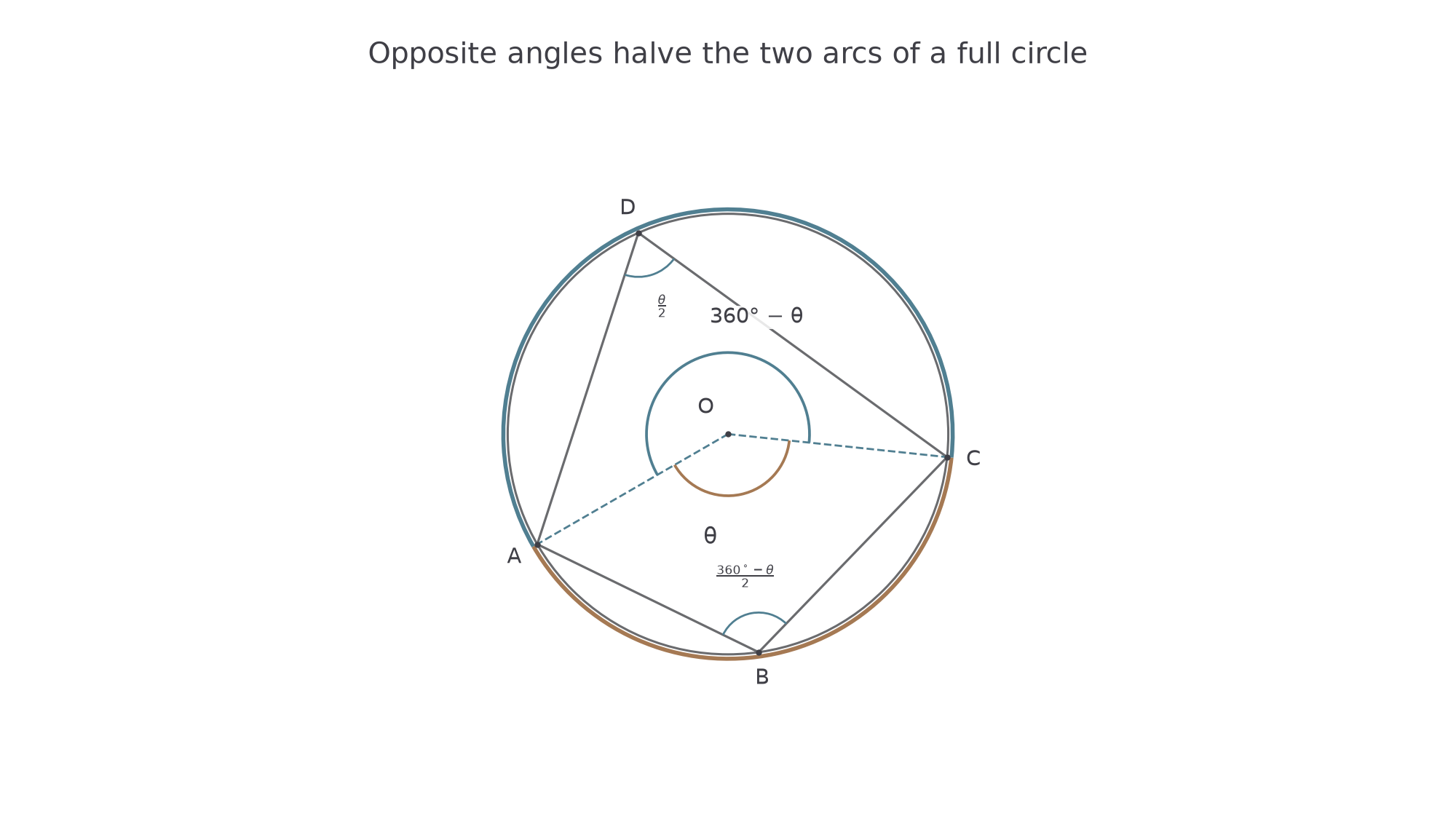
Let the central sweep along arc be . The remaining sweep along arc is . By the centre-angle theorem,
Using diagonal endpoints and proves the other opposite pair. This proof uses the established centre-angle theorem, not the cyclic rule it is trying to prove.
Opposite cyclic angles
For distinct vertices , , , in order on one circle,
“Supplementary” means a sum of , not equal angles.
Not on the 2027 formula sheet: learn it.
When angles contain algebra, write the geometric relationship as an equation before solving it.
Worked example 1: opposite angles with algebra
Question. In cyclic quadrilateral , and . Find .
Plan. Add the opposite angles to make .
Answer. .
Check. The angles are and ; both are valid interior angles and .
Change only the constant in the second angle. It changes the solution, but not the circle relationship.
Worked example 2: a different constant
Question. In another cyclic quadrilateral, the opposite angles are and . Find .
Plan. Set their sum equal to .
Answer. .
Check. Substitution gives and , summing to .
Continue this lesson.
You’re previewing NovaLearn without an account. Create a free account to read the rest.
Create free account