10.05a, 10.05b - Lengths and angles in three dimensions
How long is a straight support running from one corner of a box to the opposite corner, and how steeply does it rise above the base? In this Higher tier lesson, find flat right-angled triangles inside solids, then apply Pythagoras and trigonometry in those triangles. The drawing represents three dimensions, but each calculation still happens in a plane.
Finding a useful plane triangle
A triangle inside a solid lies in one flat plane, even when that plane cuts diagonally through the solid.
First label the solid's vertices and identify the actual perpendicular directions. A square-looking corner on a perspective drawing does not establish a right angle. Use the solid's stated properties: a cuboid has rectangular faces and perpendicular edge directions.
For the cuboid below, ABCD is the base. E, F, G and H are directly above A, B, C and D respectively. The vertical edge CG is perpendicular to the base plane, so it is perpendicular to every base line through C, including AC. This makes triangle ACG right-angled at C.
[DIAGRAM: asset_name: A plane triangle inside a cuboid; asset_slug: cuboid-plane-triangle; caption: The base diagonal and vertical edge form a right triangle with the space diagonal.; description: Cuboid ABCDEFGH has base ABCD with AB equal to 6 cm and BC equal to 8 cm. Its vertical edges have length 12 cm and E F G H lie above A B C D respectively. The base diagonal AC, vertical edge CG and space diagonal AG form a highlighted plane triangle ACG. A separate true-shape view shows triangle ACG right-angled at C, with AC labelled 10 cm and CG labelled 12 cm.]
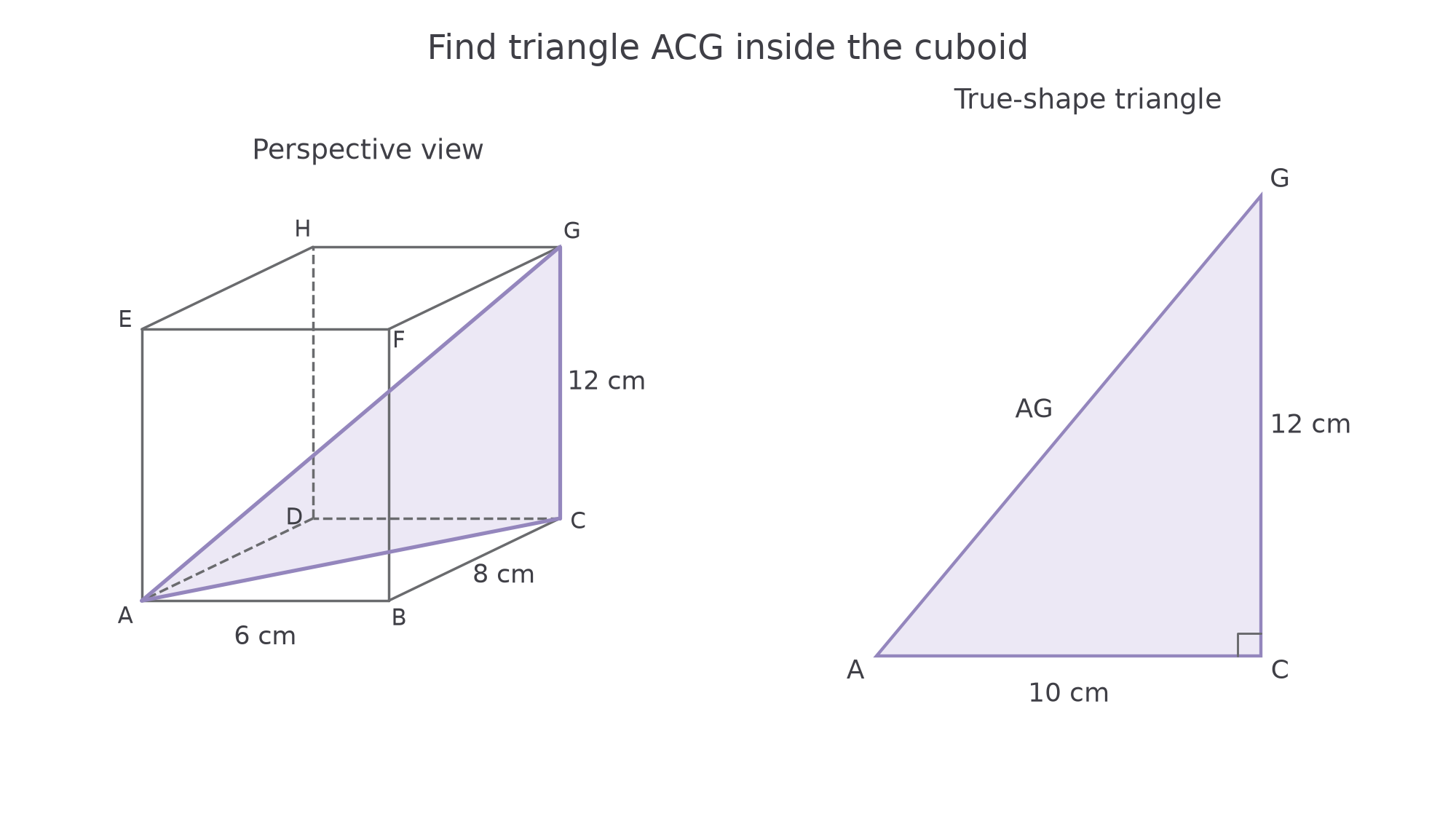
A face diagonal joins opposite corners of one face. A space diagonal, such as AG, passes through the interior between opposite vertices. They are different lengths and belong to different triangles.
Worked example 1: extracting the cuboid triangle
Question. A cuboid has base sides AB = 6 cm and BC = 8 cm, and vertical height CG = 12 cm. Choose a right triangle containing space diagonal AG and find the two perpendicular side lengths needed to use it.
Plan. Find base diagonal AC first, then use the vertical edge through C.
Answer. Use triangle ACG, with perpendicular sides 10 cm and 12 cm. Its hypotenuse is AG.
Check. CG meets the base at C at right angles. AC lies in that base through C, so the selected triangle has a justified right angle, regardless of its appearance in the solid drawing.
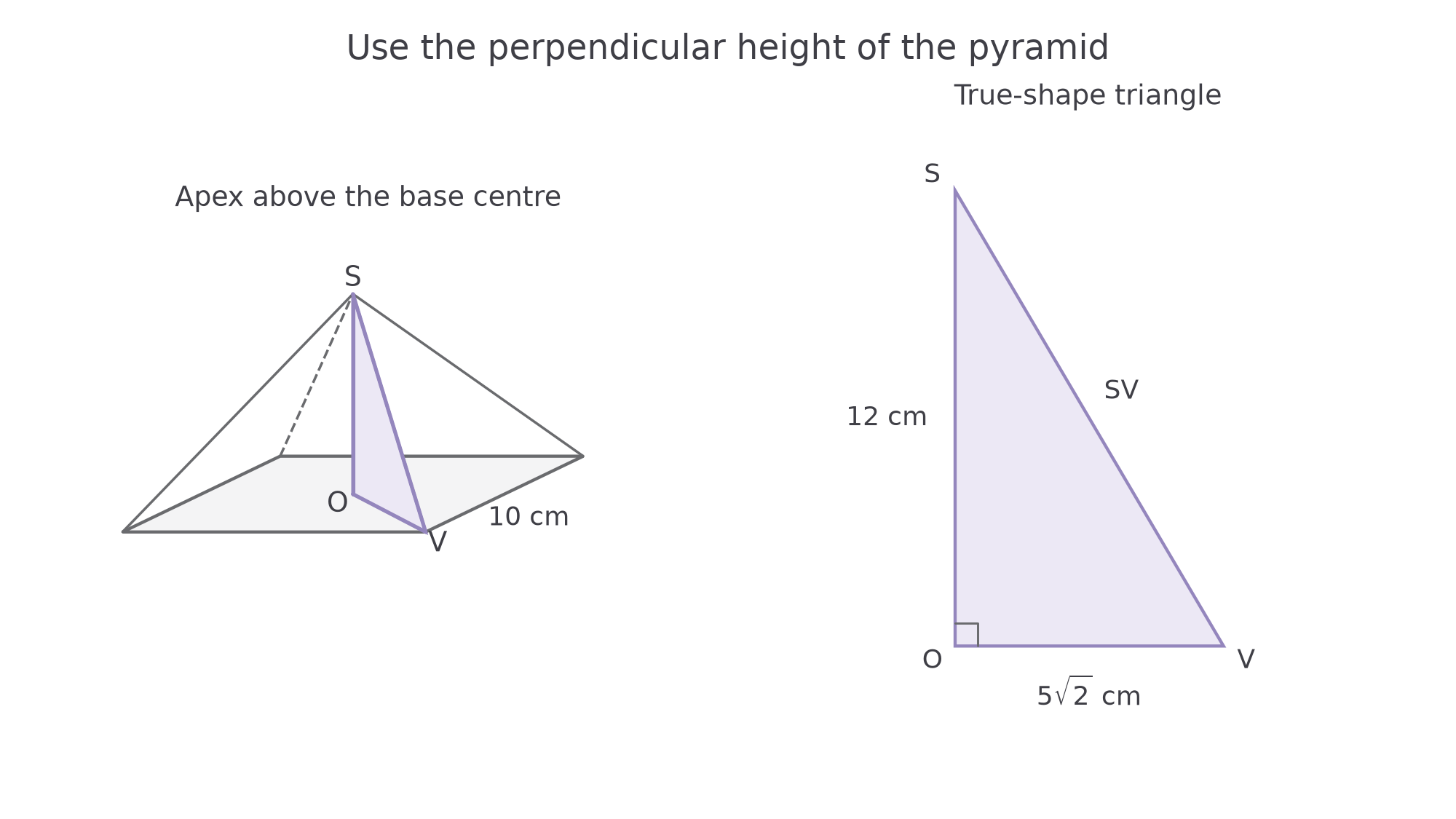
A pyramid needs the same decision, but its perpendicular height usually falls inside the base rather than on an edge.
[DIAGRAM: asset_name: A vertical triangle inside a square pyramid; asset_slug: pyramid-plane-triangle; caption: The perpendicular height meets the centre of the square base.; description: A square-based pyramid has apex S directly above base centre O. The square has side 10 cm and vertex V at a corner. SO is the perpendicular height 12 cm. The highlighted triangle SOV has a right angle at O, a base segment OV equal to half a base diagonal, and sloping edge SV. A true-shape view shows the same triangle with OV labelled 5 square root of 2 cm and SO labelled 12 cm.]
Worked example 2: extracting a pyramid triangle
Question. A pyramid has a square base of side 10 cm. Its apex S is directly above the base centre O, with SO = 12 cm. V is a base vertex. Choose a right triangle containing SV and find its two perpendicular side lengths.
Plan. Use the perpendicular height and the centre-to-vertex line in the base.
Answer. Use triangle SOV, with perpendicular sides and 12 cm. Its hypotenuse is SV.
Check. A square's diagonals bisect each other at O, so OV is half a diagonal, not half a side. The stated perpendicular height SO justifies the right angle at O.
A useful projection sends a point straight down a perpendicular onto a line or plane. In the cuboid, G projects to C on the base. The angle between AG and the base is therefore the angle between AG and AC, namely . A line's angle with a plane is measured against its perpendicular projection, not against an arbitrary edge of that plane.
Lengths in three dimensions
Find a diagonal in a known face first, then use it as a side in a second right triangle.
In a cuboid of perpendicular dimensions , and , call the base diagonal and the space diagonal . Two uses of Pythagoras give
This three-square shortcut follows from those two right angles. It does not apply to three arbitrary edges of an oblique solid. Keep exact squared values through both stages instead of rounding the first diagonal.
Worked example 3: the box support
Question. A cuboid has base dimensions 6 cm and 8 cm, and height 12 cm. Find its space diagonal to 3 significant figures.
Plan. Find the squared base diagonal, then combine it with the height.
Answer. .
Check. Subtracting the height's square gives , the squared base diagonal. The support is longer than the 12 cm height and the 10 cm base diagonal.
Keep the base fixed and double the height. The support length changes, but it does not double: only one of its three perpendicular components doubled.
Worked example 4: a taller box
Question. A cuboid has base dimensions 6 cm and 8 cm, and height 24 cm. Find its space diagonal.
Plan. Reuse the base diagonal, then change only the height term.
Answer. .
Check. , so the base diagonal remains 10 cm. The new support is less than twice example 3's length.
You can reverse the method when a space diagonal is known. Subtract both known squared dimensions to find the missing dimension's square.
Worked example 5: recovering an unknown height
Question. A cuboid has base dimensions 5 cm and 12 cm, and space diagonal 14 cm. Find its height exactly.
Plan. The space diagonal is the hypotenuse in the second triangle, so subtract the base diagonal's square.
Answer. .
Check. . The radicand is positive, so a nonzero height is possible.
Increase only the space diagonal from 14 cm to 15 cm. With the base fixed, a longer diagonal should mean a greater height.
Continue this lesson.
You’re previewing NovaLearn without an account. Create a free account to read the rest.
Create free account