6.03d, 7.01c - Turning points and intersections
Can an equation reveal a curve's lowest point before you draw it? Use completed-square form to identify turning points, then connect curve–line intersections with simultaneous equations. This lesson is for Higher tier.
The turning point in completed-square form
For , which input gives the smallest possible output? A table might suggest an answer; completing the square explains why it is the minimum.
You already know how to complete a square. Here,
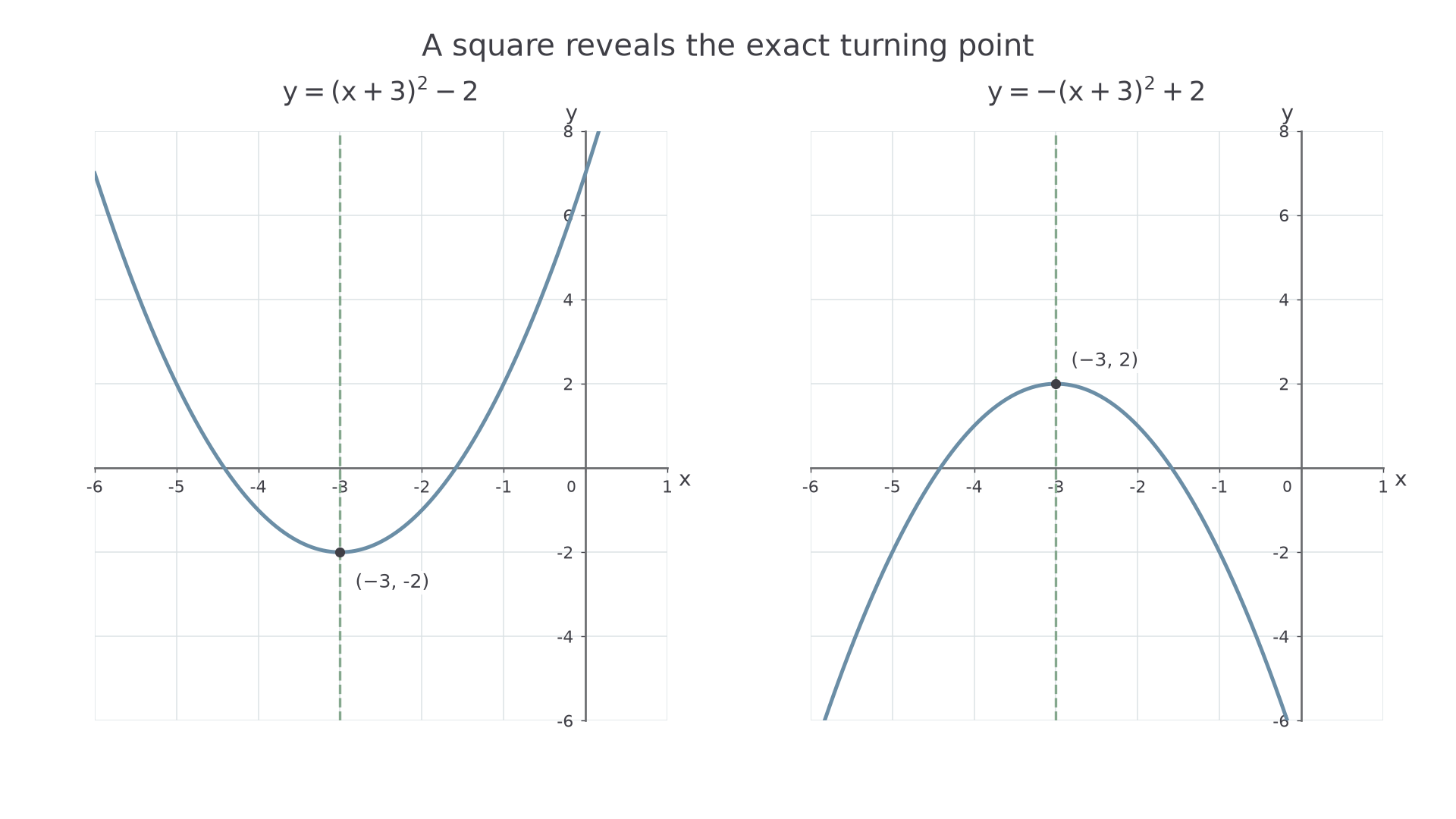
The square is never negative, and reaches zero precisely at . The smallest height is therefore .
Turning point from a completed square
For , with , the turning point is and the symmetry line is . It is a minimum if , or a maximum if . Not on either 2027 formula sheet: learn how the square explains it.
Read the input that makes the bracket zero, rather than copying the sign printed inside it. The bracket is zero at .
Worked example 1: the minimum hidden in an expansion
Question. Find the turning point of , stating its type and symmetry line.
Plan. Complete the square and use the smallest possible value of a square.
Answer. Minimum , with symmetry line .
Check. Substituting in the original gives . At and , the height is in both cases, confirming the equal-height pattern around the turning point.
Negate the whole quadratic. This reverses every height, turning a minimum into a maximum without moving the symmetry line.
Worked example 2: a maximum instead
Question. Find the turning point of , stating its type and symmetry line.
Plan. Factor out the negative sign, then use the completed square from the corresponding positive expression.
Answer. Maximum , with symmetry line .
Check. The original expression gives at . At and , it gives , below that maximum.
[DIAGRAM: asset_name: A completed square locates the turning point; asset_slug: completed-square-turns; caption: The bracket is zero at the symmetry line and the sign decides minimum or maximum.; description: Two scaled graphs show x squared plus six x plus seven and its negative. The minimum negative three negative two and maximum negative three two are labelled, and each has symmetry line x equals negative three.]
Watch out
In , the turning point is , not . Solve to find the input.
Use the square to justify the type as well as locating the point.
Intersections of a curve and line
A line and a curve share a point only when its coordinates satisfy both equations, just as with two straight lines.
At an intersection of and , their heights are equal, so . Solving that equation gives the horizontal positions. Substitute each one into either original equation to find its matching height. Keep each paired with its own .
A graph can estimate these coordinates; algebra can often give exact values. Two crossings give two solution pairs. A line touching a quadratic at its turning point can give one pair, while a line missing the curve gives no real solution. For example, meets only at , whereas never meets it because a square cannot be negative.
Worked example 3: two exact intersection points
Question. Find the intersections of and .
Plan. Equate the heights, solve the resulting quadratic, then calculate each corresponding .
Answer. Intersections and , giving two simultaneous solution pairs.
Check. The curve gives at , and at . Both pairs also satisfy the line.
Raise only the line's intercept from to . The curve stays fixed, but both intersections move.
Worked example 4: pairing the two new solutions
Question. Find the intersections of and .
Plan. Equate expressions, factorise, and calculate the matching line height for each root.
Answer. and .
Check. The curve heights are and , independently confirming the two values found from the line.
Continue this lesson.
You’re previewing NovaLearn without an account. Create a free account to read the rest.
Create free account