6.03c - Simultaneous equations with quadratics
A line and a curve can share two points, so simultaneous equations may have two different solution pairs. You will substitute to obtain a quadratic, keep each coordinate with its matching partner, and form equations for pairs of unknown numbers.
Substituting into a quadratic relation
Can and both be true for two different pairs of numbers?
Higher only. A simultaneous solution must satisfy both equations. Since both expressions equal the same , they must equal each other: . This is the same substitution idea used for linear pairs, but now the resulting equation is quadratic.
Each real -root can give a matching -value. On a coordinate diagram, a shared point lies on both graphs, so its coordinates satisfy both equations. We will find the pairs algebraically.
[DIAGRAM: asset_name: Two shared points of a line and a curve; asset_slug: line-quadratic-pairs; caption: Each labelled point satisfies both y = x squared and y = x + 2.; description: A coordinate graph shows the parabola y equals x squared and the line y equals x plus two. Their two intersections are labelled negative one, one and two, four. Pale dashed guides help match each horizontal x-coordinate with its own vertical y-coordinate.]
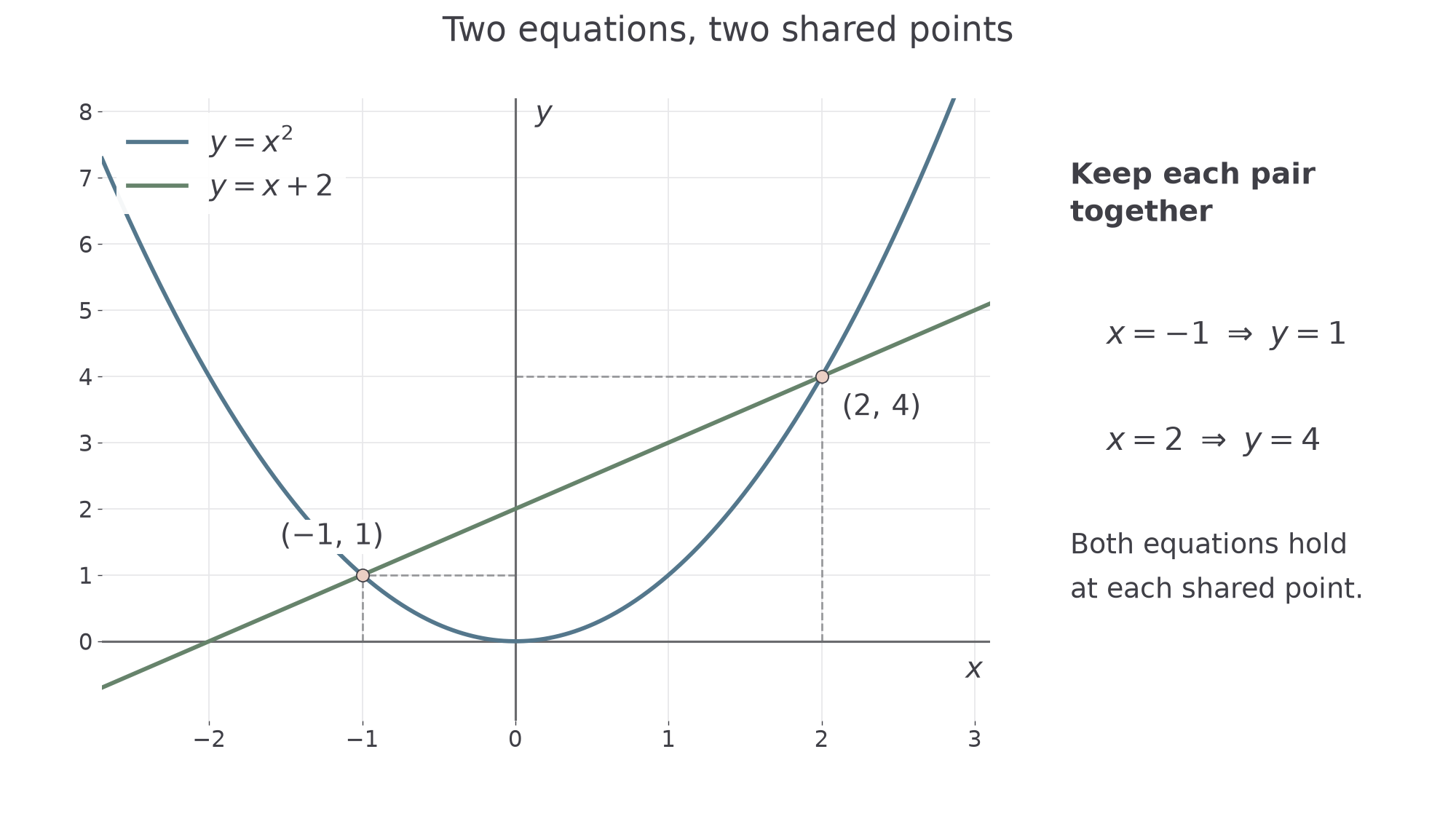
Worked example 1: equating two expressions for y
Question. Solve and simultaneously.
Plan. Equate the two expressions, solve for , then calculate for each root.
Answer. or .
Check. At , . At , . Each complete pair satisfies both originals.
Change only the line's constant from two to six. Its slope stays the same, but the shared points move.
Worked example 2: changing the line's constant
Question. Solve and simultaneously.
Plan. Equate, factorise, and substitute each -root separately.
Answer. or .
Check. , and . The new pairs also fit the same parabola.
If the quadratic has discriminant zero, the branches give one distinct pair. If it has negative discriminant, there is no real pair. For example, with would require , impossible for real . Finding two solutions is possible, not compulsory.
Watch out
Do not stop at two -roots. A simultaneous solution includes the corresponding , and both values must satisfy both equations.
Use the changed constant in the line to find both pairs.
Matching the two coordinates
Two -values and two -values do not create four freely interchangeable pairs. For each , substitution determines its own .
A small table is a safe way to preserve the match. Exact surd answers need the same care: the plus branch of an -root does not automatically mean the plus branch of . The substituted expression decides the signs.
Worked example 3: matching integer coordinates
Question. Solve and , presenting matched pairs.
Plan. Solve the quadratic, then make one row for each -value.
| Pair | ||
|---|---|---|
Answer. or .
Check. and , so both also satisfy the quadratic relation. The crossed pair fails both: and .
Change only the line's constant from three to four. The roots become surds, but matching uses exactly the same substitution.
Continue this lesson.
You’re previewing NovaLearn without an account. Create a free account to read the rest.
Create free account