8.01d, 8.06a, 8.06b - Solids, plans and elevations
Could two different buildings have the same front view? Use the solid vocabulary in 8.01d and 8.06a to describe three-dimensional shapes, then use 8.06b to connect solids with plans, elevations and isometric drawings.
Faces, edges and vertices
Could you rebuild a stack of cubes from one photograph? A photograph can hide cubes. Naming the surfaces and looking from agreed directions gives us a more reliable description.
A cereal carton is modelled by a cuboid. Its six flat rectangular faces meet along twelve edges. Three edges meet at each of its eight vertices. A cube is a cuboid whose six faces are squares of the same size. Turning either solid does not change these counts.
[DIAGRAM: asset_name: A family of solids; asset_slug: solid-family; caption: Flat faces and curved surfaces distinguish these solids.; description: Labelled sketches of a cube, cuboid, triangular prism, cylinder, square-based pyramid, cone and sphere.]
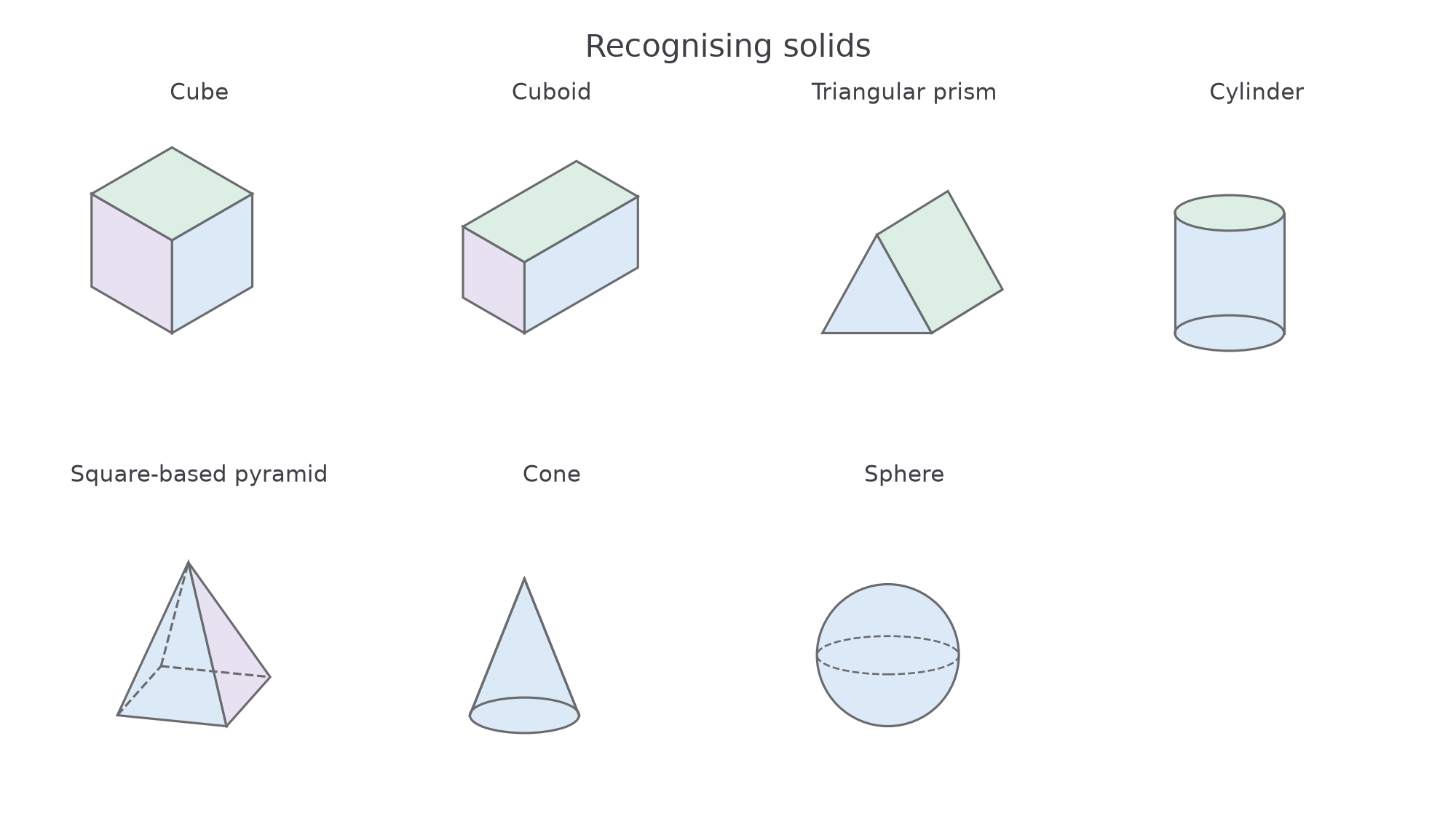
Parts of a solid
A face is a flat surface of a solid. An edge is a boundary where faces meet, and a vertex is a corner. A polyhedron has only flat polygonal faces. For curved solids, describe flat faces and curved surfaces separately: this avoids counting a curved surface as a polygonal face.
A prism has the same cross-section all the way along its length, with two parallel congruent ends. Here the ordinary polygonal prisms are right prisms: their joining edges are perpendicular to the ends. A triangular prism has two triangular ends and three rectangular side faces. A pyramid has one polygonal base and triangular faces meeting at a single apex.
| Solid | Flat faces | Curved surfaces | Edges or circular rims | Vertices |
|---|---|---|---|---|
| Cube or cuboid | 6 | 0 | 12 straight edges | 8 |
| Triangular prism | 5 | 0 | 9 straight edges | 6 |
| Square-based pyramid | 5 | 0 | 8 straight edges | 5 |
| Cylinder | 2 circular | 1 | 2 circular rims | 0 |
| Cone | 1 circular | 1 | 1 circular rim | 1 apex |
| Sphere | 0 | 1 | 0 | 0 |
A cylinder has two parallel congruent circular ends joined by a curved surface. A cone has a circular base and tapers to an apex. Every point on a sphere is the same distance from its centre. A circle is flat, whereas a sphere is a solid.
The prism's end shape matters. For a prism with an -sided polygonal end, the two ends give vertices. There are edges round each end and joining edges, so there are edges and faces. These counts concern polygonal prisms, not cylinders. The following pair changes only the number of sides on the end.
Worked example 1: counting a pentagonal prism
Question. Find the number of faces, edges and vertices of a pentagonal prism.
Plan. Count two pentagonal ends, then the joining faces and edges.
Answer. faces, edges and vertices.
Check. Count edges through their endpoints: each of the ten vertices meets three edges. This counts each edge twice, so edges.
Change only the polygonal end from a pentagon to an octagon. The two-end structure stays the same.
Worked example 2: counting an octagonal prism
Question. Find the number of faces, edges and vertices of an octagonal prism.
Plan. Apply the same counts with eight sides around each end.
Answer. faces, edges and vertices.
Check. Sixteen vertices each meet three edges. Counting each edge twice gives , agreeing with the rim-and-joining-edge count.
Now use the whole structure, rather than just what a sketch happens to show.
Key idea
Describe a solid's whole structure, including hidden faces and edges. The number of visible corners in a sketch is not its number of vertices.
Use the two ends to organise the count.
Reading plans and elevations
A plan looks vertically down on a solid. A front elevation looks horizontally from the marked front. A side elevation looks horizontally from the marked side. These are flat, straight-on views: parallel edges stay parallel, and distance from the viewer does not shrink a face.
For cube stacks, imagine looking along each row. The tallest stack blocks shorter stacks behind it. The plan records which ground positions are occupied, not how high their stacks are. We will use stacks with no gaps underneath cubes.
[DIAGRAM: asset_name: One solid and its three views; asset_slug: cube-stack-views; caption: The front view combines stacks behind one another. Each small square has side one unit.; description: An isometric cube stack with front-row heights two, one, zero and back-row heights one, one, one. Arrows mark the front and right viewing directions. The plan occupies five squares, the front heights are two, one, one, and the right-side heights from front to back are two, one.]
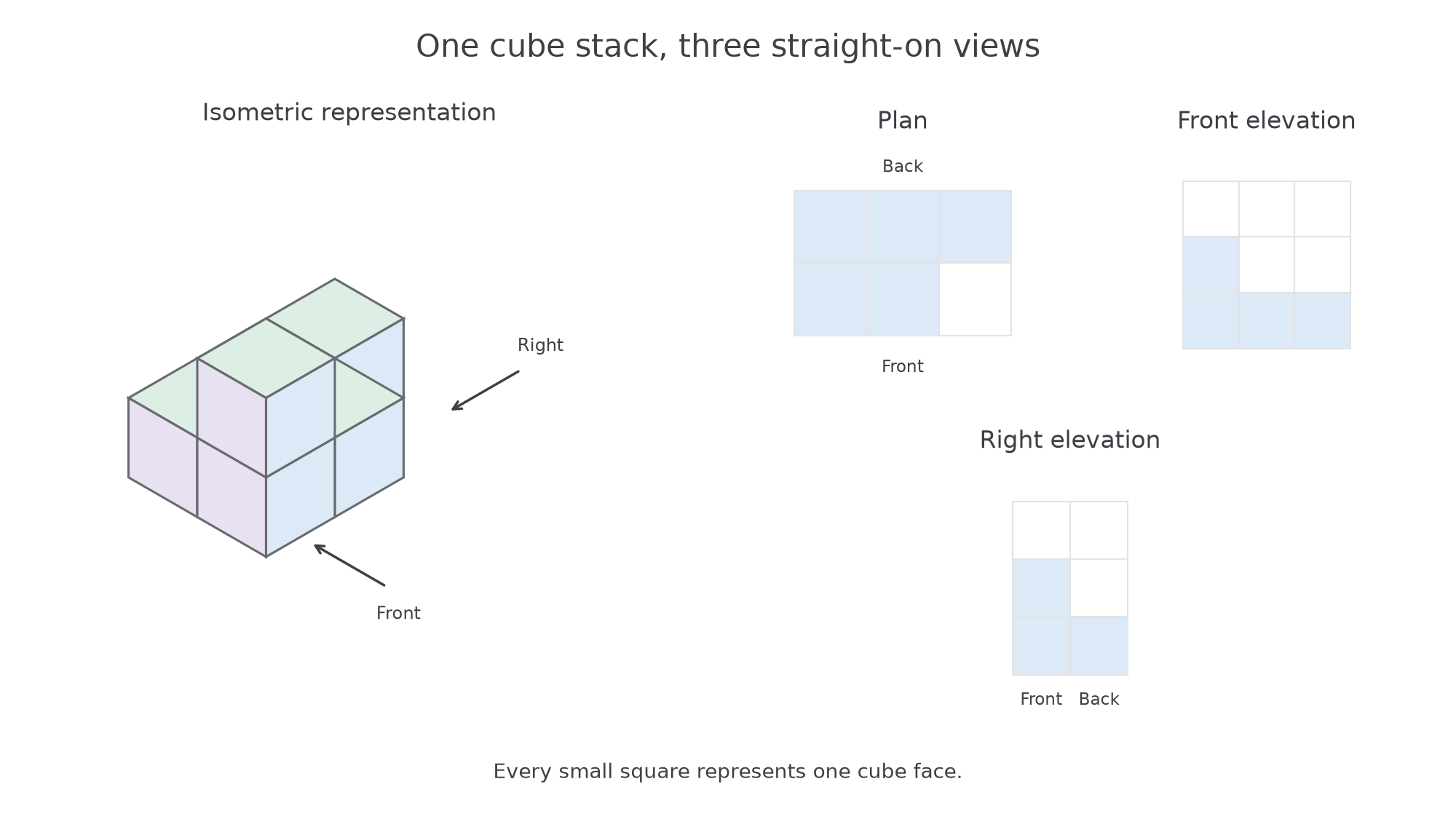
Worked example 3: reading the first stack
Question. The diagram's front row has heights , from left to right. Its back row has heights . State the front-elevation heights and the number of squares in the plan.
Plan. Take the larger height at each left-to-right position, then count occupied ground squares.
Answer. Front heights , and plan squares.
Check. The rightmost front position is empty, but the cube behind it is visible in the front elevation. A height of zero there would miss that cube.
Now raise only the back-middle stack from one cube to three cubes. Its ground position stays occupied, so the plan stays unchanged.
Worked example 4: a hidden height becomes visible
Question. Keep the front row , but change the back row to . Find the front heights and the right-side heights, reading the side view from front to back.
Plan. Combine front and back for the front view, and combine left-to-right positions for the side view.
Answer. Front heights , right-side heights .
Check. Both elevations reach height , as the solid's tallest stack must appear in both. The five-square footprint has not changed.
An elevation usually shows visible edges between differently positioned surfaces, but it does not reveal every hidden cube. Never add heights along a line of sight.
Watch out
A front stack of height with a back stack of height gives elevation height , not . The stacks stand behind one another, not on top of one another.
Use the same agreed directions for the next stack.
Continue this lesson.
You’re previewing NovaLearn without an account. Create a free account to read the rest.
Create free account