11.02a, 11.02b - Counting and choosing representations
A menu can offer dozens of meals without listing each one. Under 11.02b you will count combined choices efficiently and decide when order creates a new outcome. Under 11.02a you will choose a representation that makes a probability problem manageable.
The product rule for counting
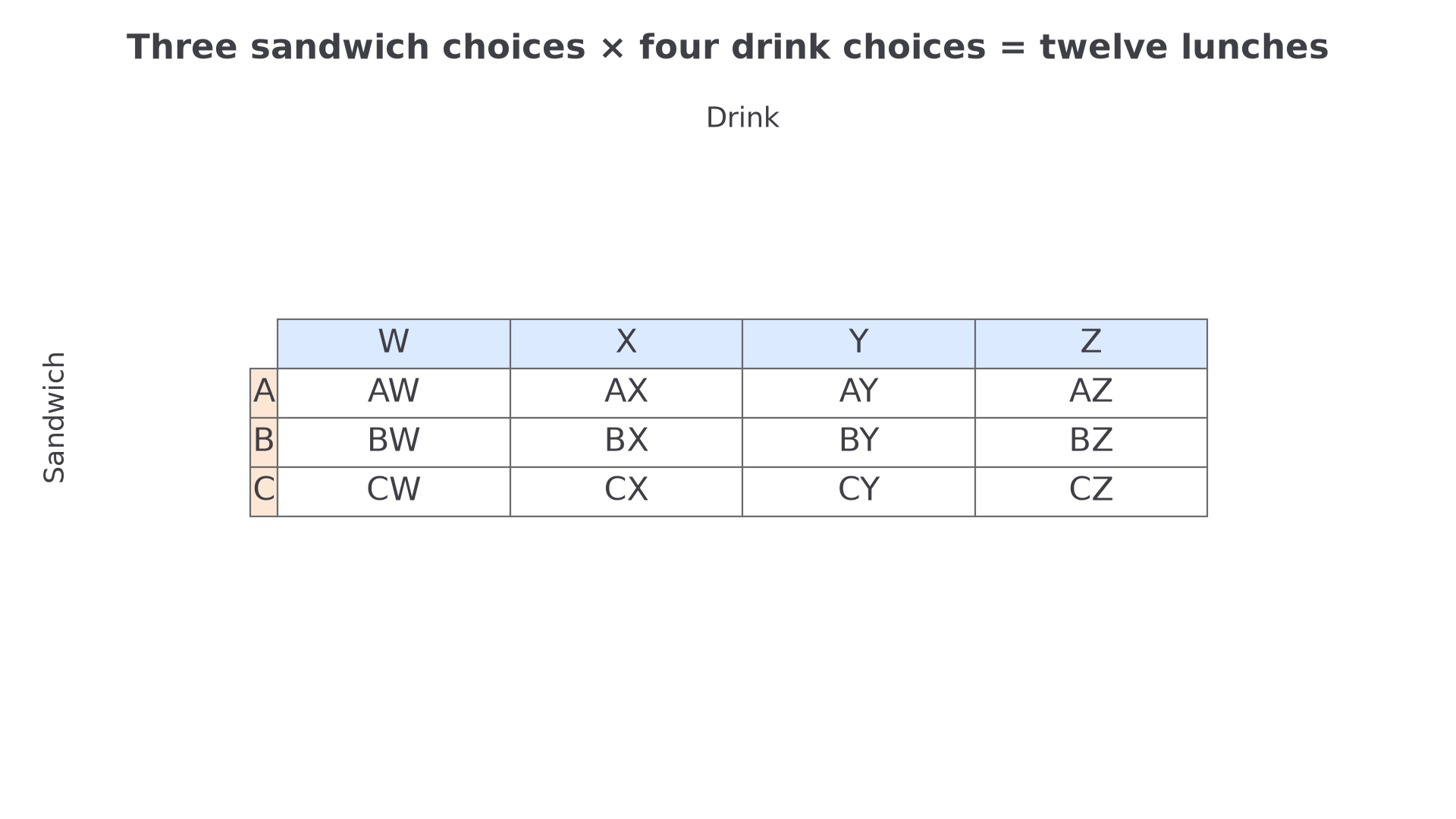
How can three sandwiches and four drinks produce twelve different lunches? Fix one sandwich: it can be paired with each of the four drinks. The next sandwich has another four pairings, and the third has another four.
The product rule
If a first stage has choices and each first choice has possible second choices, the combined process has outcomes. For more stages, multiply the number of available choices at each stage, provided that number is the same for every route reaching that stage.
A small grid explains the multiplication before we use it for larger counts.
[DIAGRAM: asset_name: Twelve lunches; asset_slug: product-lunch-grid; caption: Each sandwich pairs with each of four drinks.; description: A three-row four-column grid with sandwich labels A B C and drink labels W X Y Z. Each of the twelve cells contains its unique sandwich-drink pair.]
Worked example 1: two choices
Question. A café offers three sandwiches and four drinks. A lunch contains one sandwich and one drink. How many lunches are possible?
Plan. Count the drink choices for each sandwich.
Answer. There are different lunches.
Check. Reading the grid by drink instead gives four groups of three, also . Each cell identifies exactly one lunch.
Add just one feature: a choice of two desserts. Every existing lunch now has two versions.
Worked example 2: adding a stage
Question. The same café adds two desserts. A meal contains one sandwich, one drink and one dessert. How many meals are possible?
Plan. Extend each of the twelve lunch choices with either dessert.
Answer. There are different meals.
Check. For either fixed dessert there are meals. The two dessert groups do not overlap, so .
The product rule counts possibilities. It does not require choices to be random or equally likely. Equal likelihood matters later if you turn a count into a probability.
Watch out
Do not use for a sandwich and a drink: that counts individual menu entries. If some sandwiches have only two permitted drinks, is no longer valid. Split into cases and add the valid groups instead.
Try a three-stage choice with fresh numbers.
Avoiding repeated outcomes
Aisha as captain with Ben as deputy differs from Ben as captain with Aisha as deputy. A two-person team containing Aisha and Ben is the same team in either order. Decide what an outcome means before multiplying.
Ordered and unordered selections
An ordered selection distinguishes positions or roles. An unordered selection records only which distinct objects or people are selected. Selecting without repetition reduces the choices available at later stages.
The same five people can therefore give different counts for different tasks.
Worked example 3: different roles
Question. Five people are available. Choose a captain and a different person as deputy. How many appointments are possible?
Plan. Choose the captain, then remove that person from the deputy choices.
Answer. appointments.
Check. Each person appears as captain in four appointments. Five separate groups of four account for all appointments exactly once.
Change only the roles: now choose an ordinary two-person team. Our previous count includes each team twice.
Worked example 4: no different roles
Question. Choose an unordered two-person team from the same five people. How many teams are possible?
Plan. Count ordered choices, then remove the two orders of each pair.
Answer. teams.
Check. Label the people A–E and list each pair alphabetically: AB, AC, AD, AE, BC, BD, BE, CD, CE, DE. There are ten, with no repeat.
Continue this lesson.
You’re previewing NovaLearn without an account. Create a free account to read the rest.
Create free account